Register For Our Mailing List

Register to receive our free weekly newsletter including editorials.

Home / 596

Why ASX miners will handily beat banks in the long-term

Banks crushed it in 2024. They were up 34%, easily outpacing the ASX 200’s 11% return. The stellar performance was led by Westpac (ASX:WBC), up 41% in price terms, closely followed by Commonwealth Bank’s rise of 37% (ASX:CBA). NAB (ASX:NAB) and ANZ (ASX:ANZ) lagged the big two banks, climbing 21% and 10% respectively.
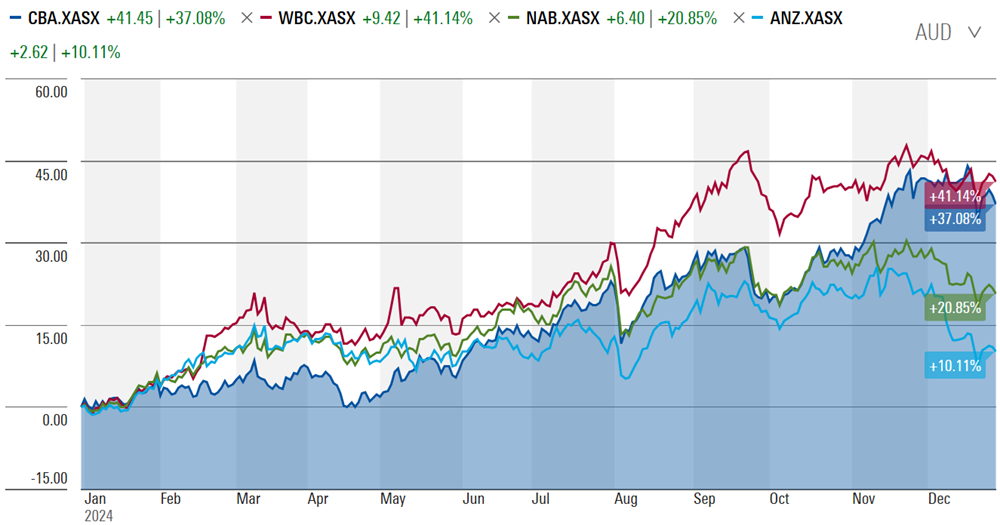

Source: Morningstar

The amazing part of the banks’ run is that it happened despite earnings going backwards. Normally, share prices follow earnings, yet that didn’t occur last year. The stocks rose purely due to an expansion in valuation multiples.

Why did this happen? Many blame passive investing, or a pool of liquidity via super funds that needed to find a home. Though it was more likely a case that miners were unloved, and if investors wanted to put money into the ASX, they didn’t have much choice but to invest in the banks.

Valuations for banks now look steep. It’s especially so for CBA, which is trading at 27x trailing earnings and 25x forward earnings. Westpac isn’t cheap either, trading at 16x forward earnings. Meanwhile, the smaller banks are at much lower multiples.
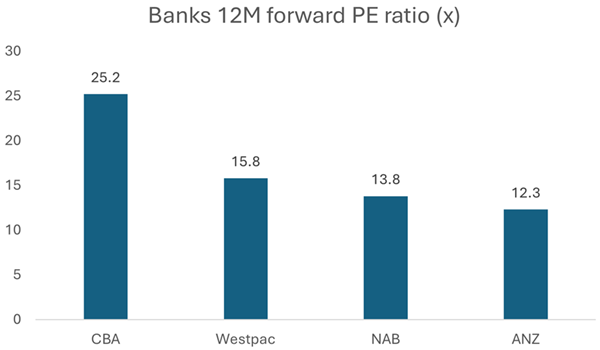

Source: Morningstar

The Big Four banks’ price-to-earnings (PE) ratio is at a slight premium to the ASX 200’s forward multiple of 17.6x. That’s unusual versus history, and it’s difficult to square when the sector has struggled to grow recent earnings.

Is a great sector rotation imminent?

The big question for 2025 is whether bank profits can justify current valuations. And if they disappoint, will there be a great rotation out of the banks into the other ASX 200 heavyweight, resources?

Unlike the banks, miners had a terrible 2024. Their share prices were down 15%, trailing the ASX 200 by 26% and the banks by 47%.

They were pummelled by a stuttering Chinese economy that hit iron ore prices and the bursting of the lithium bubble. Big caps such as BHP (ASX:BHP) and Rio (ASX:RIO) held up better than most miners, ending the year down 22% and 18% respectively.

It’s left the resources sector at far cheaper valuation multiples compared to the rest of the ASX. The miners are trading at a 12-month forward PE ratio of 11.2x, a 36% discount to the ASX 200 and a 37% discount to the ASX financials sector.

There might also be a ‘double discount’ with miners too. Not only are they on inexpensive multiple, but their earnings are also at depressed levels after recent commodity price falls.

The short-term case for a rotation

It wouldn’t take much for a sharp rotation to happen from the banks into miners. Given the spluttering economy and slowing credit and house price growth, it wouldn’t surprise if bank earnings disappointed the already modest projections of analysts.

On the flip side, expectations for the resource companies are the low end. The market will jump on any sign of good news.

The long-term case for a rotation

There’s a good case to be made that a rotation out of banks into miners could last a long time, rather than just a few years.

Over the past week, I’ve spent too much time staring at the following chart:
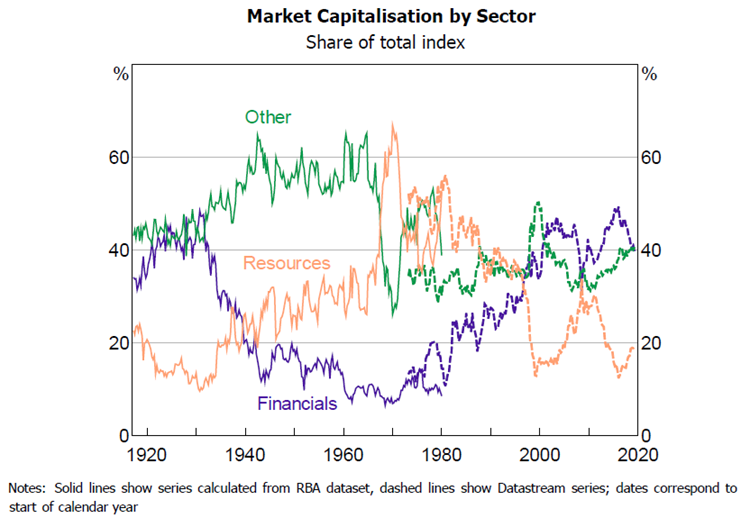

Source: Thomas Mathews, RBA Discussion Paper: ‘A history of Australian Equities’.

The chart tracks the market cap share of different sectors of the ASX 100 from 1917 to mid-2019.

It’s a chart that’s mesmorised me for a few reasons:

  1. Investors nowadays are trained to think short-term, when business, equity, and capital cycles can often last decades, and this chart reflects that.
  2. Look at how the financials and resources sectors have mostly moved inversely to each other. When you think about it, this shouldn’t surprise because they are the two largest ASX sectors.
  3. Notice how the peak share for the financials sector topped out at similar levels in 1930 and then again 78 years later in 2018.
  4. Banks performed horribly for 40 years between 1940 and 1980. This was principally due to stricter regulation post the Great Depression and World War Two.
  5. Also notable is how the resources sector bottomed in the mid to low teens share in 1930, 1999, and 2017-2018.
  6. The ‘other’ sector – comprising all the remaining sectors in the ASX 100 – was huge between 1940 and 1980, reflecting the rise of Australian manufacturers. However, since the decline of many manufacturers, the market cap share has been relatively steady, hovering mostly between 35% and 45%.

The chart finishes in 2019. Updating it to now, the market share of banks in the ASX 100 has increased over the past five years to 42%, while resources have also risen to 22%.

Zooming in on the banks since 1980, their share of the market has lifted from close to 10% to what it is today. It’s been a remarkable rise.

It’s partly been a global story of growing financialisation – the increase in the size and influence of financial institutions vis-à-vis the economy and other sectors. Macquarie’s Viktor Shvets estimates that the value of financial assets around the globe is at least 5x greater than the real economy, and possibly 10x including gross derivatives and private capital.

Financialisation has been driven by the massive uptick in global debt, aided by lower interest rates, over the past 45 years. Total world debt reached US$322 trillion in the third quarter of last year, around 326% of global GDP. That percentage is up from around 230% of GDP in 2000.

It isn’t just an overseas phenomenon. In Australia, housing - valued at $11 trillion – is almost 4x larger than the size of our economy. Superannuation has also grown into a behemoth, with assets above $4 trillion.

The financialisation of our economy has undoubtedly helped the ASX banks. Another beneficial factor has been the deregulation of the economy since the 1980s.

Both these powerful tailwinds appear unsustainable in the short and long terms. A reversal of financialisation would see capital flowing out of the financial sector into tangible assets such as commodities.

And economic deregulation already appears to be on the outer. For the banks, regulation has increased since the Royal Commission into banking, and that’s crimped credit growth. It’s no accident that the Royal Commission concluded its work in early 2019, and the banks’ share of the ASX 100 peaked in 2018.

Going back to the chart on market capitalization by sector, history would suggest that the banks’ share is close to topping out, while resources may have a long way to run. In other words, a convergence in the shares of the two sectors would appear more likely than not.

And even a minor reversal in the structural drivers which have helped banks and hindered resources in recent decades could make this happen.

Put simply, I think there are favourable odds that ASX resources will handily beat the banks over the next 10+ years.


James Gruber is Editor of Firstlinks.


  •   29 January 2025
  • 12
  •      
  •   
12 Comments
Stephen
January 30, 2025

I agree that CBA is vastly overpriced but it is difficult to know what to do about it. As investment advisers we all have clients long in CBA. Attempts to trim the position have been embarrassing as the stock has continued to go up. If you are intent on matching the Index you have to buy CBA, but at least you can buy it in an equal weight portfolio. I have found that buying the leaders of the eleven market sectors in equal weights outperforms the market by about 2% pa over the last 26 years, which is the length of my database for testing. There will certainly come a time when CBA underperforms but I am reminded of Alan Greenspan's comment in 1996 that the market had reached a level of "irrational exuberance". the US market did not peak until four years later.

Brian
February 03, 2025

'..buying the leaders of the eleven market sectors in equal weights outperforms the market by about 2% pa over the last 26 years, ..'
Interesting!
Any chance of expanding on that for the readership please?

CC
January 30, 2025

1. price takers with no control over the price of the products they sell
2. owners of depleting assets that require vast millions of dollars in capital expenditure for exploration of replacements,
3. easy pickings by governments wanting more royalties & taxes
4. Sovereign risk operating in foreign countries susceptible to coups, military takeovers, government changes in ownership laws, taxes etc.
5. Workforce shortages
6. Labour costs !!
etc.
Whilst I too have a small part of my portfolio in miners, I find it very hard to believe they will outperform in the long term. Short to medium term cyclical periods, yes they can, but inevitably followed by busts.

James Gruber
January 31, 2025

CC,

Agree with what you say, but do you know the long term returns of ASX 100 resources vs the market and banks? From 1917-2019, Resources returned 10%, on par with the market, and only marginally behind banks' at 10.2%.

Resources have obviously been highly volatile but there are periods to buy them and sell them.

As for banks, they're also capital intensive, sell commodity like products and have a patchy capital allocation record. Their main saviour - a govvrnment enforced oligopoly... Through history, investors have often disliked banks as much as you dislike miners. It ebbs and flows.

James

Robert
January 08, 2026

All true, but we face increasing, future demand for copper, titanium, vanadium, rare earths and on and on.... The increasing demand and cost of electricity will underpin this demand along with demand for gas and coal for base load generation.

Kent
January 30, 2025

Does the graph include a nominal capitalisation for the biggest bank, CBA, before it was privatised?

Gerard
January 30, 2025

We all know that making predictions is a risky business.
Were I the author of this article, being a rather humble chap, I would have entitled it "Why ASX miners might beat banks in the long-term"

James Gruber
January 30, 2025

Hi Gerard,

I wanted a more humble title, had a brain block and couldn't think of one, so had to go with this, unfortunately. And you came up with a simple alternatively in two seconds.

So, I need to eat humble pie for an un-humble title.

James

Steve
January 30, 2025

Why are the other 3 big banks so relatively cheap? I always thought the oligopoly allowed the banks to produce largely similar returns, so even if one simply sold CBA and split the proceeds 1/3 each into NAB, WBC and ANZ wouldn't the long term outcome be better? Is CBA really that superior? And the comments above from CC on the miners is spot on. Reckless with shareholders capital. Also no mention of the impending African iron ore supply to China. The rout in nickel from Indonesia was only last year and we've forgotten already!

James Gruber
January 31, 2025

Steve,

I don't think the other banks are cheap for no growth businesses. Maybe on relative terms, certainly not on absolute terms.

Reckless capital spending is mostly a function of the last mining boom ending in 2012. Such recklessness certainly isn't confined to miners.

As for the other issues, yep there are some supply issues in iron ore but this article was principally a decade plus view, not a 2025 one.

The almost universal pushback to the article and miners says something, I think.

James

Derek D
February 04, 2025

Irrespective of what happens in China, India's demand for iron ore and steel is increasing rapidly. The transition to a renewables (low-carbon emission) future in the developed world will also require steel.

Michael
January 31, 2025

One needs to be careful when looking at the graph presented and making interpretations without looking at the underlying drivers of past growth

Looking at the economy as a whole and the various sectors over the last century, primary and secondary industry shares have been decreasing as a percentage of GDP as the tertiary and quaternary sectors have grown. This should be reflected industry weightings in the stock market make-up, at least to some extent.

This doesn't mean that Australia doesn't have internationally competitive agricultural and mining sectors and have great companies in these sectors to invest in. In particular mining industry investment in iron ore, coal and oil and gas was significant particularly in the 70's to 90's period but this has now plateaued, and is unlikely to re-accelerate.

On the other hand the expanding service sector has been a beneficiary, particularly the financials. In addition, privatisations (e.g. CBA, Telstra, CSL and various infrastructure assets) has been another influence on the make-up of the market. However looking to the future these tertiary and quaternary sectors are also increasingly being exposed to international competition - think Google, Netflix, Vanguard, Visa etc

So the investing question for the future is where will the growth in locally listed companies come from?

Growth will continue to come from migration and travel & hospitality which are based on our natural assets. However productivity growth is anemic. Service sectors which are government funded (e.g. health, education), are generally not accessible and public companies also struggle to make a significant return on investment in these areas. Manufacturing for a number of reasons will remain uncompetitive except in niche areas. With rising energy costs (in contrast to the comparative economic advantage in past years), government policies which have not been a positive for industry over the last decade, and increased regulation it is difficult to see the growth of the past continuing.


Leave a Comment:

RELATED ARTICLES

Who will get left holding the banks?

Bank reporting season scorecard November 2025

The naysayers may be wrong again on the Big Four banks

banner

Most viewed in recent weeks

Building a lazy ETF portfolio in 2026

What are the best ways to build a simple portfolio from scratch? I’ve addressed this issue before but think it’s worth revisiting given markets and the world have since changed, throwing up new challenges and things to consider.

Get set for a bumpy 2026

At this time last year, I forecast that 2025 would likely be a positive year given strong economic prospects and disinflation. The outlook for this year is less clear cut and here is what investors should do.

Meg on SMSFs: First glimpse of revised Division 296 tax

Treasury has released draft legislation for a new version of the controversial $3 million super tax. It's a significant improvement on the original proposal but there are some stings in the tail.

Ray Dalio on 2025’s real story, Trump, and what’s next

The renowned investor says 2025’s real story wasn’t AI or US stocks but the shift away from American assets and a collapse in the value of money. And he outlines how to best position portfolios for what’s ahead.

10 fearless forecasts for 2026

The predictions include dividends will outstrip growth as a source of Australian equity returns, US market performance will be underwhelming, while US government bonds will beat gold.

13 million spare bedrooms: Rethinking Australia’s housing shortfall

We don’t have a housing shortage; we have housing misallocation. This explores why so many bedrooms go unused, what’s been tried before, and five things to unlock housing capacity – no new building required.

Latest Updates

Economy

Making sense of record high markets as the world catches fire

The post-World War Two economic system is unravelling, leading to huge shifts in currency, bond and commodity markets, yet stocks seem oblivious to the chaos. This looks to history as a guide for what’s next.

Australia’s generous housing subsidies face mounting political risk

Mark Carney has spoken of a rupture in the rules based system that has governed the world since 1945. That rupture means nations like Australia will need to boost defence spending and find savings elsewhere.

Shares

Finding yield on the ASX

With ASX dividend yields now below government bond yields, investors face an upside-down market where income is scarce, growth is muted, and careful selection of bond-like stocks has never mattered more.

Investment strategies

Digging for value among ASX miners

ASX miners are back in favour after playing second fiddle to banks for years. Is it too late to get in? Here are some thoughts on the large caps such as BHP and Rio, and the hot gold mining sector.

Gold

It’s economic reality, not fear-based momentum, driving gold higher

Most commentary on gold's recent record highs focus on it being the product of fear or speculative momentum. That's ignoring the deeper structural drivers at play. 

Investment strategies

Asia in 2026: Riding AI, reform and a shifting global order

Tariff turmoil tested Asia, but AI leadership, policy easing and reform momentum are restoring investor confidence and strengthening the region’s outlook for 2026. 

Investment strategies

Investors beware: Bull markets don’t last forever

New research explains why high valuations, low dividends and bullish sentiment rarely coexist with strong long-term returns after extended bull markets. 

Sponsors

Alliances

© 2026 Morningstar, Inc. All rights reserved.

Disclaimer
The data, research and opinions provided here are for information purposes; are not an offer to buy or sell a security; and are not warranted to be correct, complete or accurate. Morningstar, its affiliates, and third-party content providers are not responsible for any investment decisions, damages or losses resulting from, or related to, the data and analyses or their use. To the extent any content is general advice, it has been prepared for clients of Morningstar Australasia Pty Ltd (ABN: 95 090 665 544, AFSL: 240892), without reference to your financial objectives, situation or needs. For more information refer to our Financial Services Guide. You should consider the advice in light of these matters and if applicable, the relevant Product Disclosure Statement before making any decision to invest. Past performance does not necessarily indicate a financial product’s future performance. To obtain advice tailored to your situation, contact a professional financial adviser. Articles are current as at date of publication.
This website contains information and opinions provided by third parties. Inclusion of this information does not necessarily represent Morningstar’s positions, strategies or opinions and should not be considered an endorsement by Morningstar.