Register For Our Mailing List

Register to receive our free weekly newsletter including editorials.

Home / 118

Are recessions a thing of the past?

Australia hasn’t had a recession for almost a quarter of a century, so are they a thing of the past? The word ‘recession’ connotes fear for those that have been through one, being less than half today’s workforce. The word ‘depression’ suggests terror for those that went through the last one in the 1930’s as a worker, being 31,000 Australians, or just 0.13% of the population.

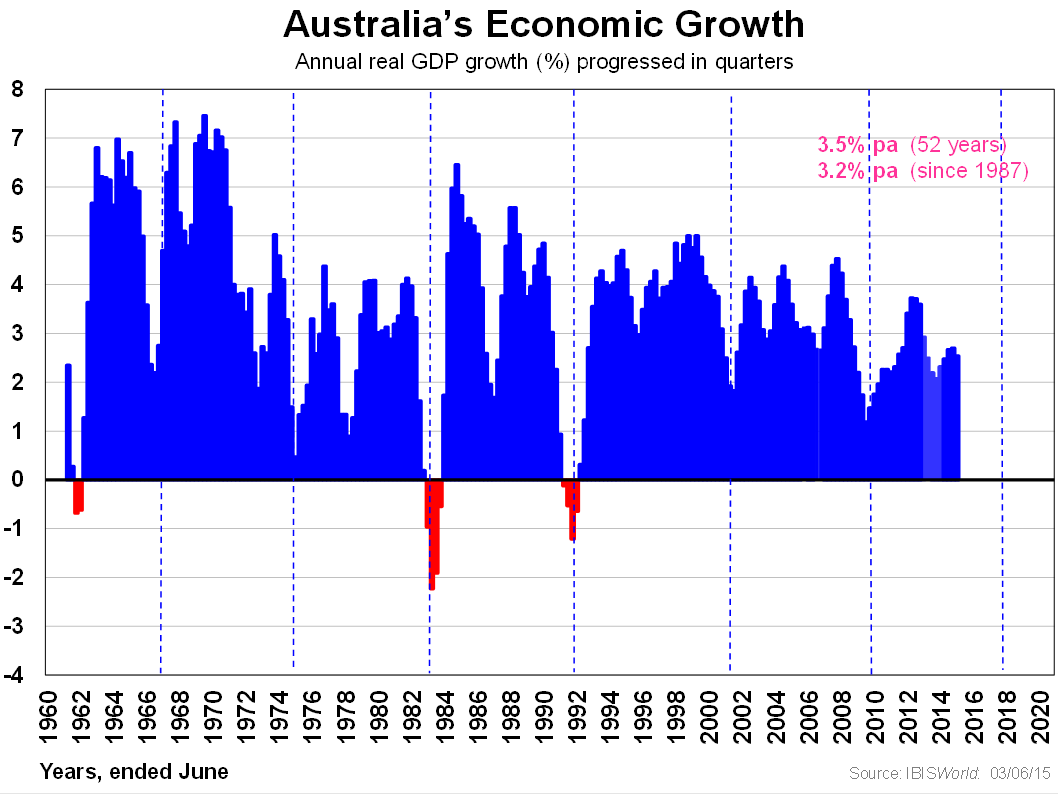
A recession occurs when we have two or more quarters of negative economic growth, usually converting to a negative year overall. A depression occurs when we have two or more negative years, usually four in a row for Australia.

Fortunately, we have had only four depressions in 227 years, the last one ending over 80 years ago in the 1930s. And we have fewer recessions than in the Industrial Age - when we had 20 of them over a 100 year period or one every five years on average - but only two over the past 50 years since the new Infotronics Age began in 1965. The last one was 23 years ago, ending in 1992 as shown in the exhibit. We return to the prospects of another one shortly.
Avoiding complacency setting in

Half today’s workforce of 11.8 million has never experienced a recession in their working lifetime. It carries the risk of the boiling-frog syndrome whereby complacency sets in, productivity growth slows, deficit spending becomes a habit, workplace reforms are put off, and unemployment rises. This is Australia today, and Greece is an extreme example over a much longer period: two generations at least, and now a classic basket-case, as they say.

Strangely, we may be better to have another one sooner rather than later to correct the above drift, notwithstanding we have a very low national debt and a relatively modern economy.

A lot of things need to be done, as the list below suggests. There are not enough ‘yesses’.
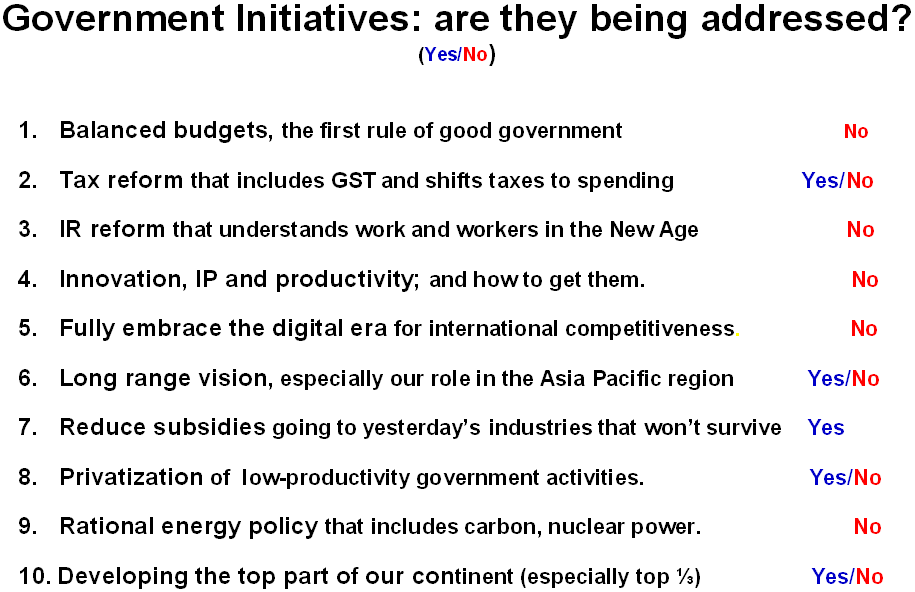
The nation has had reform paralysis for much too long, and that is dangerous given our new economic and social homeland of Asia: the biggest, most dynamic and fastest growing region of the world, where we will be trading and competing for a century or more.

We need workplace reform, involving penalty rates, contractualism (to reward on outputs not inputs), more worker freedom and flexibility.

We need reform: in our parliament (Senate election protocols); in our Federal budgeting (the deficit habit); in our taxes (GST in particular); in our negative productivity in government-owned activities (22% of the nation’s GDP); in our society (more fairness, but also more self-reliance); in our energy policy area, and more.

However, while all these issues are important to our rising standard of living - indeed critical over the longer term - the cause of recessions lies elsewhere.

Potential causes of recession

Markets pull the economy (GDP) along, not production. There are three major sectors in the marketplace:

  • overseas expenditure (our exports)
  • consumption expenditure (households and government on our behalf)
  • capital expenditure.

Exports do go negative in growth but rarely, and even those occasions have not been severe enough to trigger a recession over the past 50 years.

Consumption expenditure has not gone negative since World War II, so has never caused a recession in the lifetime of most Australians unless they are well over 75 years of age. One of the factors that has helped keep consumer spending in the positive zone is the dominance of services in household spending. Goods once consumed over two-thirds of household budgets a century ago. Now, only a fifth is due to manufacturing productivity and - more recently - cheaper imports.

Indeed, in 2013, household spending on outsourced chores and services exceeded retail goods spending for the first time in history. Consumers are less likely to stop or curtail spending on services than goods, especially durables. They will still pay for electricity, insurance, health, education and even entertainment of one form or another. The facts show this to be true over the past six or more decades.

That leaves the only market sector that can cause recessions: capital expenditure. The two recessions we have had in this new age were caused by a collapse of more than 8% in a given year. This happened in the 1982-83 and 1991-92 recessions, as seen in the following exhibit.
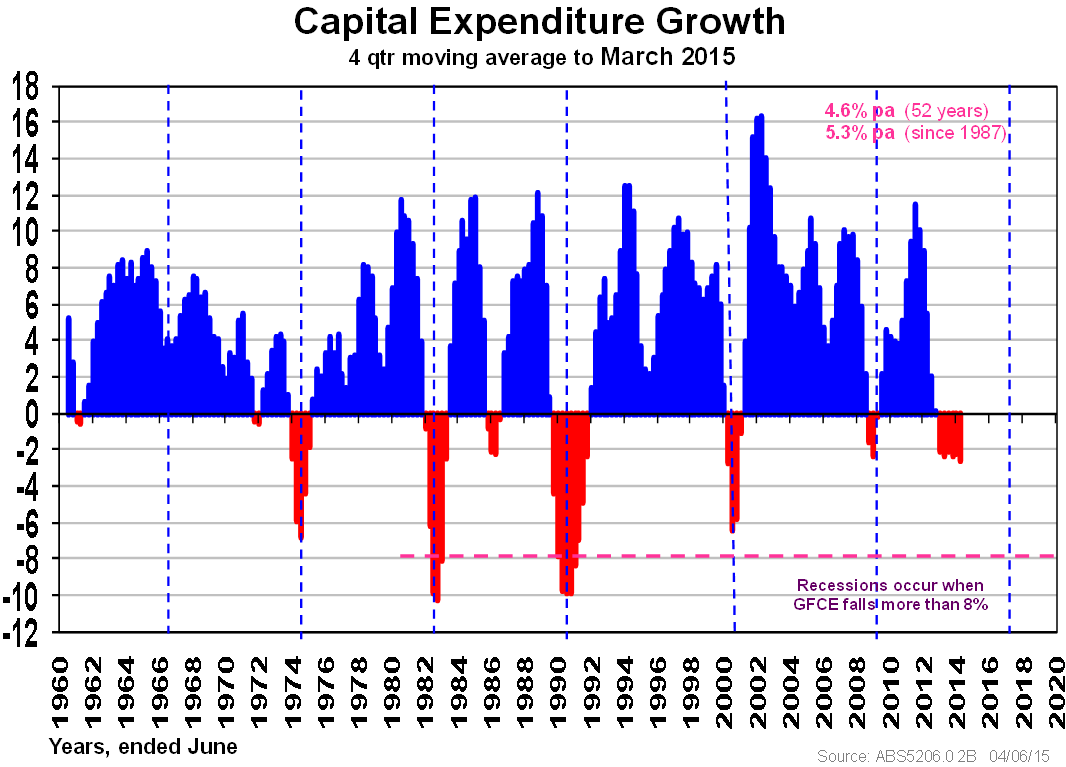
Dotted lines are shown around every 8½ years on average. This is what economists term the long business cycle. It is at the end of each of these periods when our economy is susceptible or vulnerable to a collapse in capital expenditure. It was in 2000-01, but averted by the Howard/Costello initiative in housing construction with the First Home Buyers Grant, doubled in the following year to make sure a recession was averted! We missed a recession in 2008-09 too, due to the massive backlog of mining capital expenditure.

The Rudd initiative of pink batts and give-away money in two tranches to households was not necessary, and a panic reaction. We didn’t need any bolstering of consumer spending. Mortgage rates had collapsed from 9.25% to 5.25% from 2008 and petrol price rises had fallen sharply, enough to free up over $10,000 in after-tax money for the majority of households! Better to suggest they spend some of it rather than give them more, and at the same time let the public know we were not going to experience a GFC as we had no national debt.

But the looming risk of a recession in 2017-18 at the end of the current long business cycle is very real this time. Over 25% of our capital expenditure (itself 28% of GDP) was going to the mining boom until recently. At least half of this or more will have gone by 2018, so filling that hole is the challenge in avoiding a recession. Governments are largely aware of this risk, hence the drive into more infrastructure spending.

We have a couple of years to fill this hole, otherwise a probable recession is in train. But in the absence of serious reform vision, initiatives and courage, it may not be a bad thing if we had one to shake us out of lethargy. Another one ‘we had to have’, so to speak.


Phil Ruthven is Chairman, IBISWorld and Australia’s leading futurist.


  •   16 July 2015
  • 3
  •      
  •   
3 Comments
Warren Bird
July 17, 2015

I'm not sure what this statement means: "markets pull the economy "(GDP) along, not production''. The P in GDP means production and the reason the ABS calculates this measure of the size of the economy 3 ways is that Income, Expenditure and Production are all equal. Someone's spending (on a produced item or service) is someone else's income (earned in providing that item or service). The economy is a dynamic equilibrium of spending, earning and producing - you can't say that one drives the others.

Apart from that, I agree with the point that capital expenditure is the most volatile element of the E measure of GDP and thus correlates highly with the occurrence of recessions. But I think you have to dig deeper to understand the dynamic of this. Why has capital expenditure run up and then fallen so often in the past?

One reason is the cycle of inflation and monetary policy. When we had monetary policy that allowed inflation to take off - because, for instance, it mistakenly focussed on controlling the exchange rate (pre-1983) - we sowed the seeds of excessive capital spending. When policy had to be tightened to head off the inflation that resulted, it put the screws back on capex and produced a recession. It was often said that these recessions purged the unproductive bits of the economy - hence Paul Keating's infamous statement about the 'recession we had to have' , which was a correct analysis, but poor choice of words politically.

Thus, one of the reasons we've had relative stability in growth for many years is that we got monetary policy onto a clear, focussed and sustainable path. We just don't get the old 'bucking bronco' of inflation that Keating also spoke about. The floating of the A$, moving away from trying to target monetary aggregates and focussing rate setting on generating a steady state inflation path all combined to give our economy a much better chance of having cycles with reduced amplitudes.

None of this says that we can't or won't ever have a recession again, but I think that leaving a discussion of monetary policy off the list of things to consider is leaving off the most important policy development and one of the key influences on our economic performance.

Ken Ellis
July 17, 2015

Hi Warren,
I agree with the majority of your comments. However we tend not to learn from history and perhaps a recession is the only way our politicians will address the areas that need to be addressed rather than protect their incomes and positions by doing a Greece and just pushing the can further down the road

Rachel White
July 20, 2015

Hi Phil,

An excellent article, it touches on many of the points and "sacred cows" that are very relevant to an industrial model, less so in the information age. I suspect the term "GDP" will need to be replaced at some point as the concept of "production" itself changes.

Technology itself needs a significant capital investment however I do wonder if the transition to services based business models in terms of how it's now delivered to customers (ie: supply chain and logistics) may also be a factor that starts "smoothing out" the massive capital swings, and thus boom and bust cycles, we've seen for centuries.

I'm also sad to say that the current lack of leadership at a political level may mean that a period of economic turmoil is inevitable. That's not limited to us.

Thanks for the insights, much appreciated!

Cheers
Rachel


Leave a Comment:

RELATED ARTICLES

Get set for a bumpy 2026

Global market growth hinges on Iran War and AI rollout

The bull case for Melbourne

banner

Most viewed in recent weeks

Why spending more in early retirement can improve lifetime income

Conventional wisdom encourages retirees to preserve superannuation. But if those likely to qualify for the Age Pension later in life spend a little more today, it may deliver higher lifetime income and a more stable retirement.

Testamentary trusts have secured the CGT exemption

Treasury’s latest CGT reform draft delivers a win for testamentary trusts and deceased estates, exempting estate-derived gains from the 30% floor. However, questions on death and divorce rollovers remain unresolved.

Meg on SMSFs: What do we think about reversionary pensions these days?

Reversionary pensions have long been a staple of SMSF estate planning, but are they still the best option? Meg Heffron revisits a once-clear favourite and asks whether changing super rules have shifted the balance.

Is it time to bail on Australian stocks?

For generations, Australian investors have backed banks, miners and dividends. But has that loyalty come at a cost? A look at the numbers raises an uncomfortable question about where future returns will come from.

How does the 4% rule stack up?

The 4% rule has long been retirement's gold standard. But after a difficult period for investors, fresh analysis suggests a more conservative approach may significantly improve the chances of making savings last.

Testamentary trusts survived the trust tax. The drafting battle has just begun.

The fight over testamentary trusts looked settled. Then the draft legislation arrived. Hidden in a technical detail is a question that could force many families to rethink wills they thought were already future-proof.

Latest Updates

Planning

How the typical Australian Family could save $844,350 in taxes

The value of a testamentary trust is not determined by wealth alone. Depending on circumstances, it can reduce the tax burden on inherited income, create efficiencies and help build intergenerational wealth.

Superannuation

There's a reason why your super is locked up until your 60s

For decades, it seemed settled. Then one controversial idea reignited a debate that could reshape the financial future of millions. The real question isn’t who’s right or wrong, but whether a long-held assumption deserves another look.

Property

The housing slide could become a crash

House prices are sliding across Australia, yet the most dangerous ingredient for a housing crash is still missing. If job losses surge amid growing economic risks, today's correction could become a historic property downturn.

Retirement

Under-retiring: The greatest retirement risk in a generation

Two retirees. Similar savings. Completely different lives. New research from Challenger reveals why some Australians confidently spend in retirement while others hold back and the overlooked factor shaping retirement decisions.

Five risks to watch in markets

Things you may often hear are: a recession is around the corner, markets are overpriced, the AI sector is about to flop at any moment. It’s like the never-ending laundry pile that sits in my house, it never really disappears.

Investment strategies

Do you qualify as ‘rich’?

What does it mean to be 'rich'? For something so universally desired, it is surprisingly difficult to define. That ambiguity creates a challenge for investors and raises a bigger question about what financial success really looks like.

Investment strategies

If you’re worried about your bond portfolio, you’re missing the point

Most investors think they know what bonds are for. But when markets turn volatile, a surprising misunderstanding can lead to costly decisions. Here’s the overlooked lesson that could change how you view your portfolio.

Alliances

  • ASA-Logo-RGB-ActiveGreen-web.png

© 2026 Morningstar, Inc. All rights reserved.

Disclaimer
The data, research and opinions provided here are for information purposes; are not an offer to buy or sell a security; and are not warranted to be correct, complete or accurate. Morningstar, its affiliates, and third-party content providers are not responsible for any investment decisions, damages or losses resulting from, or related to, the data and analyses or their use. To the extent any content is general advice, it has been prepared for clients of Morningstar Australasia Pty Ltd (ABN: 95 090 665 544, AFSL: 240892), without reference to your financial objectives, situation or needs. For more information refer to our Financial Services Guide. You should consider the advice in light of these matters and if applicable, the relevant Product Disclosure Statement before making any decision to invest. Past performance does not necessarily indicate a financial product’s future performance. To obtain advice tailored to your situation, contact a professional financial adviser. Articles are current as at date of publication.
This website contains information and opinions provided by third parties. Inclusion of this information does not necessarily represent Morningstar’s positions, strategies or opinions and should not be considered an endorsement by Morningstar.