Register For Our Mailing List

Register to receive our free weekly newsletter including editorials.

Home / 675

Australian inflation still well above the RBA's target

This is an update on my 6 Feb 2026 article on the RBA’s record on inflation.

Australian CPI inflation came in at 3.8% for the 12 months to June 2026. This is down from 4.6% in March, but still well above the RBA’s medium-term target range of 2-3%. The RBA’s preferred measure, ‘trimmed mean’ CPI, is also still well above target at 3.6%.

Despite inflation remaining too high, real rates are still too low, and Federal & State governments continuing on unconstrained inflationary deficit spending sprees, the RBA is reluctant to raise rates further, fearing the government will once again neutralise the rate hikes with even more ‘cost of living’ handouts and productivity-free wage rises which entrench the inflation spiral.

Has this tarnished the RBA’s long-term record on inflation targeting?

Since the RBA gained ‘independence’ in pursuing its 2%-3% target, inflation has only been in the target range just 31% of quarters, and just 36% of calendar years. It has missed its target TWO THIRDS of the time – so the RBA scores just 3 out of 10 for short-term inflation outcomes.

But it was never a short-term target. Overall inflation over the period has averaged 2.6% pa which is in the MIDDLE of its target range – so the RBA has been successful on long-term inflation targeting.

Measured by decade, inflation has been WITHIN its target range EACH decade. Inflation averaged 2.3% pa in the 1990s, 2.8% pa in the 2000s, and 2.1% pa in the 2010s. In the 2020s inflation has averaged 3.5% pa so far, but the decade is not over yet. Inflation over the past 10 years has averaged 3.1%, which is almost within target range.

So, through a host of major global and local crises over the past 30+ years, and despite some policy mis-steps along the way, the RBA has actually ACHIEVED its inflation target rather successfully.

However, I have two further important policy questions:

(1) Why the RBA has the highest/loosest monetary policy target in the developed world? and

(2) Why does the RBA, and all other central banks, target positive inflation at all?

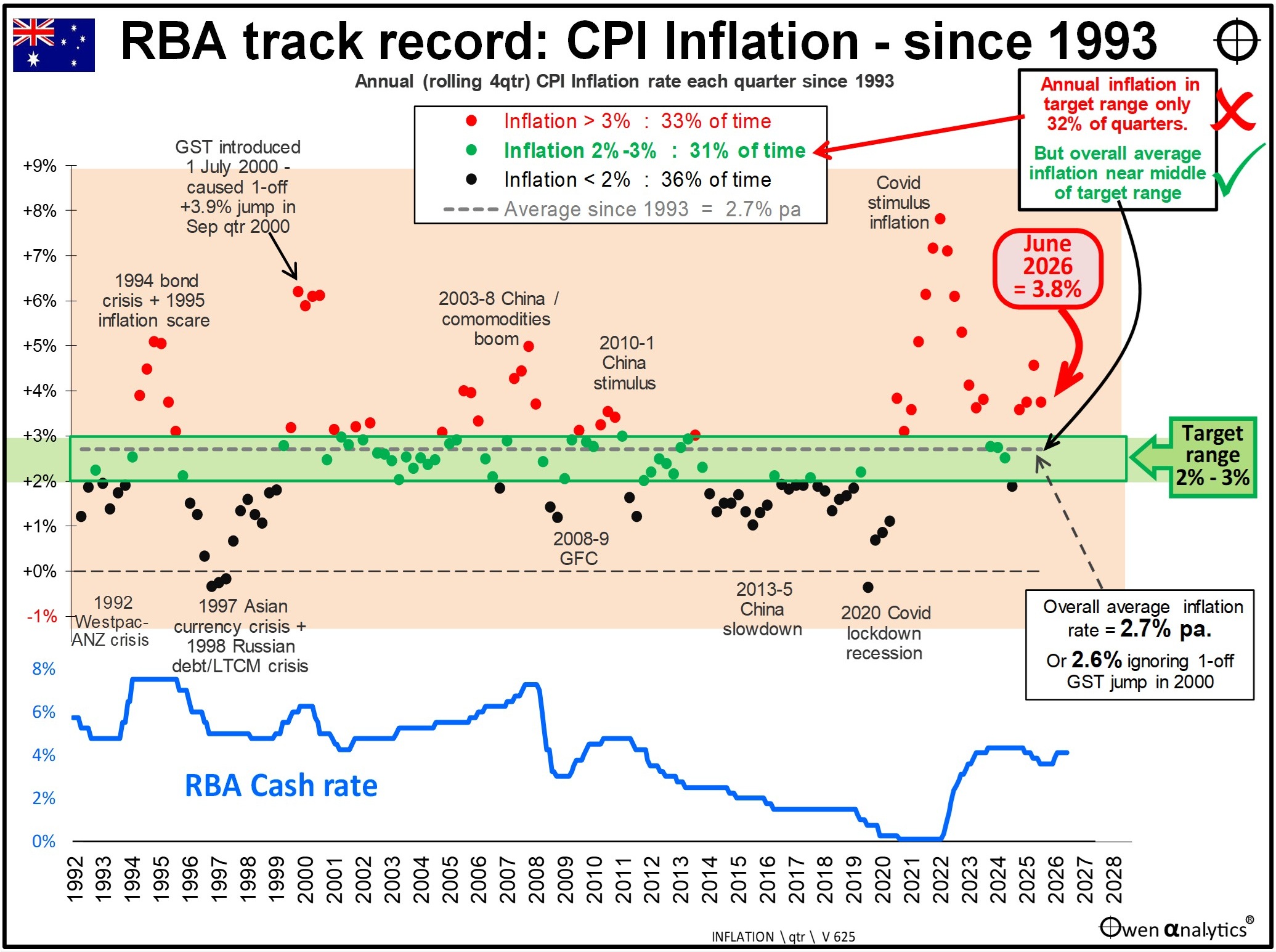
This chart shows the inflation and policy cash rate picture in Australia from 1993. The dots in the upper section represent annual (rolling four-quarter) CPI inflation each quarter (as quarterly has been the main reporting interval for inflation in Australia).

Click to enlarge

  • Red dots for inflation above 3%; black dots for inflation below 2%; and green dots for inflation within target 2% to 3% range.
  • Inflation has ranged widely from a high of 7.8% in December 2022 (Covid stimulus boom) to several quarters of negative inflation during the 1997 Asian currency crisis, 1998 Russian debt crisis, as well as 2020 Covid lockdown recession.
  • The green 2-3% target inflation range through the middle of the spray of inflation dots scattered by a host of global and local macro shocks illustrates how tough it has been to hit a narrow target range.
  • The lower section of the chart shows the RBA’s policy cash rate over the period.
  • One adjustment - for GST introduction. Just one mechanical note. The 10% Goods and Services Tax was introduced from 1 July 2000 caused a one-off +3.9% jump in the general price index in the September quarter 2000. It also affected the rolling four-quarter annual inflation rates in the subsequent three quarters. We can see these four quarterly red dots in 2000-1 on the chart. A step change in the general price index due to a one-off tax change is not ‘inflation’, so I adjust for this in measuring average inflation rates.

How has the RBA done?

Taken from 1993 as the start of RBA targeting a 2-3% inflation range with substantive policy and operational independence (although you could use 1994 or 1995 or 1996 with the same results), and adjusting for the one-off GST impact in 2000 (as it was not ‘inflation’ but a one-off tax change) we get the following inflation results for the RBA:

Annual inflation outcomes per quarter and per year

Annual (ie rolling four-quarter) inflation has only been within the 2-3% target range just 31% of quarters, and just 36% of calendar years. So the RBA scores just 3 out of 10 for short-term inflation targeting. A quick look at the chart shows only around one third of the dots are in the target (green) range.

However, that is actually not bad given the enormity and impacts of the global macro challenges faced by central bankers over the past 30+years.

Decade averages

Quarterly and yearly inflation measures are rather harsh tests given the volatile nature of inflation components and the data lags involved - from measurement, reporting, decisions, and impacts.

Therefore if we view inflation outcomes decade by decade, inflation has been within the target range each decade:

  • Inflation averaged 2.3% pa in the 1990s,
  • 2.8% pa in the 2000s,
  • 2.1% pa in the 2010s.
  • So far in the 2020s inflation has averaged 3.8% pa to date. This above target but we have some years left to run for this decade, so it is too early to call.
  • However, for the 10 years to December 2025, inflation averaged 3.1%, which is just inside the target range.
  • Therefore the RBA gets full marks on decade average inflation outcomes.

Overall inflation experience

Overall inflation over the whole period has averaged 2.6% per year (or 2.7% pa if you don’t adjust for the one-off GST jump in 2000). This is in the middle of target inflation range – so the RBA scores 10 out of 10 for long-term inflation targeting.

Further thoughts

I have concluded that the RBA has done a pretty good job in achieving its mandated inflation target. Overall at least 8 out of 10. However, I do not agree with the RBA’s inflation goal. (Government sets the goal, not the RBA.)

There are two serious questions I will leave for another day:

The first is why RBA has been given the highest inflation target (ie loosest monetary policy target) in the developed world?

For example, from Federation up until inflation targeting in the 1990s, Australian inflation averaged 1% higher than the US (4% pa in Australia versus 3% pa in the US), for a variety of structural reasons, including our unique system of centralised wage fixing, which was a problem pointed out by Keynes in 1936 and still a problem today (Keynes, ‘General Theory of Employment, Interest and Money’, London, Macmillan, 1936. pp. 267-9 in my 1973 edition).

Now, with specific inflation targeting regimes in place, the RBA’s target is still higher than the US target, which pretty much guarantees Australian inflation will remain higher than the US in future as well (ie looser monetary policy, higher interest rates, and weaker currency).

Is there a valid policy reason for this? I say No.

The second question is why the RBA and other central banks aim for positive inflation at all?

With fiat/paper currencies, inflation is government-endorsed theft of the wealth of its citizens. Inflation is the most regressive form of tax imaginable, as its hits low income earners and the poor much more savagely than high income earners and the rich. Inflation is essentially a deliberate and pernicious transfer of wealth from creditors (bank depositors, savers) to debtors (asset owners and especially geared-up asset owners, and governments).

The Reserve Bank Act (initially in 1959 and still now) mandates ‘stability of the currency’ which means stable purchasing power of the currency – ie stable prices. ‘Stable’ prices means ‘flat’ prices, NOT constantly inflating prices, which is deliberate, constant, government-mandated, forever-compounding theft from its citizens.

Is there a valid policy reason for this? I say No, for reasons that go back to Nicholas Oresme, St Thomas Aquinas, and even Aristotle. But that is another story for another day.


Ashley Owen, CFA is Founder and Principal of OwenAnalytics. Ashley is a well-known Australian market commentator with over 40 years’ experience. This article is for general information purposes only and does not consider the circumstances of any individual. You can subscribe to OwenAnalytics Newsletter here.


  •   12 August 2026
  • 18
  •      
  •   
18 Comments
Greg D
August 13, 2026

Excellent summary 

1
ashley owen
August 14, 2026

hey Alan - yes things are looking pretty dark - bit like the early 1970s in a lot of respects with indexation entrenching a wage-price inflation spiral, and government focus purely on taxing and spending rather than growth and productivity. There is light at the end of the tunnel . . . . but it might be the light of an on-coming train!
cheers
ao

1
B2
August 13, 2026

Best part of the article is the end:
There are two serious questions I will leave for another day:
The first is why RBA has been given the highest inflation target (ie loosest monetary policy target) in the developed world?
The second question is why the RBA and other central banks aim for positive inflation at all?

The WHY is probably less relevant to the man on the street than the CONSEQUENCES of the above 2 facts. Rudimentary international financial economics gives the definitive answers.
Thank you Ashley.

6
ashley owen
August 13, 2026

Hey B2 - yes, deliberating aiming for price inflation is institutionalized government theft of citizens wealth.
cheers
ao

4
Dudley
August 14, 2026


"constantly inflating prices, which is deliberate, constant, government-mandated, forever-compounding theft from its citizens":

What can the citizen victims do to stop the theft?

First propose a workable means of calculating the inflationary loss of capital due to inflation.
For a bank account that could be the Daily Weighted Average Balance multiplied by the Inflation Rate resulting in the Account Imaginary Interest.
Then the Account Nominal Interest minus the Account Imaginary Interest results in the Account Real Interest.
Negative Account Real Interest (Real Loss) to be carried forward and set against Positive Account Real Interest (Real Profit).
Tax to be paid on Net Account Real Interest.

3
Geoff F
August 15, 2026

And how do you propose that the citizen victims actually facilitate those steps?!

1
Dudley
August 15, 2026


"citizen victims actually facilitate those steps":

Gifted with a gracious anti-grifting government: nothing - compliance is banks problem.

Once per year, for each account, banks to sum daily balances and divide by 365 (day 366 is bankers reward), total the interest paid and forward the two numbers to ATO (and account holder) which will record calculate and carried forward losses and add real interest to taxpayer's taxable income.

1
Geoff F
August 18, 2026

Tx Dudley, I understand the concept of "real" (ie after taking into account inflation) interest (positive, zero or negative) and its calculation.
My query pertained to your "What can the citizen victims do to stop the theft?" question, my interpretation of which was that you were inferring that it was in the control of "citizen victims" to deal with it. Your subsequent response revealed that the point of control would actually be in the hands of the govt as it would have to first change the tax law.
(It appears there was a misunderstanding between us)
A potential revolution by us "citizen victims" regarding this matter has been snatched away from our grasp at the very last minute by the evil govt !
So near but yet so far ...

Simon N
August 13, 2026

Ashley,
I look forward to reading your future article expanding on the questions for another day.

2
Sue
August 13, 2026

Interesting article.
Ad on the same page tells me that Australians have saved $4.5 trillion for retirement.
I'd like to see a well thought out article on the impact this level of saving has had on our economy over the last 40 years.

1
Jason
August 13, 2026

Great insights

Trevor
August 16, 2026

With persistent government deficit spending and inflation what is the case for investing in fixed interest/bonds?

ashley owen
August 18, 2026

Great question Trevor. Main problem is that bonds generated near-equity-like returns (and negative correlations to shares) during the great period of disinflation (early 1980s to 2020 in US/UK/Europe, but early 1990s to 2020 in Australia as we were a decade late in seriously tackling inflation). So academic finance textbooks, and all long-term diversified pension/retirement/super funds in Australia and around the world mandate specific allocations to fixed rate bonds as a 'safe haven' because they assume simplistically that the great bond returns and negative correlations over the past 3- 4 decades will continue in the future. WRONG! That golden disinflation era of great bond returns and negative correlations to shares is clearly over and we are into the next rising inflation phase (like 1946 to 1979, 1900 to 1920, etc). with protectionism replacing free trade, on-shoring replacing out-sourcing, big/interventionist governments replacing free markets, re-regulation replacing deregulation, military build-ups replacing the 'peace dividend', 'just-in-case' replacing 'just-in-time' supply chains, lower immigration, new restrictions on free movement of people, capital & ideas, etc, etc. Bonds generate negative real total returns in rising inflation conditions.
Fortunately, individual investors are not bound by silly mandates/trust deeds based on flawed assumptions and simplistic extrapolations of recent history. have been entirely out of fixed rate bonds in my portfolios and advised portfolios since 2021. I may take another look in a decade or so!
cheers
ao

Trevor
August 19, 2026

Thanks Ashley,

John
August 18, 2026

"So far in the 2020s inflation has averaged 3.8% pa to date. This above target but we have some years left to run for this decade, so it is too early to call.
However, for the 10 years to December 2025, inflation averaged 3.1%, which is just inside the target range.
Therefore the RBA gets full marks on decade average inflation outcomes."

We are 6 years into decade. 3.1% is ouside target band not inside and nearly 25% above target. Scores 3 out 10. Sure international macro is difficult but that is exactly the prudence job. I think you are being very generous. However, I do believe there is a strong case to wind back Chalmers failed reforms.

ashley owen
August 21, 2026

hi John - yes the 2020s decade to date inflation is above target range, but there are a few years left - plenty of time for a sharp local/global recession, where inflation would probably fall back significantly, (albeit temporarily). There are a truck-load of risk factors piling up that would trigger the next big contraction (eg bond market forcing sharp drop in gov spending; or following crash of the current tech bubble, etc, etc). The only question is the timing/trigger.
cheers
ao

Philip Sammons
August 19, 2026

I agree with Dudley. The government has just moved back to indexing capital gains cost bases to avoid taxing inflation. What about tax relief for the interest on term deposit like investments so holders are not taxed on the inflation component of the interest? ie only tax real interest. I suspect that would be too expensive.


Leave a Comment:

RELATED ARTICLES

How the RBA scores on its inflation goal

Shares rebound on hopes of war ending, but stalemate the likely outcome

Five simple reasons why Australian cash rates are highest

banner

Most viewed in recent weeks

Are you making these SMSF mistakes?

After four decades advising investors, there are a few common mistakes I've seen SMSF investors make. From holding too much cash and chasing yield to overtrading and trusting tips. Are these errors costing you?

Why have Australian living standards 'fallen' and how do we fix it?

For the last few years there has been much talk of a 'cost-of-living' crisis in Australia and of 'falling living standards'. Lately this has flared up again with the pickup in inflation resulting in a renewed fall in real wages.

Will you run out of money in retirement?

Fear of running out has become a defining retirement anxiety. Why do some retirees die with substantial wealth while others deplete their nest egg? Evidence suggests the answer is more complicated than we think. 

Four options for an income investor’s next dollar

What if Australia’s golden age of dividends is ending? Rather than overhaul your portfolio, it may be worth considering where new capital can work harder. I discuss four income strategies and the trade-offs behind each.

Retirement spending is not one-size-fits-all

New data challenges the idea that Australians are underspending their super. The bigger issue may be helping retirees navigate complexity, make confident decisions and use their savings to support security, wellbeing and choice.

The missing link in the CGT debate

A little-noticed consequence of Labor’s tax changes could have implications well beyond investors’ tax bills. The issue raises bigger questions about incentives, capital allocation and the drivers of long-term economic growth.

Latest Updates

SMSF strategies

Meg on SMSFs: What do we think about reversionary pensions these days?

Reversionary pensions have long been a staple of SMSF estate planning, but are they still the best option? Meg Heffron revisits a once-clear favourite and asks whether changing super rules have shifted the balance.

The ageing ‘crisis’ has not and will not happen

Rising age dependency is frequently treated as a warning sign for economies. But when actual workforce participation is examined, a strikingly different picture emerges about ageing, productivity and economic sustainability.

Retirement

How does the 4% rule stack up?

The 4% rule has long been retirement's gold standard. But after a difficult period for investors, fresh analysis suggests a more conservative approach may significantly improve the chances of making savings last.

Shares

Four charts that expose market concentration risk

Investors have recently been rewarded for backing market leaders, but history suggests this eventually comes at a cost. Now may be the time to review whether your portfolio is carrying unintended risks beneath the surface.

Investment strategies

The case for gearing beyond property

Most Australians gear into property but ignore shares. That may be a mistake. Used carefully, geared equity strategies can enhance long-term returns, reduce cash tied up in growth assets and support retirement income goals.

Economy

Australia's $1 trillion debt pile

The headlines exclaiming that Australian government debt has hit A$1 trillion and US government debt has hit $40 trillion has turned heads, but how serious are they really? Will Australia's mix of debt create challenges?

Economy

Has 100 years of growth made us any happier?

For decades, GDP has been the benchmark for economic success, but has it made us materially happier? If happiness does not rise in lockstep with prosperity, are we overlooking what constitutes a successful society?

Sponsors

Alliances

  • ASA-Logo-RGB-ActiveGreen-web.png

© 2026 Morningstar, Inc. All rights reserved.

Disclaimer
The data, research and opinions provided here are for information purposes; are not an offer to buy or sell a security; and are not warranted to be correct, complete or accurate. Morningstar, its affiliates, and third-party content providers are not responsible for any investment decisions, damages or losses resulting from, or related to, the data and analyses or their use. To the extent any content is general advice, it has been prepared for clients of Morningstar Australasia Pty Ltd (ABN: 95 090 665 544, AFSL: 240892), without reference to your financial objectives, situation or needs. For more information refer to our Financial Services Guide. You should consider the advice in light of these matters and if applicable, the relevant Product Disclosure Statement before making any decision to invest. Past performance does not necessarily indicate a financial product’s future performance. To obtain advice tailored to your situation, contact a professional financial adviser. Articles are current as at date of publication.
This website contains information and opinions provided by third parties. Inclusion of this information does not necessarily represent Morningstar’s positions, strategies or opinions and should not be considered an endorsement by Morningstar.