Register For Our Mailing List

Register to receive our free weekly newsletter including editorials.

Home / 659

Five simple reasons why Australian cash rates are highest

This is one of the most common investor questions I receive from advisers, and it is one of the easiest to answer. It’s fairly simple.

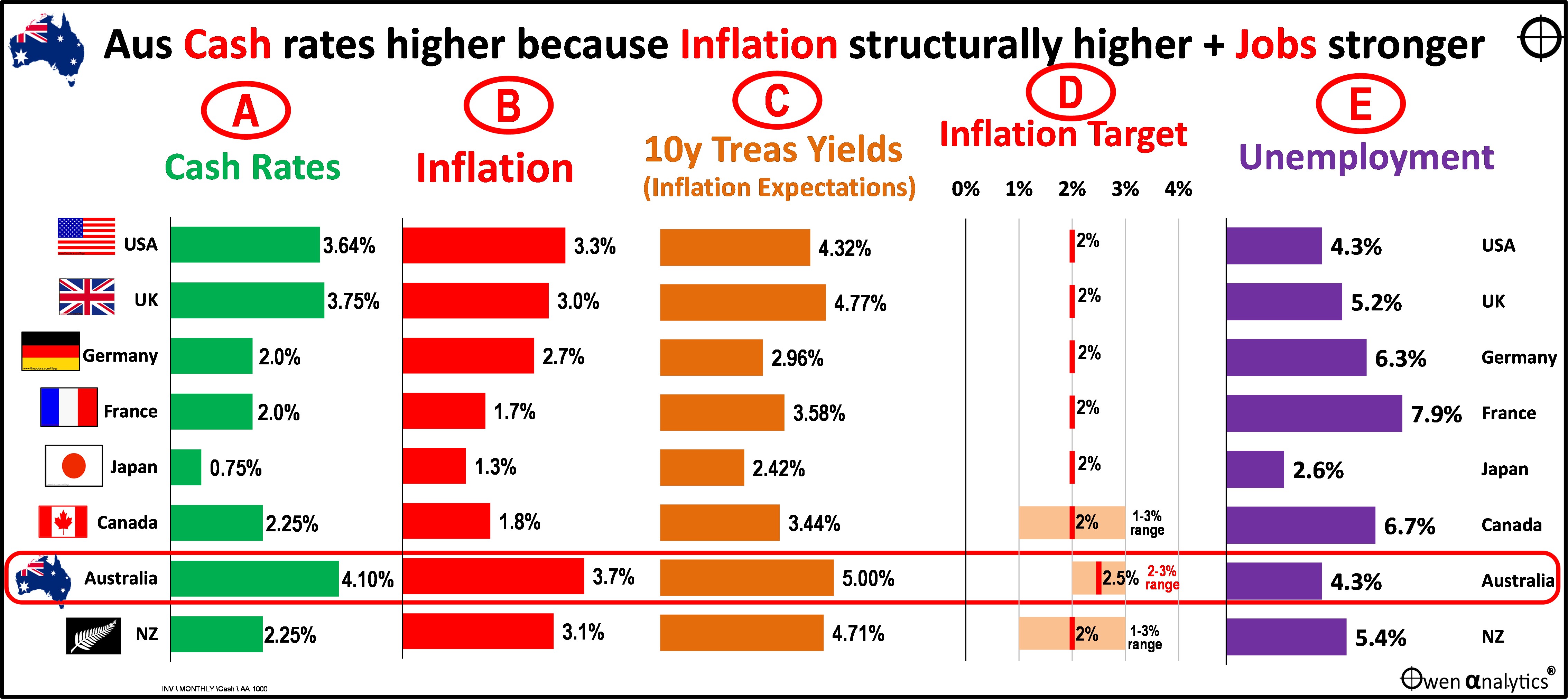
Australians suffer the highest cash rates amongst their rich country peers (chart A) because Australia has:

  1. The highest inflation rate (chart B),
  2. The highest medium-long-term inflation expectations ie highest treasury yields (C),
  3. The highest central bank inflation target (D) – for no good reason at all,
  4. The strongest jobs market eg lowest unemployment rate (E) (apart from Japan which has a declining population and workforce), and
  5. The loosest / most undisciplined monetary and fiscal policies during and since Covid.

Bottom line = locked-in structurally higher inflation.

Click to enlarge

Cash rates (A)

Australia’s 4.1% cash rate is much higher than in peer ‘rich world’ countries. (There are plenty of other countries with higher interest rates of course – including Venezuela with 58%, Turkey 37%, Zimbabwe 35%, Argentina 29%, Nigeria 26%, Brazil 14.75% and others, but they are not our ‘rich country’ peers.)

High cash rates are more important in Australia than in any other country because we have the highest proportion of variable/floating rate mortgages in the world. The rest of the world relies much more on fixed rate mortgages, which are far less sensitive to changes in short-term cash rates.

Accentuating the problem is the fact that we have the most indebted household sector.

Australia is the only country to have had to switch from rate CUTS to rate HIKES this year, after the RBA’s three unnecessary rate cuts in 2025 (February, May, August). Those 2025 rate cuts were unnecessary because inflation was running above target, the economy was running above capacity, and unemployment was low, fuelling inflationary wage claims. I warned of this at the time.

Inflation (B)

The latest inflation rates for Australia and other countries (chart B) are to February 2026 – ie BEFORE the impacts of the latest US-Iran war. The exception is USA, which recorded inflation to March running at 3.3% pa. This was a big increase from 2.4% US inflation to February. Most of the increase was due to surging fuel prices in March.

Australia’s CPI inflation of 3.7% to February is well above its peers, and will also be higher again in March, with the impact of higher fuel prices directly and indirectly flowing through to many other categories of spending.

Inflation expectations – bond yields (C)

Australia also has the highest medium- to long-term inflation expectations, expressed in yields on 10-year government bonds (and for all other maturities / terms for that matter).

This means current and future taxpayers pay more interest on government debt, as federal and state governments have to borrow to finance their wild spending deficits and also refinance the existing piles of debt.

Central Bank inflation target (D)

The Reserve Bank has always had the loosest / highest / laziest inflation target in the world. Why? There is no good reason or excuse for this.

There is no philosophical or ethical justification for a government to deliberately set ANY positive target for inflation – ie to deliberately engineer CONTINUALLY rising prices and continually debasing the value of its mandated monopoly currency in the hands of its citizens. Deliberate price inflation / currency debasement (even 1% per year) is nothing more than officially sanctioned theft of citizens’ wealth.

Governments love high inflation because it means high interest rates, so they can lure in lenders (bond holders) to finance their debts and then repay them in the distant future with debased currency worth a faction of its current purchasing power.

High structural inflation

The reason or excuse for Australia having the highest inflation target in the world – ie the most aggressive money debasement and theft of citizens’ wealth, probably has its roots in our Federation pact.

The formation of Australia at Federation in 1901 was based on three central features for the newly formed nation:

  1. high protection barriers to keep out cheaper foreign goods,
  2. restricted ‘White Australia’ immigration policy to keep out low-wage, non-white labour, and
  3. centralised wage fixing/indexation to redistribute the windfall profits from protected industries to the protected workforce.

Today both the White Australia immigration policy, and the industry protection barriers are (mostly) long gone, but for some unknown reason we still have the heavy-handed, centralised wage fixing and indexation system, which is a relic from the distant protected past, and now unique in the world.

An additional inflationary feature of Australia’s industry structure is that just about every domestic industry (eg banks, retailers, telcos, utilities, toll roads, airlines, ASX, ports, etc) is a monopoly / oligopoly where the dominant incumbents can simply pass on rising input costs to consumers in the form of higher prices, rather than being borne by shareholders.

In addition, Australia has had the highest population growth rate in the world (outside of Africa) since Federation and still has. It also has one of the best (youngest) demographics of any ‘rich’ country. See: Australia's remarkable population-led growth (31 Jan 2024)

These factors combine to result in Australia’s higher structural inflation, which is reflected and perpetuated in our higher central bank inflation target.

Low unemployment (E)

We also have the lowest unemployment rate in the rich world, aside from Japan which has a declining population and declining workforce.

An additional problem for Australia is the fact that the vast majority of hiring is for the government sector or ‘non-market’ (private sector but revenues/prices are set by government – eg all those private suppliers to government services like NDIS, Home Care packages, construction contracts on public works, etc).

Currently the US also has a 4.3% unemployment rate like Australia, but Australia has a higher workforce participation rate of 64%, compared to 61.9% in the US, so our jobs market is tighter.

Poor monetary and fiscal policies

The RBA and federal / state governments share the blame for the post-Covid inflation we are still suffering. However, true to form, both sides now conveniently divert the blame for rising energy prices to Russia’s 2022 invasion of Ukraine, and now the 2026 US-Iran war.

The fact is that the RBA woke up to the Covid stimulus inflation later than the rest of the world, then it hiked interest rates to attack inflation LATER, SLOWER, and LOWER than other central banks.

Then, for some unknown reason, the RBA CUT rates unnecessarily in 2025 when inflation was still running above target, when the economy was running at or above full capacity (inflationary), the unemployment rate was still low (also inflationary), and the government was backing double-digit wage claims.

Meanwhile, federal and state governments have squandered windfall revenue gains from raw material export booms, run war-time-like deficits on mad un-costed spending sprees, run up war-time-like debt piles, supported inflationary wage claims, and wound back four decades of productivity-enhancing industrial relations reforms.

The next time you (or your clients) wonder why Australians suffer the highest interest rates in the ‘rich’ world, you now have some answers!


Ashley Owen, CFA is Founder and Principal of OwenAnalytics. Ashley is a well-known Australian market commentator with over 40 years’ experience. This article is for general information purposes only and does not consider the circumstances of any individual. You can subscribe to OwenAnalytics Newsletter here.


  •   22 April 2026
  • 16
  •      
  •   
16 Comments
ashley owen
April 27, 2026

hey Naomi - thanks for the feedback! Great to hear directly from someone in the trenches trying to find staff to work on actual jobs in the real workforce. I am willing to give immigrants the benefit of the doubt and assume they all come here for a 'better life' than they were fleeing/leaving behind (like me). What that life actually looks like for them is probably pretty blurry at the outset but I am willing to assume they know they will have to work long and hard for a new better life in their new adopted home (as I did).
cheers
ao

2
Wildcat
April 23, 2026

Ill disciplined and ideological based fiscal polices are one of the core problems, hiring way too many bureaucrats who are net negative for productivity growth, regulatory mountains of garbage continue to spew from government and their agencies which just adds to costs and bog down the economy.

In order to take pressure of inflation and interest rates:

1. Budget neutral (no new borrowing) with no tricky "off balance sheet" accounting
2. cut 10% of all federal employees (states and local govt to follow)
3. slash red tape
4. slash green tape
5. provide tax concessions (state and federal) for social/affordable housing
6. Gut NDIS

This will reduce inflationary and interest rate pressure, increase productivity, reduce govt expenditure as a % of GDP and generally make everyone more positive about the future except maybe for the new ex public sevrants.

10
ashley owen
April 23, 2026

interesting ideas there, but will not get elected on that platform. Too many voters are on the payroll directly and indirectly. It will take a deep/serious crisis. Can't see that happening (not even a major world war, unless it involves Australian soil being invaded) with those rivers of gold continuing to flow in from raw commodities exports. More money to spray around to buy even more votes!
cheers
ao

8
Dudley
April 22, 2026


"Australians suffer the highest cash rates":

Enjoyers: those with tax rate of 0%:
= (1 + (1 - 0%) * 5%) / (1 + 3.7%) - 1
= 1.25%

Sufferers: those with tax rate of 47%:
= (1 + (1 - 47%) * 5%) / (1 + 3.7%) - 1
= -1.01%

Interest rates need to increase to:
= 3.7% / (1 - 47%)
= 6.98%

7
Ben
April 25, 2026

Great article Ashley. I always enjoy your contributions to Firstlinks.

4
Michael
April 23, 2026

Wonderful Ashley. Straight and hard hitting with the facts so many ignore. Dudley nails it as he usually does. However, many of us do not suffer high rates which is usually expressed as a home loan issue while the govt. promotes price increases in entry level housing. We know there is no economic responsibility in the land of rorts (not just the NDIS). Please give us higher rates to get the $AUD higher for a while. People can continue to bail out of the $AUD into offshore opportunities for a while longer.

2
Lee
April 23, 2026

Just on the concept of inflation...
It's better than deflation, right? At least with some (not high) inflation consumers are more likely to spend today rather than wait until prices are lower sometime in the future (deflation). And that helps the economy. Or is my layman economics all wrong?!

2
ashley owen
April 28, 2026

Hi Lee - inflation encourages/ pulls forward spending (buy now to avoid paying more later), which encourages / pulls forward production and jobs. But inflation is government-mandated theft of citizens' wealth. Governments love inflation because it artificially boosts demand/jobs + lets them borrow and pay back debt in debased future dollars. Inflation also leads to bracket creep so people pay more tax without even knowing it. Theft by stealth. On the other hand, deflation discourages / delays spending (why by a phone/laptop/TV now when I know it will be cheaper/better next year). That's a good thing because it reduces frivolous spending on depreciable rubbish that just ends up in landfill after only few years. Best is STABLE prices (=ZERO inflation averaged over a cycle) - as per RBA's actual mandate ('stability of the currency'). Unfortunately, the RBA and all other central banks wrongly interpret 'stable' price goals as constantly rising/compounding inflation/theft.
cheers
ao

2
Dudley
April 28, 2026


"inflation encourages/ pulls forward spending":

I say negative real net Bank deposit interest rates results in brought forward spending.

Banks, Vendors and Government are competing for your $s.

The Bank gets more of 'em when after tax, after inflation deposit interest rates are positive.
The Vendors get more 'em when after tax, after inflation deposit interest rates are negative.

Government sets the tax and inflation.

1
John
April 23, 2026

A very good summary Ashley. If we had a comparable inflation target and a central bank committed to it, we’d have a Cash Rate well over 5% by now. As noted in the comments above, the combination of a dovish central bank and way too high income tax rates means even 6% would leave some savers going backwards.

Nadal
April 24, 2026

I think having a dual mandate of BOTH inflation and unemployment causes a loss of focus on keeping inflation down (as it will risk people/voters losing their jobs).

4
stefy01
April 23, 2026

4.1% interest rates? My bank is offering 5.1% right now.
And that is before the RBA interest rate rise shortly to come in May.

Dudley
April 23, 2026


RBA is not your bank:
https://www.rba.gov.au/statistics/cash-rate/

2
Barry
May 03, 2026

Well done Ashley. Another excellent article. Love your work.

Ashley owen
May 10, 2026

Thanks barry. I just focus on facts + original thought. Avoid all that ai vomit everywhere!
Cheers
ao


Leave a Comment:

RELATED ARTICLES

Shares rebound on hopes of war ending, but stalemate the likely outcome

Iran war hands politicians free ticket to blame oil prices for inflation

Yikes! Three critical factors acting on inflation and rates

banner

Most viewed in recent weeks

Indexation implications – key changes to 2026/27 super thresholds

Stay on top of the latest changes to superannuation rates and thresholds for 2026, including increases to transfer balance cap, concessional contributions cap, and non-concessional contributions cap.

The missing 30%: how LIC returns are understated, and why it matters

The perceived underperformance of LICs compared to ETFs is due to existing comparison data excluding crucial information, highlighting the need for proper assessment and transparent reporting.

Little‑known government scheme can help retirees tap into $3 trillion of housing wealth

The Home Equity Access Scheme in Australia allows older homeowners to tap into their home equity for retirement income, yet remains underused due to lack of awareness and its perceived complexity.

Origins of the mislabeled capital gains tax ‘discount’

Debate over the CGT discount is intensifying amid concerns about intergenerational equity and housing affordability. This analysis shows that the 'discount' does not necessarily favor property investors.

2 billion reasons to fix retirement income

A proposal to address Australia's 'stranded balances' in retirement by requiring super funds to transition members to pension phase at 65, boosting retirement income and reframing super as a source of income.

The ultimate superannuation EOFY checklist 2026

Here is a checklist of 28 important issues you should address before June 30 to ensure your SMSF or other super fund is in order and that you are making the most of the strategies available.

Latest Updates

Investment strategies

Putting portfolios together when the world is falling apart

Global equity markets have grown more correlated due to globalization, but this trend may reverse which boosts the benefits of cross-country diversification.

Property

Housing belongs in the inequality story

Research highlights the significant impact of excluding housing income from income inequality analysis in Australia, arguing for the inclusion of imputed rent and capital gains to provide a more accurate picture.

Exchange traded products

Lithium's rally is real this time – but no-one trusts it

The lithium rally mirrors the early-2010s tech stock surge, with demand set to double by 2030. Supply has been slow to respond, creating a market deficit for future tech like humanoid robotics and solid-state batteries.

Economy

Why is Aussie inflation so stubborn?

Increasing our official cash rate contrasts with almost every other developed country in the world. Canada, UK, Europe, and USA, so far, have not reversed recent cuts while their inflation issues appear to be contained.

Strategy

How to stop Australian democracy going the way of the US

Around the world, democracy as a system of government is backsliding. After more than 50 years of liberal democracy in ascendancy, democratic progress plateaued around the turn of the century and is now going backwards.

Economy

Off-budget, but not off-the hook

Financial commentators await the federal budget with focus on debt and deficit. 'Off-budget' accounting alters the fiscal picture with unseen programs.

Economy

Shares rebound on hopes of war ending, but stalemate the likely outcome

Ashley Owen's abridged monthly snapshot uncovers what is front of mind for investors around the world and his view on the likely outcome of the stand-off in the Middle East.

Sponsors

Alliances

© 2026 Morningstar, Inc. All rights reserved.

Disclaimer
The data, research and opinions provided here are for information purposes; are not an offer to buy or sell a security; and are not warranted to be correct, complete or accurate. Morningstar, its affiliates, and third-party content providers are not responsible for any investment decisions, damages or losses resulting from, or related to, the data and analyses or their use. To the extent any content is general advice, it has been prepared for clients of Morningstar Australasia Pty Ltd (ABN: 95 090 665 544, AFSL: 240892), without reference to your financial objectives, situation or needs. For more information refer to our Financial Services Guide. You should consider the advice in light of these matters and if applicable, the relevant Product Disclosure Statement before making any decision to invest. Past performance does not necessarily indicate a financial product’s future performance. To obtain advice tailored to your situation, contact a professional financial adviser. Articles are current as at date of publication.
This website contains information and opinions provided by third parties. Inclusion of this information does not necessarily represent Morningstar’s positions, strategies or opinions and should not be considered an endorsement by Morningstar.