Register For Our Mailing List

Register to receive our free weekly newsletter including editorials.

Home / 645

Building a lazy ETF portfolio in 2026

In 2023, I wrote an article that proved popular – ‘The challenges of building a lazy portfolio’. It was about how I had spare cash at the time and wanted to create a simple, long-term portfolio with exchange-traded funds (ETFs). The aim was to capture the performance of markets at low cost via such funds.

What I thought would be an easy task turned complicated and the article addressed the many issues I considered before finalising my portfolio. In the end, I opted for a three-ETF portfolio – 80% in equities with half in a US stock market ETF and the other half in a World ex-US ETF, and 20% in bonds via an Australian government bond ETF.

A lot has changed since I wrote that article. US stocks have skyrocketed, Australian shares have badly lagged, investors have lost faith in bonds after five years of poor performance, precious metals have become a trendy asset to own, and private assets have grabbed an increasing share of institutional and retail wallets.

It just so happens that I again have spare cash on hand and am considering how best to deploy it into a simple ETF portfolio for the long term. And I’ve tweaked my thoughts on the topic since last time around, which I’ll run through today.

The allocation to stocks in a lazy portfolio

The idea of a lazy portfolio is to keep it as simple and passive as possible. To keep biases and preferences to a minimum to benefit from the rise in markets over the long term. That’s easier said than done.

With the stock part of a portfolio, the simplest way to gain exposure to global markets is through investing in a global market ETF like the Vanguard MSCI Index International Shares ETF (ASX: VGS) or Betashares Global Shares ETF (ASX: BGBL).

So, is it best to invest in this ETF or a similar one and be done with the stock allocation part of the portfolio? I’d suggest not.

The reason is that if you look under the hood of VGS or BGBL, 73-74% of the portfolio is in US shares. That means by buying these ETFs, you’re essentially buying America.

That makes me nervous on few levels.

First, the US itself has become reliant on a handful of stocks. The top 10 stocks represent more than 35% of the index, far higher than even at the heights of the dot.com bubble.
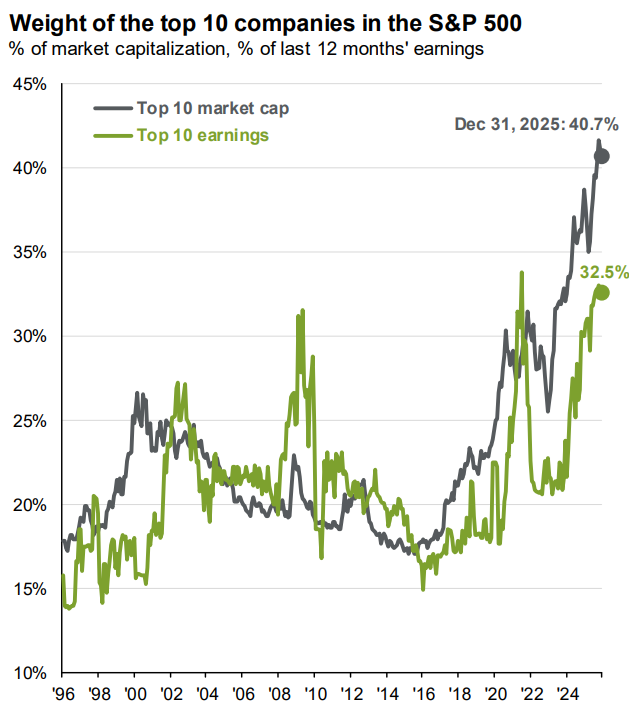

Source: Factset, Standard & Poor’s, J.P. Morgan Asset Management.

Much of the concentration is in tech companies. Officially, the tech sector is 26% of the S&P 500 index. But that’s deceptive because the likes of Tesla and Amazon are classified as consumer discretionary stocks and Meta and Alphabet as communications services companies. The real weighting of the S&P 500 to technology is closer to 45% when these stocks are included.

This means that if you’re buying VGS or BGBL, not only are you taking a concentrated bet on America, but you’re also taking a concentrated bet on the handful of stocks which are driving US markets.

Second, US markets are expensive on every valuation metric. Whenever the US has been at current valuations, returns have been poor over the next decade on every single occasion in the past ie. flat to low single digit per annum returns.
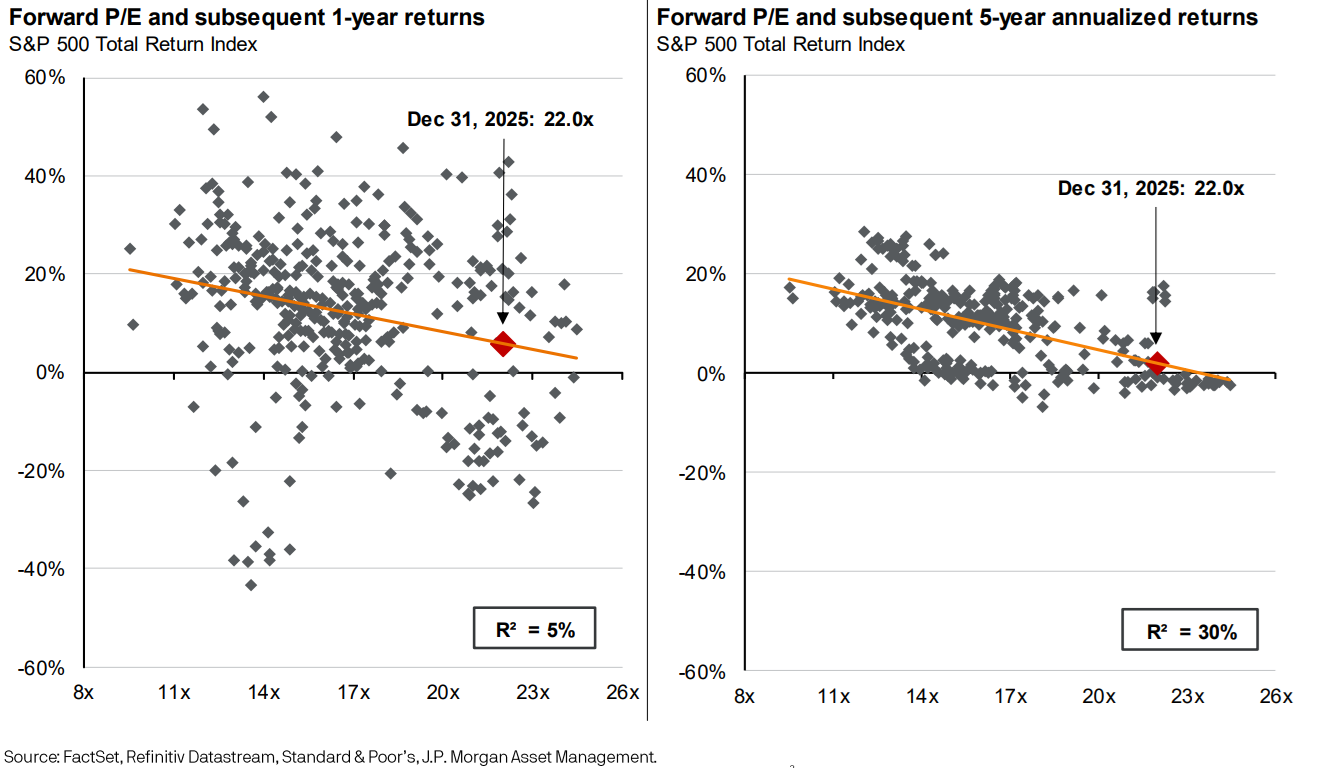
These are worrying statistics if you’re trying to design a lazy portfolio for the next 10 or so years like I am.

Third, the US has had an almost 17 year bull market and bull markets in America have averaged 18 years through history. So, we may not be far from the end of this one.

These factors make me uncomfortable buying a global stock ETF for the stock portion of my portfolio.

Granted, I had similar concerns when doing this exercise in late 2023. Those concerns have only grown though.

What can we do with stocks for our portfolio, then? In my original article, I decided on a 50:50 allocation between a US stock ETF (main options include ASX: VTS and ASX: IVV) and a World ex-US ETF (main options are ASX: VEU, ASX: EXUS, ASX: ACWX). I’m now inclined to bring the US stock portion down and the international portion up, to make it a 40:60 split. That is, invest 40% of my lazy portfolio in US stocks and 60% in international ex-US stocks.

There’s no science to this breakdown and one possible issue is that I am using my judgement, and potentially my biases, to make this decision. In other words, I’m going from investing passively to investing actively.

I get the issue though I don’t think there’s a way around it. You either invest in an international stock ETF and make a big bet on America (which is an ‘active’ decision), or you can diversify your stock holdings as I suggest (which is also an active decision).

What about Australian stocks?

Why haven’t I included an Australia-specific allocation in the portfolio? Two reasons. First, Australia is about 4% of global ex-US stock ETFs so I can already get exposure there. Second, my preference is to go global with stock exposure rather than overweight my home country.

I know some of you may prefer more Australian exposure to access franking credits and regular income. That’s fair enough though an income-focused portfolio is different to the one that I’m trying to create here.

The allocation to bonds in a lazy portfolio

What about the bond portion of the portfolio? Last time, I opted for a plain vanilla Australian government bond ETF and I don’t see a good reason to change this option.

The idea for bonds in a portfolio is for them to function as a buffer to smooth out volatility over time. Put simply, when stocks have a large dip, as they invariably do at times, bonds can help to mitigate the fall in equities.

A government bond ETF like Vanguard’s Australian Government Bond ETF (ASX: VGB) is my preference. VGB offers triple-A rated securities, with a yield to maturity of 4.35%. It remains a solid offering.

What about corporate bonds? High-yield bonds? Floating-rate bonds? These are possibilities but you need to know what you’re doing. And while all of them offer more yield than government bonds, they also entail more risk. That’s a trade-off that I’m unwilling to take with the bond portion of my portfolio.

How about international bonds? Most of the research I’ve seen suggests that the risk-reward of investing in international government bonds versus Australian ones isn’t worth it. That’s especially when currency risk with international bonds is taken into account, or alternatively, the associated costs to hedge that risk.

The stock-bond split

In 2023, I went with an 80:20 stock-bond split for the portfolio. This may seem aggressive, though it reflects the long-term, hands-off intentions for the portfolio.

The split between stocks and bonds really depends on you and your circumstances. If you’re conservative and get anxious during market downturns, a higher bond portion may make sense. If you’re retiring or retired, larger bond exposure may also work better. If you’re young and have a high risk tolerance, more stocks may suit.

What about commodities?

Commodities are back in vogue as gold and silver hit new highs, and copper climbs on bullish data centre demand. Investment legend Ray Dalio is a big advocate of including commodities in a portfolio. For instance, his famed all-weather portfolio suggests a 7.5% allocation to commodities and a further 7.5% allocation to gold. He believes gold and commodities can protect portfolios during periods of high inflation, when stocks and bonds typically underperform.

Though Dalio’s idea has merit, I’m not convinced by his case. Gold has a mixed record during times of rising inflation. And though its returns have been inversely correlated to stocks (gold goes up when stocks go down) through much of the past 100 years, that hasn’t been the case lately with both reaching record highs.

Also, stocks typically hold up ok during inflationary periods. Certain types of stocks can do very well during inflation ie. for example, value stocks in the US outperformed commodities, including gold, during the 1970s.

For these reasons, I’ve opted to leave commodities out of my simple ETF portfolio.

What about adding more elements to the portfolio?

There are an infinite number of ways to build a portfolio. For stocks, there is the option of splitting the US and non-US exposure into further parts. For the US portion, you could put 50% in an S&P 500 ETF, and the rest split between value, quality, and small cap stocks. After all, research shows that value, quality, and small stocks have beaten the index over long periods. You could attempt similar splits with your international exposure.

There are two main disadvantages to doing this. First, it makes the portfolio more complex. Second, it can open the door to the portfolio reflecting more of your in-built biases. That can defeat the main objective of a lazy portfolio, which is to capture the performance of the overall market rather than second guess the future direction of markets.

What about hedging?

Can hedging international exposure help a portfolio? All the research says that while hedging can impact returns in the short term, it makes little difference in the long term. Additionally, there are increased costs associated with hedging.

Consequently, I’ve chosen not to hedge in my lazy portfolio.

Why not one ETF instead of three?

In sum, this time around I’ve chosen to go with a 3-ETF portfolio again, but with a slightly different mix: 80% in shares - 40% of that in a US total market ETF and 60% in an international ex-US ETF – and 20% in bonds via an Australian government bond ETF.

One question I got last time was whether it was simpler to invest in a ready made portfolio ETF like Vanguard Diversified High Growth Index ETF (ASX: VDHG). VDHG has 90% in stocks and 10% in bonds.

My advice would be to double check the fees and costs involved. For instance, VDHG has a management fee of 0.27% per annum. That compares to a potential three-ETF portfolio comprising VTS (US shares with a management fee of 0.03%), VEU (All World ex-US stocks with 0.04% management fee), and VGB (Australian government bonds with a management fee of 0.16%).

Disclosure: ETF providers Vanguard and VanEck are Firstlinks sponsors.


James Gruber is Editor at Firstlinks.


  •   14 January 2026
  • 51
  •      
  •   
51 Comments
James Gruber
January 15, 2026

Hi Lauchlan,

Thanks for the comments.

My suggested 40% exposure to the US in the stock part of the portfolio is a big difference to 73-74%. Yes, that 73-74% may adjusst down over time, though it is likely to be very slowly if history is any guide.

As for the choice of whether to go 100% equities, that's certainly an option. It would be most appropriate for those with long term horizons and with a risk tolerance for the inevitable volatility that would come with owning a 100% stock portfolio.

3
Lauchlan Mackinnon
January 15, 2026

Yes, I get that 40% exposure is less than 73-74% :)

And I get that shifting to be less US-exposed is probably a sensible stance going forwards, as US equities are arguably overpriced (but also, arguably, equities in most markets are overpriced).

I was coming at it from the point of view that I think a fully lazy" portfolio should be a once-off "set and forget" asset allocation rather than repositioning it for different market cycles or contexts - and (to me) the easiest way to diversify globally is to essentially buy the MSCI index.

Lazy portfolios aside, I think portfolio theory and asset allocation, largely grounded in modern portfolio theory and its academic descendants and refinements, is extremely poor at recognising and mitigating real risks.

In particular, topics like the role of Donald Trump over the next three years - which countries does he invade next, does he take over the US Federal Reserve and dictate monetary policy and ultimately bring US inflation up to Turkey, Zimbabwe or Venezuela type levels, what happens when / if tariffs really kick in, does NATO survive a Greenland annexation and what does the world look like post-NATO, does the Trump aggression give China a green card to invade Taiwan and what does that do (even just to the role of silicon chips in the global supply chain, let alone the rest of it) and so on - makes predicting future market outcomes rather difficult other than noting we are at the peak of a market cycle now and common sense would suggest that the next logical movement is, at some point, is downward.

I agree that 100% equities "would be most appropriate for those with long term horizons and with a risk tolerance for the inevitable volatility that would come with owning a 100% stock portfolio". I generally assume that people buying ETFs have or should have a time horizon longer than a market cycle, or long enough to last a long downturn, which I take to be about 7 years as a rule of thumb. Thanks for sharing your thoughts on 100% equities, it's a topic that interests me so it's great to hear your perspective.

Another topic that interests me, which I am interested in anyone's thoughts on, is in relation to bonds.

You allocate "20% in bonds via an Australian government bond ETF". That's a fairly typical approach. I believe in 100% equities portfolio allocations (or, at least, no bonds) during the growth / accumulation phase, so I'm not a bond buyer (except indirectly, through a superannuation fund). But if I was in the income phase, bonds would make sense.

In that scenario I would be unlikely to buy bonds through ETFs, as it's not as easy to control the maturity term and so on. ETFs tend to mix up term and types of bonds. I'd probably just pick out a particular type (e.g. government bonds) and a term (e.g. three year bonds) and then buy directly if the coupon rate looked right. Then I'd hold for the term, and make the same kind of decision again when the term ends.

The upshot of that rambling is that I'm very interested in the case for bond ETFs vs buying bonds directly. Other than diversifying the risk of high yield corporate bonds, why would it be better to buy a bond ETF rather than buy bonds directly?

1
James Gruber
January 16, 2026

Hi Lauchlan,

You can buy the bonds directly. ETFs are just a convenient way of doing so.

1
Phil
January 18, 2026

A very odd porfolio, I reckon.
80% Intrernational Equities not sensible for Aussie investors.
1st, higher risk, due to considerable exchange rate risk. Remember early 2000's, high Aussie $ International Equities a real disaster.
2nd, higher risk due to very low (or non existent) dividends v Aussie Equities basically reliable dividends virtually guarantee at least 4% return. US tax too, at least 15% on VTS?
3rd, No franking credits.
4th, US concentration, tech risk, worse that Aussie market.
Aussie Equities outperformed US over 150 years. Last 15 year outperformance is aberational.
I/N Equities, basically paper profits, doesn' t suit most people.
As for 20% bonds, that' pretty dumb too.
As Warren Buffett would say: Why pay 25 times earnings for an investment that doesn't grow! Return very low. Barely beats inflation.
Cheers
Phil Kennon KC
30 years on Investment Committee of two Industry Funds

3
Dudley
January 20, 2026


"Why pay 25 times earnings for an investment that doesn't grow!":
Because it does not shrink.

When knocking on heavens' door, there is insufficient time for returns on capital to make much difference, growing or shrinking, relative to return of capital. Roughly equal chance of growing or shrinking.

Drawdown: return 0%, time 5 y, PresentValue -1, FutureValue 0:
= PMT(0%, 5, -1, 0)
= 0.20 / y

Drawdown: return 10%, time 5 y, PresentValue -1, FutureValue 0:
= PMT(0%, 5, -1, 0)
= 0.26 / y

Drawdown: return -10%, time 5 y, PresentValue -1, FutureValue 0:
= PMT(0%, 5, -1, 0)
= 0.14 / y

3
Phil Kennon
January 22, 2026

James
Could you please reply.
Particularly, as to the triple whammy of risks here: Exchange rate, minimal (or no) dividends, very high PE's (as James points out, likely to revert to mean).
Thanks
Phil

James Gruber
January 22, 2026

Hi Phil,

1) Exchange rate risk - limited when investing over +10yrs as mentioned in article.
2) less divvys internationally - yes, but dividends don't make total returns.
3) Very high PEs - outside the US they're not.

1
AlanB
January 15, 2026

I have some ETFs, but am becoming less enamoured with them. This is because in the past few FYs their complicated Attribution Managed Investment Trust (AMIT) statements have 'attributed' large capital gains and necessitated post FY cost base increases or decreases. All ETFs are AMITs, meaning they operate under specific tax rules where income is attributed to investors for tax purposes, even if less cash is distributed, with cost base adjustments. My lazy (=uncomplicated) portfolio will now invest more in good old fully franked Australian dividend producing shares - that have no AMIT statements to deal with. Many of these companies have overseas exposure.

14
Trevor
January 17, 2026

Hi Alan,
I don't currently hold any ETF investments but it appears to me that AMIT would only require some simple annual bookkeeping entries to record the change in cost base?

2
OldbutSane
January 18, 2026

Trevor, the accounting for the cost base adjustment is, as you suggest simple, a basic spreadsheet does the job easily (not much different to shares where there is a return if capital). However you do often get a taxable income item that is not a cash distributions. However, that is the price you have to pay for easier diversification as buying overseas shares direct is not always simple.

1
Mark
January 18, 2026

All the AMIT Information is automatically captured by the sharesight platform and it's just a matter of reviewing it once the annual statements come through. It's not too painful at all

AlanB
January 21, 2026

The point I was making is that for the 'lazy' portfolio, holding ETFs is not as simple as holding direct shares. The difference is the often large annual capital gains that are attributed by ETFs as AMIT entities and which have to be recorded for tax returns. With BHP/WBC/WES and other non-REIT Australian shares, you only declare capital gains if you make capital gains from a sale. Not so with ETFs which attribute capital gains to holders, even when holders have made no sales. These capital gains are often quite substantial and well in excess of actual distributions received. I understand this attribution of taxable capital gains occurs because of the ETF rebalancing itself to maintain compliance with its index or share holdings policy. There are also the cost base adjustments that have to be done to the end of FY ETF balance, which are simple adjustments, but can only be done after the AMIT statement is received some months after the EFY. Simple but irritating. I hold some Australian domiciled ETFs for diversification and overseas exposure and they perform ok, but in my opinion their AMIT status detracts from the aim of simplicity, which is better achieved from direct holdings of Australian shares. Something I thought potential ETF buyers should be aware of.

FeralCat
January 16, 2026

The biggest issue with this portfolio isn’t which ETFs are chosen for 2026. It’s that the portfolio appears to be rebuilt every year. New ETFs, new weights, new logic, that’s not lazy/passive investing. That’s annual tinkering dressed up as simplicity; a genuinely lazy portfolio should be almost boring to write about.
As Hallam puts it, complexity doesn’t improve returns, it improves regret. The danger isn’t choosing the “wrong” lazy ETF in 2026, it’s believing there’s always a better one just around the corner

10
Sammm
January 15, 2026

Hi James,
What was the outcome for the 2023 ETF lazy portfolio?
And
When people look at a long term ETF portfolio like 10 years. Does this mean the person should be on their 20s'- to 40's?

I am 63 and also have spare cash to use

8
Lauchlan Mackinnon
January 15, 2026

Sammm,

If you are 63 and have a life expectancy of 85, or you want to cover yourself for a potential retirement lasting up to the age of 100, then your actual investing time horizon is perhaps more like 22-37 years.

The way I'd think of it personally is that it might be useful to consider investing at least some of your money with a long term outlook. That depends of course on your risk preferences and how aggressive / conservative you want to be.

5
Nadal
January 15, 2026

Some people think of their investments as not for them as individuals, but take a family office approach, with future generations in mind. In that case, you can take a 50-100 years timeframe - equities and other high growth assets becomes the answer, obviously. All asset allocations depend on risk tolerance / time horizon of the investor.

2
Sammm
January 18, 2026

Thank you. I have thought of a long term horizon like 20 yeas etc. Aa I am single and just retired, ill look at re-evaluating my time horizon.

James Gruber
January 16, 2026

Hi Sammm,

The 2023 ETF lazy portfolio has returned 17% p.a. over the just over two years since. The return has been high due to the stellar performance of US shares. You shouldn't expect that type of performance going forward.

The lazy portfolio can potentially be used by anyone though everyone has different circumstances that they need to take into account.

2
Tom
January 15, 2026

Worth perhaps mentioning that VTS and VEU are only cross listed on the ASX. They are both US domiciled ETFs that are exposed to changing US estate tax laws and lack auto ATO tax reporting

7
RodinOz
January 15, 2026

Hi Tom,
I'm not sure this is true any more. I think they may now be domiciled in Australia.
Worth checking.

1
Martin
January 15, 2026

No they are both still US domiciled unfortunately.

2
Mark Reynolds
January 18, 2026

Indeed, this is why I sold them both off. And won't buy non AU domiciled ETFs again. It seems trivial, just another form. Alas, the form is a nightmare to understand, and 5 years is not that long!

1
Geoff
January 19, 2026

And buying a US-domiciled ETF, because of the paperwork, sort of undermines the concept of "lazy" IMO.

If you wanted a smaller exposure to the US, maybe achieve it via VGS, but at a lower level than you would otherwise, to account for it being 30%-ish other global stocks - at least at the moment.

I'm with you. Not interested in non-AU domiciled ETFs.

1
charlie
January 15, 2026

Hi James,

I am a fan of Mark's income approach so my core portfolio is basically 50% VGS (invested via the Vanguard super platform), 30% MVW (vaneck equally weighted aussies), and 20% in the vanguard diverfied income (VDIF- a 60/40 boring portfolio with high yield equities and bonds). I also keep a healthy amount of cash on hand to invest during a market correction/ recession. That's pretty much it. Keep it simple:)

2
Stan
January 15, 2026

So James avoids Australian corporate bonds because they are riskier than Australian government bonds then puts 80% into equities ?

2
James Gruber
January 17, 2026

Hi Stan,

Not sure what your point is here.

I talked about corporate bonds in the context of the bond portion of the portfolio. It doesn't have anything to do with the stock portion.

With a traditional portfolio, you take more risk via equities and try to balance that out with bonds. Whether you want corporate bonds in the bond portion is up to you; I put forward my view in the article.

1
Kevin
January 15, 2026

Spend it on a holiday.How old are you,have you got 30 to 50 years of compounding ahead of you? Then you have no problem.
People paid me to travel so it was great,didn't miss out on much. Paying for my own travel between partners was no hassle.Still young enough to think sleeping on airport floors before code share came in was an adventure.

Now we can turn right going on to the plane as often as we like,but long haul is still a pain,and party party party is nearly impossible. All the money in the world can never bring back youth or the great memories created.

Pick a good holiday,the more unusual the better,and create memories,trying different foods and cultures etc

2
Scott
January 18, 2026

Hi James, I love reading your articles but I think you’ve dropped the ball with this one!

You mention a portfolio consisting of VGS/BGBL accounts for ~ 73% US market. This is true but it’s missing emerging markets which account for ~ 12% of total markets so adding an Em to this portfolio would further diversify and also reduce US market share. You also fail to mention that VEU internally holds ~ 27% Em.

I would suggest that building a ‘Lazy Portfolio’ using MSCI ACWI IMI Index as guide to be far superior to using emotion or sentiment.

So a portfolio of:
63% VTS / 37% VEU or
88% BGBL / 12% (Em)

Would be my choosing!

2
James Gruber
January 18, 2026

Hi Scott,

Thanks for the comments. The point was to diversify away from the US more into other markets including EM.

Your portfolios was have 63% US equity market exposure in option one and 65% in option two - these are too large in my opinion.

1
Phil Barry
January 15, 2026

Hello James - thanks for the article. Have you previously written on a lazy income focussed portfolio? If not, I would appreciate your thoughts.

1
James Gruber
January 15, 2026

Hi Phil,

Not exactly though I did address the issue here: https://www.firstlinks.com.au/the-challenges-with-building-a-dividend-portfolio

Might be worth another article.

Lauchlan Mackinnon
January 16, 2026

Hi James,

Thanks for the article https://www.firstlinks.com.au/the-challenges-with-building-a-dividend-portfolio.

If you're going to write a new / updated article, the parts of it I'm interested in (because it's unclear to me) are:

1. the currency / hedging implications of buying the overseas dividend aristocrats.

The US/AUD rate has been relatively stable for an extended period, but at time has gone up to near parity again, or it could conceivably go the other way, below 60c to the USD. A USD near parity instead of say AU67c to the USD could make significant differences to both dividend flows and the capital value of the assets in AUD.

2. the tax implications of purchasing US shares directly, and the impact of tax on the effectiveness of the strategy

1
Rix
January 16, 2026

Hi James,

Always like reading your personal thoughts to investing (appreciate its not 'financial advice').

Just a quick query on the graphs used showing the correlation of subsequent returns based upon forward PER.

You rightly noted the R-squared which is a useful statistical measure. The 1 year and 5 year R-squared measures are noted as 5% and 30%. From my basic understanding this means that only 5% of the movement (subsequent returns) is explained by the independent variable (1 year forward PER). Similarly only 30% of the movement can be explained by the 5 year forward PER.
This correlation seems to be very low to me to be a reliable measure and base your investment decisions on??? Or have I missed something here.

1
James Gruber
January 17, 2026

Hi Rix,

Great question.

I wanted to show a 10 year chart but couldn't find one. Yes, over five years the correlation is modest at 30%. At 10 years, it goes up to 60-70%.

What this indicates is that valuation plays a smaller part in subsquent returns over shorter time periods, though becomes a more dominant factor over longer periods.

1
Steve
January 18, 2026

Buy SOL Australian shares direct

1
Knights of Nee
January 18, 2026

Why not just buy Vanguard High Growth - asset allocation sorted and rebalanced and tax effective - all for approx 20 bps

4
Kevin
January 19, 2026

SOL is a good company.The calculator on their site tells you,$1 K in 1994 is ~ 50K now ,so ~14% CAGR.That may repeat,it may not. The problem is all the noise and the nonsense that people come out with.Can you do nothing for the next 30 years?. How much are you going to put in all at once? What happens in the first big pullback or crash? Panic? What happens if it flat lines ,or falls for 5 years,as CBA did for me. 5 years of falling from the top of 2015,then COVID ,then it took off and I made a lot of money.The "experts" are repeating the same thing now,look!!!!!!. CBA are down from their high,it's the end of the world,everybody panic. I can hear the time machine starting up now ,he's on his way.

For the record I bought SOL on 2/1/26 @ $37.50 each ( including commission). First purchase,and all at once. I'll work out whether it is for the charity portfolio or the not yet born ( or planned) great grandchild(ren) in a month or two. The cash came from the NAB,WES,ANZ and MQG dividends in December. I can do nothing for 30 years,I won't be here in 30 years so I don't know how it will work out.

The registry are slow to get in touch ,do I want to use the DRP or supply a bank account number for direct deposit.Still nothing off them yet.

Kevin
January 20, 2026

The narrative is important,so while SOL has been repeated on the board as you must own this,CBA is avoid at all costs, overrated etc. I knew CBA had outperformed SOL but I'm surprised by how much. From my margin lender and their research/ history etc then CBA is on a P/E ratio of 23.84. SOL is on a P/E of 36.58.

1,3,5 and 10 year returns are CBA ,(SOL)
- 1.7%. (15.1%) 15.8. ( 13.2) 17.25 (10 ).
11.8 (11.6).
The SOL calculator gives a ~ 50 X return for ~ 30 years. CBA doesn't have a calculator but on 1/1/94 according to the margin lender CBA was $7.91 a share. Buy 1000@ $7910.Reinvesting the dividends at a rough estimate you would have ~ 4,500 shares in CBA,probably a few more. So 4,500 X $153 = $688,500/7910 = ~ 87.
So SOL is a ~ 50 bagger and CBA is a ~ 87 bagger over the medium term ( to me), a big difference.

Narrative is important. Doing nothing at all for ~30 years and more is extremely difficult when everybody is screaming at you you can't do that,what about rebalance,concentration risk AND the Japanese market. I've never followed the crowd and would pay the sales team/ experts to keep away from me. Your choice.

Pete L
January 25, 2026

I recently held VAS as part of a mostly Australian Listed share portfolio and looked through the list of holdings. Yeah, the top 20-30 were “quality” ? stocks and mostly banks, but when I went down the list, the stocks that had the biggest potential upside or “bang for your buck”, were held in such miniscule percentages, that I really had to ask “what’s the use ?”. Especially when the market is at the upper end of the scale anyway. During COVID, when opportunities were aplenty, it made sense. I have since sold and gone with a manager with greater conviction.
Another way of accessing ETFs is along with an experienced manager (Disclosure: I hold). with the Marcus Padley ETF Fund. Although he is at 100% cash at the moment, his mandate allows him to invest in any major ETF listed on the ASX, in any area. He achieved a 20% return very rapidly, decided that the market was overvalued and went to 100% cash where he remains. I understand that it’s not a strategy for 100% of ones portfolio, but a great alternative “bolt on” and an excellent alternate strategy for the “sleep at night” test.

1
Burrow Smorgasboard
January 15, 2026

I like your thinking Lachlan, as long as you' re happy to be out of Australia all together (VGS is ex ASX).

Lauchlan Mackinnon
January 15, 2026

Good point!

My thinking is that if you are diversifying geographically, Australia is - according to Google's search AI - around 2% of global capital markets:

"Australia's share of global capital markets is relatively small, with its listed equity market representing around 1.9% of global market capitalization, though its overall capital market is growing, driven by significant superannuation pools and foreign investment".

So if you really wanted to keep fully global you'd keep 2% of your portfolio in an ASX 200 ETF.

My own attitude is that if you're constructing this as a "lazy" portfolio, I wouldn't bother with buying, rebalancing and maintaining the 2% in Australian equities. It's an extra hassle, without significant material impact to outcomes - the portfolio is already very well diversified geographically.

1
Tom
January 15, 2026

Timing of entry is also important. Are you dollar cost averaging in?
Thanks

James Gruber
January 15, 2026

Hi Tom,

No. To see why, read this week's article from Ophir's Andrew Mitchell on the topic.

2
Bert James
January 16, 2026

Hi James, I can’t see the value of any bonds in your portfolio. If you’re after something to even out the volatility, maybe look at some of the Private Mortgage Credit companies. 8.5% returns is easily obtained as a retail investor. A couple of companies I rate highly. If you’re not accessing your portfolio in the near term, why risk the poor returns of Bonds in any case.

James Gruber
January 16, 2026

Hi Bert,

I think replacing government bonds with private mortage credit in a core portfolio is a dangerous idea. You take on far more risk with private mortgage credit (that's why they offer 8.5% returns) compared to government bonds which are considered 'risk-free' ie. you'll get your money back. Also, assuming private mortgage credit will have minimal volatility in future is a big assumption - let's see when the cycle turns.

It doesn't mean you shouldn't have private mortgage credit in a portfolio, but I'd be disinclined to make it a core component.

2
Trevor
January 17, 2026

Are there any material differences between VGS and BGBL apart from management fees? VGS is 0.18% compared to BGBL at 0.08%.

James Gruber
January 17, 2026

Hi Trevor,

There is quite a bit of difference as they track different indexes. VGS tracks the MSCI World ex-Australia while BGBGL tracks the Solactive GBS Developed Markets ex Australia Large & Mid Cap Index.

It gives the different exposure to countries and companies.

That said, the performances of the indexes and the two ETFs have been pretty similar over time.

Daniel
January 18, 2026

James, you supposedly gave two reasons why you left out asx exposure. The second was, “ my preference is to go global”
It might have been insightful if you explained why.

Dane
January 18, 2026

Id you are making big bets against market cap weights it's not a lazy portfolio. That's active investing.

Pete
January 28, 2026

Lazy? ETF's? Ok then...
Australia: IOZ/STW/VAS/A200
North America: IVV (Aussie domiciled)
Ex-US: VEU.
Assign your own %

Or DHHF which will automatically get you (approximately):
VTI (Total US Index) - 41%
A200 (ASX 200) - 35%
SPDW (Ex-US) - 16%
SPEM - (Emerging Markets) 6%

Cost = 0.19%

Can't get much more lazier than that.

Have fun.


Leave a Comment:

RELATED ARTICLES

Passive ETF investors may be in for a rude shock

Four ways to determine your international equities allocation

The challenges of building a lazy portfolio

banner

Most viewed in recent weeks

Building a lazy ETF portfolio in 2026

What are the best ways to build a simple portfolio from scratch? I’ve addressed this issue before but think it’s worth revisiting given markets and the world have since changed, throwing up new challenges and things to consider.

Get set for a bumpy 2026

At this time last year, I forecast that 2025 would likely be a positive year given strong economic prospects and disinflation. The outlook for this year is less clear cut and here is what investors should do.

Meg on SMSFs: First glimpse of revised Division 296 tax

Treasury has released draft legislation for a new version of the controversial $3 million super tax. It's a significant improvement on the original proposal but there are some stings in the tail.

Ray Dalio on 2025’s real story, Trump, and what’s next

The renowned investor says 2025’s real story wasn’t AI or US stocks but the shift away from American assets and a collapse in the value of money. And he outlines how to best position portfolios for what’s ahead.

10 fearless forecasts for 2026

The predictions include dividends will outstrip growth as a source of Australian equity returns, US market performance will be underwhelming, while US government bonds will beat gold.

13 million spare bedrooms: Rethinking Australia’s housing shortfall

We don’t have a housing shortage; we have housing misallocation. This explores why so many bedrooms go unused, what’s been tried before, and five things to unlock housing capacity – no new building required.

Latest Updates

3 ways to fix Australia’s affordability crisis

Our cost-of-living pressures go beyond the RBA: surging house prices, excessive migration, and expanding government programs, including the NDIS, are fuelling inflation, demanding bold, structural solutions.

Superannuation

The Division 296 tax is still a quasi-wealth tax

The latest draft legislation may be an improvement but it still has the whiff of a wealth tax about it. The question remains whether a golden opportunity for simpler and fairer super tax reform has been missed.

Superannuation

Is it really ‘your’ super fund?

Your super isn’t a bank account you own; it’s a trust you merely benefit from. So why would the Division 296 tax you personally on assets, income and gains you legally don’t own?

Shares

Inflation is the biggest destroyer of wealth

Inflation consistently undermines wealth, even in low-inflation environments. Whether or not it returns to target, investors must protect portfolios from its compounding impact on future living standards.

Shares

Picking the next sector winner

Global equity markets have experienced stellar returns in 2024 and 2025 led, in large part, by the boom in AI. Which sector could be the next star in global markets? This names three future winners.

Infrastructure

What investors should expect when investing in infrastructure: yield

The case for listed infrastructure is built on stable earnings and cash flows, which have sustained 4% dividend yields across cycles and supported consistent, inflation-linked long-term returns.

Investment strategies

Valuing AI: Extreme bubble, new golden era, or both

The US stock market sits in prolonged bubble territory, driven by AI enthusiasm. History suggests eventual mean reversion, reminding investors to weigh potential risks against current market optimism.

Sponsors

Alliances

© 2026 Morningstar, Inc. All rights reserved.

Disclaimer
The data, research and opinions provided here are for information purposes; are not an offer to buy or sell a security; and are not warranted to be correct, complete or accurate. Morningstar, its affiliates, and third-party content providers are not responsible for any investment decisions, damages or losses resulting from, or related to, the data and analyses or their use. To the extent any content is general advice, it has been prepared for clients of Morningstar Australasia Pty Ltd (ABN: 95 090 665 544, AFSL: 240892), without reference to your financial objectives, situation or needs. For more information refer to our Financial Services Guide. You should consider the advice in light of these matters and if applicable, the relevant Product Disclosure Statement before making any decision to invest. Past performance does not necessarily indicate a financial product’s future performance. To obtain advice tailored to your situation, contact a professional financial adviser. Articles are current as at date of publication.
This website contains information and opinions provided by third parties. Inclusion of this information does not necessarily represent Morningstar’s positions, strategies or opinions and should not be considered an endorsement by Morningstar.