In a crazy 12 months for markets, it became clear to us that what was a logical and compelling macro view one moment could fundamentally change a few months later. While we cannot completely divorce our macro view from bottom-up stock picking, we resisted the temptation to make investment decisions based substantially on our macro view.
Picking macro trends is incredibly difficult and if FY21 taught us anything, it is to keep an open mind. We cannot change the past, but we can learn from it. The core of our investment decisions will remain our fundamental bottom-up stock picking.
Here are five stock ideas which have worked well for us.
Eagers Automotive (ASX:APE)
We spend a lot of time looking at cyclical companies. We are not afraid to own companies exposed to a cycle. The opportunity generally arises in the stock market at the low end of a cycle when earnings momentum is negative. This is often met with a weak share price as momentum investors, passive funds and quant funds tend to sell when a company downgrades short-term earnings. The opposite also happens. When there is an up-cycle, earnings momentum is positive and this is usually combined with a strong share price and positive analyst recommendations. This is despite the mid-cycle valuation not really changing.
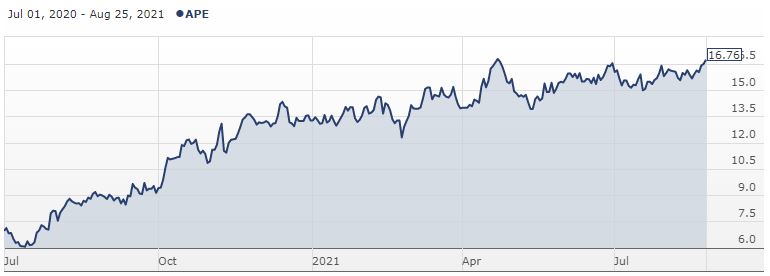
APE is a good example of this. In February and March 2020 there were on average four buy recommendations despite the share price languishing between $3/share and $4/share. Currently with the share price over $15/share the number of buy recommendations from sell side analysts has doubled to eight.
The important formula is to make sure you own the best managed company in the space, which has a strong balance sheet to take advantage of bargains at the lower end of the cycle - either through mergers and acquisitions or strategic investments. Going into COVID, the auto retailers were already going through recessionary conditions. There had been more than two years of negative industry new car sales and regulatory changes made it more difficult to generate commission from finance products.
In the middle of this, APE took advantage of its strong balance sheet and excellent management team to buy its biggest competitor AHG. We like this sort of move at the low end of a cycle, however, it is easier said than done. During the middle of COVID, APE fell below $3.00/share in March 2020. For our sins, we continued to buy all the way down. We got comfort from the strength in the management team, the strength of the balance sheet and the experience of the board. We felt that mid-cycle earnings for APE would be around $0.60/share conservatively, and hence we thought we were getting a good price at $3-$4/share.
The stock rallied hard over FY21 and finished the year at over $15/share. While we were happy that we kept our nerve when everything was looking bad and everyone was selling the stock, we also got a bit lucky. For a variety of reasons, there is a global shortage of microchips which are essential for new car manufacturing currently. This has stifled supply of new cars. At the same time, change in consumer behaviour has seen a big spike in demand for cars. This has resulted not only in car volumes bouncing back (something we thought would naturally occur as the cycle turned) but margins are at record highs (something we didn’t predict).
Iluka Resources (ASX:ILU)
The summary of our investment view was that we liked the supply side set up for both the zircon and high-grade chloride feedstock markets and that if demand were to start to rebound, the market would tighten up and pricing would follow. We also thought that there was optional upside with the company’s rare earths opportunity in its tailings deposit in Eneabba.
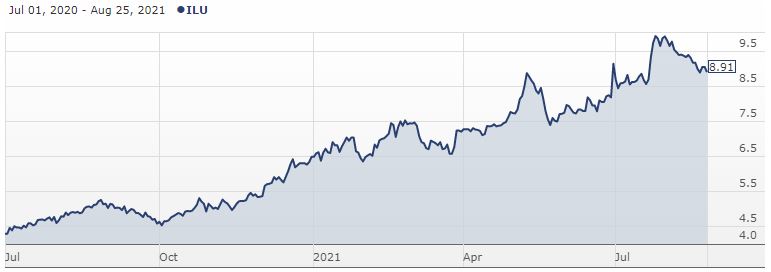
Since the beginning of November, the Iluka share price has rallied 73% and has been a large contributor to our performance. Already in 2021, contrary to market expectations, we are seeing this tightness lead to price increases. We expect the zircon market to remain in a structural deficit over the next few years and view the price increases as sustainable. The other major part of Iluka’s revenue stream is from titanium feedstocks (used to make pigment) and this market has also tightened significantly.
On the project side, we feel the market is only beginning to recognise the potential of Iluka’s Rare Earth assets. The major advancement during 1H21 was a letter from the Federal Government for funding support (non-recourse loan) for the construction of a REE refinery in Australia by Iluka as part of the Strategic Mineral Policy. Despite the very strong share price performance over the past ~6 months, we remain positive on the outlook for the business and continue to hold a significant position in the fund.
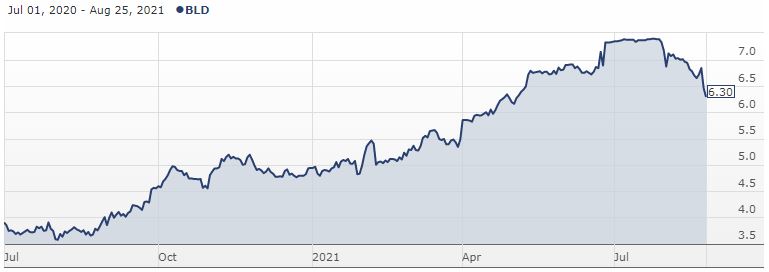
During March 2020, BLD’s share price fell from $4.50/share to a low of $1.80/share. The stock had been weak heading into this period due to underwhelming performance in the US business and a slowing cycle being compounded by increasing competition in the core Australian market. As markets fell materially on the initial COVID panic, the market became concerned about BLD’s balance sheet and the ability to withstand a long period of subdued operating conditions.
BLD’s NTA at the time was $2.10/share and we accumulated a decent position in the fund around this level. Our view was that even considering the COVID related uncertainty, the business was worth materially more than NTA and had significant optionality within its portfolio of assets. Our view was that the Australian business had sustainably delivered returns on funds employed of ~14% over the last decade and thus deserved to trade at a material premium to NTA. We see the Australian construction materials business as high quality with hard to replicate assets including its quarry base.
We also noted the investment the company had made in Australian quarries in recent years ($380m) which had yet to generate full returns. We felt the US business was also worth materially more than its NTA value. In terms of the balance sheet risk, we felt that the market was too focussed on the leverage ratio of the business in an environment where the earnings were depressed and overlooked the optionality the business had on the asset side of the balance sheet. In particular, BLD has a number of surplus property assets in Australia that we felt could have been sold to strengthen the balance sheet without impacting the earnings power of the business. Given this relative comfort and the view that the business was materially undervalued on a mid-cycle view and verse NTA, we continued buying on the weakness.
Over the last financial year, the optionality we saw within the BLD portfolio has played out. BLD sold its 50% share in the plasterboard JV for US$1.015b or 15x FY20 EBITDA. It has also sold its US building products business for US$2.15b and is currently exploring a sale of its North American Fly Ash business which could release another $US1b.
Post this sale, BLD will no longer have any operations in the US and will be left with just its Australian construction materials business which is the #1 in the Australian market. Seven Group (ASX:SVW) launched an off-market takeover for BLD at $7.40/share after initially buying a 10% position at $3.11/share in June last year. In our view, at this price the assets of the business are fairly valued and thus we have sold the position to SVW at $7.40/share.
Woolworths has been a great investment for us over the last five or so years. We started buying it in mid-to-late 2016 and have been holders to varying levels since that time. Our initial interest was aroused as the share price waned in light of the over-earning, complacent core supermarket business making an ill-fated venture into the hardware market through Masters, made possible by a weak management team and Board. The core grocery business still retained much that was good, but its high margins were not only unsustainable, they had also attracted competition from the likes of Aldi and Costco.
From our perspective, that changed with Board refreshment and appointment of the current management team. We looked favourably on the overall operating assets, balance sheet and turnaround strategy of the company. Initial strategic steps included selling out of Masters, replacing store roll out with upgrades to the existing supermarket store network and sacrificing short term margins for longer term sustainable growth. More generally, Woolworths under this new (current) leadership took short, medium- and long-term strategic decisions centred around resetting itself as a genuine value proposition to customers. This meant becoming increasingly sustainable and defendable over time through sound behavioural practices and solid investment across all aspects of business. Investment has been very substantial over the past five years and while never 100% without hitch, Woolworths is increasingly effective in presenting the most compelling customer offer in the marketplace.
Woolworths is now beginning to grow its overall and already market-leading food market share. Woolworths has a 50%+ market share in the online grocery market in Australia despite having only 37% market share in the traditional land-based grocery market.
We believe that as far as loyalty, digital, data, supply chain and store footprint, Woolworths is materially ahead of any of its national competitors. Just the Australian Woolworths food business has almost 13m active loyalty customers, 12.5m weekly visits to its app or online and almost $4bn annual online sales (growing up 92% in H1 21). The numbers are mindblowing.
The most interesting aspects for me are the customer loyalty and further aligned activities possible for Woolworths within a growing ecosystem of interconnected goods and services. Potentially future developments and innovation will further fortress the Woolworths core food operations with adjacent earnings and unlock the value that is inherent within this enormous customer database. Extensive infrastructure built out over time including important consumer protections, embedded behavioural practices and management accountability added to now incrementally growing scale is expected to offer increased leverage and earnings growth into the future.
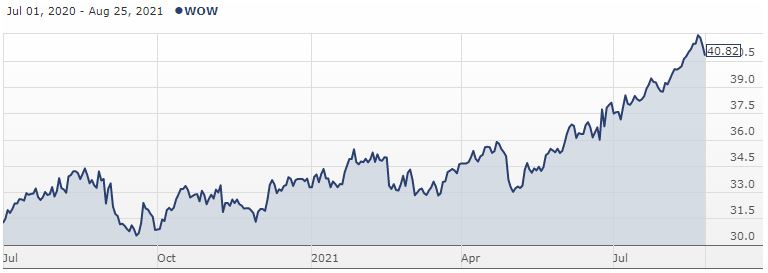
While this was the picture over several years, Woolworths was a detractor from relative performance over FY21 generating a return of 18.5%. That is a good annual return, however was a drag on relative performance given the market was up just under 30%.
Despite underperforming in FY21, the stock has performed strongly already in FY22 following the spin-off of the Endeavour Drinks division. While the share price may have gotten ahead of itself in the short term, we believe Woolworths has a good growth outlook which should be able to deliver earnings no matter what the macro environment supported by a stellar balance sheet.
Underweight (avoiding) CSL
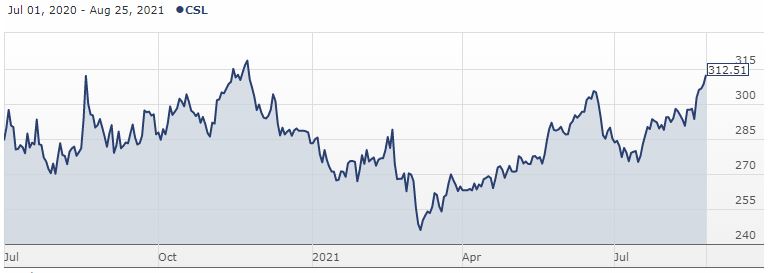
As a value manager, generating alpha from being maximum underweight a company like CSL Limited (ASX:CSL) when it underperforms should be a given. No value manager can look at you with a straight face and tell you that buying a specialist pharmaceutical company at 40x+ P/E (double its overseas equivalent companies) is a value investment.
We have been maximum underweight CSL as we are value managers and no matter what way we look at the valuation, we have and continue to believe that CSL is overvalued. Generating alpha from not owning CSL when it underperforms is pleasing given the alpha which it has detracted on the way up, however, this should be a given and hence we don’t take credit for that. As a fundamental value manager where we think we can add value is avoiding some stocks which cosmetically look cheap but are in fact value traps.
The fund was short or did not own AGL, AMP, Aurizon, Coles, Lend Lease, Cimic, Amcor, IAG and QBE for most of this year. These are all traditional value-style companies and all underperformed the market materially. We spent a lot of time analysing these companies and, for one reason or another, felt that while cosmetically cheap a lot of them were value traps.
Anthony Aboud is a Portfolio Manager at Perpetual Investments, a sponsor of Firstlinks. This article contains general information only and is not intended to provide you with financial advice or take into account your objectives, financial situation or needs. Stock charts are provided by Morningstar.
For more articles and papers from Perpetual, please click here. For information on the Perpetual funds that may invest in the stocks mentioned, click the following links: