Register For Our Mailing List

Register to receive our free weekly newsletter including editorials.

Home / 667

Inequality destabilises economies

Australia’s billionaires increased their wealth by $25.7 billion over the past year such that the 20 richest Australians now boast more wealth than the poorest three million households, says Oxfam Australia.
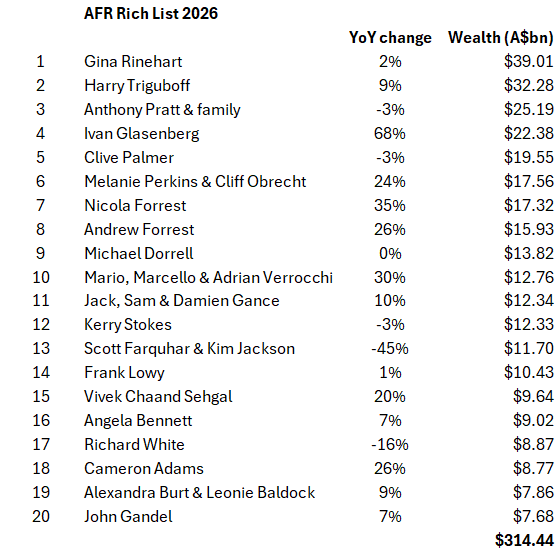

Source: The Australian Financial Review

In the US, Federal Reserve data shows the richest 1% of Americans owned a record 31.9% of US wealth at the end of 2025. Plutocrats, the richest 0.00001%, possessed an all-time high 12%, while the poorest 50% owned just 2.5%. The trillion-dollar floats tied to artificial intelligence will send more wealth towards the rich amid talk AI will create an underclass of displaced workers.

Still in the US, labour’s share of economic output this year has plunged to 51%, the lowest since records began in 1947, while the profit share sits near a record high of 12.1%. That’s because real wages have only grown 3% since 2019, while profits have soared 50%.

These statistics are just some of many that hark to the widening gap between the haves and have-nots in most developed and developing countries due to how free-market economic reforms in recent decades created a winner-take-more society.

The rich and skilled thrived as governments took decisions that allowed capital to dominate labour just as new technology and the globalisation it enabled eroded the bargaining power of the semi-skilled and unskilled. The highest marginal income-tax rates were slashed while taxes aimed at the rich such as those on capital gains and inheritances were reduced or abolished. Fighting inflation took priority over reducing unemployment. A push to maximise shareholder value reigned, while organised labour was defanged through regulation and outsourcing. Government assets were sold, often cheaply, and turned into private monopolies. Low, even negative, interest rates and central-bank purchases boosted asset prices, especially stocks and housing. The other side of the surge in asset prices is that to keep up much of the public became indebted, especially to educate and house themselves.

This all took place, of course, as living standards rose. So what’s the problem? It’s this. Inequality comes with political and economic risks that threaten future wealth creation.

One political risk stems from the associated feeling that everyone is out for themselves. This impression undermines the social cohesion that lubricates economies and societies. As people become more selfish and insecure, corruption flourishes, crime jumps, anti-social behaviours increase, labour unrest stirs and legal disputes tied to commerce rise.

A second political risk tied to inequality is that resentment against economic injustice nurtures an environment ripe for demagogues promoting populist politics that are economically damaging – note how surveys show the young in advanced countries are leaning socialist. Democracies across the Western world including Australia are prone to a political backlash that undermines economic efficiency whether the populists be left- or right-wing.

A third political risk is the concentration of economic power can undermine democracy because it gives the mega rich too much political power. As the wealthy – or the ‘Epstein class’ as the unaccountable elite are now known in the US – use their financial muscle to expand their economic interests (via, for instance, subsidies or anti-competitive protections around their assets), the core political institutions of society erode. Rule of law and connected property rights, liberties such as free speech, open debate and fair elections are among protections vulnerable if society tilts towards ‘wealthtocracy’.

The extreme case with these political risks is that people eventually react when they feel they no longer live in a fair society or one where they or their children have opportunities. Inequality combined with economic hardship can thus lead to labour unrest and upheavals that topple governments and change political systems. Rarely does such turmoil lead to prosperity.

A fourth problem linked to inequality is that unequal societies prove to be faulty and inefficient economies. When too much income and wealth streams to the top, the middle and lower classes are incapable of marshalling the purchasing power needed to fan sustainable economic growth. The lack of aggregate demand tied to the perennial inequality of Latin America has retarded these countries economically as well as politically. Federal Reserve officials have lately warned the loss of demand due to widening inequality increases the risk of a US downturn.

Rising inequality can thus force indebted governments to run larger fiscal deficits to keep the economy running, perhaps to the point (like now) where public debt poses a menace for financial stability.

Another way inequality undermines economic growth is that people don’t work as hard if they feel they are not rewarded properly. Another is that inequality directs economic activity towards acquiring government-sanctioned monopolies rather than innovation.

Politicians often talk about tackling inequality. Solutions proffered involve higher taxes on the rich and capital gains and the closing of tax loopholes that favour the wealthy. Governments promise to spend more on education, health, welfare payments and public works, especially in poorer areas. But that costs money indebted governments don’t have. Another category of remedies is to raise minimum wages, tilt employment laws towards labour and tighten anti-competitive regulations. But the first two reduce competitiveness and fan inflation while the third is often window-dressing.

While the end of easy money could cool asset markets and decrease inequality, the indebted will struggle under higher interest rates and any rise in joblessness would devastate these households. Less regulation might allow smaller businesses to rise and challenge Big Business. But vested interests are skilled at pressuring governments to impede capitalism’s inherent creative destruction.

The challenge for policymakers is to overcome how no easy solutions loom to tackle the economic and political damage wrought by inequality. But something needs to be done.

It should be noted that some argue that inequality measures would be less alarming if factors such as homeownership, taxes, transfers, pension entitlements and the way people move through income brackets across their lives are taken into account. Perhaps. It’s true that the masses are better off these days on GDP-per-capita measures. But people because don’t feel better off because they aren’t relatively better off.

Sometimes it seems like the only way inequality will be diffused as a political rallying cry is a crisis that destroys wealth, similar to how wars and depressions reduced inequality in for most of the 20th century.

A more optimistic view, however, would be that well-designed policies that promote shared prosperity would help economies and liberal democracies thrive too.


Michael Collins is a freelance writer and editor, economist, and investment specialist. Republished with permission from the author’s Substack newsletter @denouementwatch.


  •   17 June 2026
  • 21
  •      
  •   
21 Comments
Steve
June 20, 2026

I find this a very insightful article.

A ‘deserve’ argument for wealth is so often naive and selectively applied. Arguments that billionaires / trillionaires ‘deserve’ their wealth ignore that:
(1) Property rights exist only because the state enforces them. We can’t accept state authority to enforce our property while rejecting its authority to tax or regulate fairly.
(2) Much of financial success depends on luck and circumstance—timing, where you were born, access to education, family background—factors beyond individual control (see Morgan Housel’s The Psychology of Money, Chapter 2: “Luck and Risk”).
(3) If we’re applying ‘deserved reward’ logic consistently, it must include the essential unpaid, underpaid / eploited labour
(4) Billionaires increasingly shape media and politics—owning outlets, funding campaigns, influencing public discourse. If we accept that everyone pursues self-interest, this concentration of power becomes an argument for well-designed policies that constrain that self-interest. Underregulated self-interest leads to rent-seeking, regulatory capture, and democratic capture by the wealthy—not shared prosperity.
Well-designed policies promoting shared prosperity don’t punish wealth—they strengthen the social contract upon which that wealth accumulates, and enable economies and democracies to thrive into the future.


5
Hiker
June 21, 2026

I think you have missed the main point. The inequality lies in the wealth CREATION.

Steven
June 21, 2026

I think you missed or misunderstood my points. Wealth creation depends upon and is only possible within the social contract.

It cuts both ways, and luck has much to do with wealth creation than anything else.

1
JanH
June 19, 2026

Gina Rinehart inherited some of her wealth from her father. She has made pots of money from iron ore. Although she has paid royalties and taxes, the Australian people have little to show for that wealth. Besides taxpayers are subsidising her Nolan’s rare earth refinery. Yet she has 39 biillon dollars of her own. Why does she need taxpayer subsidies? Taxpayers should not be subsidising such contentious projects when the money should go to health, education and helping our homeless and poor.

10
Albert
June 20, 2026

Gina Reinhart is the best argument for an inheritance tax ever made.

8
john
June 20, 2026

Agree 100%

5
James#
June 21, 2026

"Although she has paid royalties and taxes, the Australian people have little to show for that wealth"

Gina employs a lot of people, give her some credit. Also, through Hancock Prospecting and her private foundations, directs significant philanthropic support to veterans (including $200 million to purchase properties to provide emergency accommodation for homeless veterans), elite sports, medical research, and education.

Ever wondered why America's economy and productivity far exceed ours? A highly flexible labor market (much less union interference), continuous technological innovation, a deep venture capital ecosystem, and structural advantages like strong intellectual property protections. Entrepreneurship is encouraged and success praised and desired to be emulated, not denigrated and envied!

Capital is mobile ,as are the truly wealthy, we want more of them not less!

3
Steven
June 21, 2026

I find this a very insightful article. Arguments that billionaires ‘deserve’ their wealth or pay their fair share of taxes ignore that: (1) Property rights exist only because the state enforces them. We can’t accept state authority to enforce our property while rejecting its authority to tax or regulate extreme wealth (2) Much of financial success depends on luck and circumstance—timing, where you were born, access to education, family background—factors beyond individual control (see Morgan Housel’s The Psychology of Money, Chapter 2: “Luck and Risk”). (3) If we’re applying ‘deserved reward’ logic consistently, it must include carers and essential workers whose unpaid and underpaid labour sustains society. (4) Billionaires increasingly shape media and politics—owning outlets & so ial media, funding campaigns all to influence public discourse. If we accept that everyone pursues self-interest, this concentration of power becomes an argument for well-designed policies that constrain that self-interest. Unregulated self-interest leads to rent-seeking, regulatory capture, and democratic capture by the wealthy—not shared prosperity.

Well-designed policies promoting shared prosperity don’t punish wealth—they strengthen the social contract and enable economies and democracies to thrive. The ‘deserve’ argument is too often selectively applied to wealth, not work.

3
FRANCESCO
June 21, 2026

where does it say that we are subsidising her Nolans Refinery ................ Gina has shares in the company just like you or i can have in Arafura Resources which is the Nolans project in Alice Springs and the Federal Govt. has also bought in on the Project so they are also shareholders not subsidising Gina

Nadal
June 18, 2026

Michael, I think you will find that these billionaires have a work ethic / entrepreneurial spirit which leaves those in the lowest decile for dust. They are winners not whingers (lifters not leaners), in my mind. Those special ingredients have them well-rewarded.

9
Greg
June 19, 2026

Another article that criticises “the rich” but at the same time ignores the fact that these people risked their own money and future to create a new business ( along with the many thousands of jobs for Australians). Give it up, would you prefer that we have a society where more people have a hand out?

8
Dudley
June 20, 2026


"Why does she need taxpayer subsidies?":

She doesn't, the country and allies need to subsidise to make cost of product competitive with the subsidies, smaller costs, larger resource and greater skill of Chinese producers so that Chinese government can not block supply.

Someone has to earn the money else no money for "health, education and helping our homeless and poor".

6
Rick
June 21, 2026

I don’t feel the article is criticising the rich. It’s not personal, it’s discussing how our society and country could do better. Comments above suggesting that anyone who is poor is probably just not trying hard enough don’t really help the discussion. That fact that certain countries have very high levels of poverty does not mean it’s full of “wingers and leaners”. The article is simply suggesting there are structural problems that lead to gross wealth inequality and discusses the detriment this has on a society as a whole. Broad based tax reform with some political bipartisanship is badly needed. However attempts to introduce anything is met with cry’s of disaster predominantly from political opponents and is undermined by those who have the most power and influence. Any political party in opposition seems to take its position literally and simply opposes any reforms introduced by the government taking the rusted on voters with them. The GST should be increased with all members of society contributing according to their level consumption. Progressive marginal tax rates are fine but we need to get rid of the complexity in the tax system and the minimisation vehicles that flourishes because of it. The addition tax captured would enable a reduction in personal tax rates for all and incentivise hard work. If nothing changes society may eventually have to deal with revolting peasants!

3
David
June 22, 2026

"If you are 20 and are not a socialist you haven't got a heart. If you are 30 and are not a capitalist, you haven't got a brain!"
On another note, I have never seen a convincing arguement that Elon Musk getting richer necessarily makes others poorer. Any takers?

2
Rick
June 22, 2026

The article is not persecuting the rich. I say the more millionaires the better. The article I read is stating the economic fact that if wealth is over concentrated at the top, aggregate demand in the economy is reduced. One person or family worth 20 billion will generate much less demand in the economy than 2,000 people or families each worth 10 million.
There are structural problems that need addressing. Marginal tax rates were established for a purpose however there are too many flat tax rate structures, and others, that blatantly allow avoidance of the appropriate tax payable and the higher one's income is, the greater the benefit from those structures. If you are on a low marginal tax rate, then these structures have no value at all begging the question of who created them and continually supports their existence.

2
Wildcat
June 21, 2026

Where does the employment come from, where does the tax paid come from? Persecute the so called "rich" and they will just leave.

"people because don’t feel better off because they aren’t relatively better off", yes they have security, education and free health care but "relatively" they are poorer. Isn't this just envy?

Where it's not working is:
1. Young ppl can't afford a home = governments fault - immigration and building restrictions and charges
2. Young ppl are screwed by the tax system = governments fault
3. Retirement benefits too generous = = governments fault - too many grey voters
4. Education seems to be more about ideology than learning objectively = governments fault
5. Productivity is failing = governments fault, too much red/green tape and non market (govt) employee numbers have sky rocketed.
6. Interest rates too high = governments fault (unemployment hasn't risen as too many new public servants hence inflation stays high) and RBA can't cut. Secondly government spending (NDIS etc) massively too high also fueling inflation.

The last thing that's more of an issue in the US than here is political influence. This I would like to see curbed/controlled against the billionaires.

Before we start after the very people that provide real productive employment and pay the VAST majority of the taxes we need to think about the source of ALL of our major problems. Inept governments.

Secondly unless anyone counted, if we taxed the entire list 100% of their wealth, we'd have $11,321 per person. What then 5 minutes after that money has gone? This is 35% of just ONE years federal budget, not incl states, territories and councils.

Taxing your way to prosperity is like standing in a bucket and trying to pick it up by the handle. Winston Churchill.

1
Jack Boot
June 23, 2026

Taxing extreme wealth is not persecution though, is it? I really don't understand this oddly sympathetic defence of billionaires, as if they are suffering some awful plight. They are doing just fine and will still be outrageously rich after paying a bit more tax. The idea that they will leave is a fallacy as well. Rich New Yorkers whined about higher taxes 20 years ago and threatened to leave, but they didn't because they were still rich post-tax and loved living in NY. Where were they going to move, anyway? Additionally, the idea of these billionaires "creating employment" is a just a perspective - an equally valid view is that they exploited workers to make their fortune. No one will ever convince me that Gina or Elon started businesses because they wanted to find work for the masses - the workers have only ever been instruments in their lust for money and power. As others have already proclaimed, the US having a trillionaire now is not something to celebrate, it is a sign of a broken society.

Margaret Gillett
June 18, 2026

All of these Billionaires ( perhaps not Harry) do not realise that if the average person cannot afford housing and education - they will have no workers, no renters and no consumers. I think By the sounds of it some of the emerging political movements in Australia will copy Putin and claim all the assets of the Billionaires to pay for nuclear reactors and the high wages needed to attract foreign nuclear scientists required to run them. Interesting and scary times.

Timeisnow
June 18, 2026

Natural resources such as air and water are collectively owned by all. It is inherently illogical for such resources to be privately owned. Air, for example, is naturally occurring, necessary for life and invented by no one – and thus no one has a greater claim to owning air than anyone else. It is ridiculous to say that someone should have to pay to breathe air.

This logic is applied to another natural resource – land – one of the four factors of production. ‘Land’ in this sense refers not only to real estate but to all the resources that come from the Earth: coal, oil, metal ores, timber, crops and so on. Why do we consider it normal for people to own land, when land – like air – is naturally occurring, necessary for life and entirely uninvented? And why do we consider it normal for the owners of land to extract economic rent from those who wish to use that land? In essence, why do we not treat land as something collectively owned by all?

The paradox of income tax: society does not have the right to tax the income of other people, as that income was generated solely by them through their labour and hard work. Labour is not a part of the commons, and is not a natural resource that should be collectively owned by all.

All forms of income tax should therefore be abolished. Instead, society should introduce a single Land Value Tax (LVT), paid by those who own land. Landlords would pay the LVT as a form of dues to society, to compensate the public for its exclusion from their land. Specifically, we should tax the unimproved value of the land, i.e. without considering the value of man-made improvements such as houses or buildings. Society only has the right to claim the natural resources of the land, not what is built on it, as the latter is the product of someone else’s labour.

This theory was also intertwined with the belief in wealth redistribution and social justice. He argued that, after the government had secured enough revenue to fund its operations, the remainder of the money raised from the LVT should be redistributed equally to all members of society. He called this a citizen’s dividend – a way of ensuring that all citizens could benefit from the land they collectively own. Nowadays this idea, known as Universal Basic Income (UBI) is coming back into fashion, as it is a form of social security that inherently benefits the less wealthy more. This is because the UBI represents a higher proportion of the income of the less well-off compared to the wealthy.

Indeed, one of the main selling points of the single LVT is that it is inherently progressive (i.e. the rich pay more than the poor). With income tax, progressivity has to be artificially engineered, usually by creating tax bands with higher rates for higher earners. But with the LVT only landowners – typically those who are already better-off – have to pay tax. At the same time, workers get to keep the full value of their own labour. [Henry George and the Land Value Tax - edited excerpt]

Margie
June 22, 2026

Excellent article. We all need to think more about these issues.
We need to remember the causes of the French Revolution and the Russian Revolution--Inequality. Aristocrats with most of the wealth and masses of poor. If inequality keeps on, we can expect the same.


Leave a Comment:

banner

Most viewed in recent weeks

Noel Whittaker’s take on the budget

Marketed as a fix for inequality and housing affordability, the latest budget instead delivers a tangle of tax changes that leave everyday Australians worse off.

Australia has no death duties. Technically.

Australia may not levy formal death duties, but a growing web of tax measures is quietly shaping what wealth passes between generations. Now, the 2026 budget adds another layer.

Welcome to Firstlinks Edition 662 with weekend update

The debate over the budget is increasingly shaped by frustration and perceptions of unfairness, rather than clear-eyed assessment of policy outcomes.

How to minimise tax with a will

Inheritance tax implications in Australia may surprise some, as poor estate planning without proper wills or trusts can lead to costly tax bills and delays for beneficiaries.

Testamentary trusts post-budget: Estate planning, tax reform and the ‘death tax’ debate

Proposed Budget changes to taxation are casting new uncertainty over testamentary trusts, prompting closer scrutiny of estate planning structures and the real implications of reforms still taking shape.

Back to the future - Why indexing CGT is a good idea

A return to indexation of capital gains would be a fairer way to compensate households for the effects of inflation than the current discount. Importantly, it opens the door to future, broader reforms to stop the taxation of inflation.

Latest Updates

Investment strategies

Choose your hedges wisely… and often

A new market regime is exposing the fragility of static hedges. With correlations shifting and safe havens flipping, investors must rethink diversification and adopt more adaptive tools to protect capital.

Investment strategies

Yields take centre stage again

The Australian credit landscape is shifting. Yields are rising, issuance is strong and spreads continue to tighten. Income is re‑emerging as the dominant driver of returns, though pockets of risk may be building beneath the surface.

Investment strategies

The grass is always greener: Rethinking Australian vs global equities

Australia's once‑dominant sharemarket is losing ground as others surge ahead, prompting investors to question home‑bias instincts. Meanwhile, the US market appears attractive. Is it time to revisit your global equity allocation?

Investment strategies

Stop asking if there's a stock market bubble. Ask this instead.

Markets continue to push onwards despite valuations looking stretched by historical standards. Bubble talk is rampant, however investors may be focusing on the wrong thing. The real story sits deeper than the headlines.

Taxation

The GST cannot stop inflation

Raising the GST when inflation jumps sounds clever on paper, until we examine how it may play out in practice. What is pitched as a simple inflation fix can lead to a sharp turn in the wrong direction for prices.

Shares

Why SpaceX is coming to your super fund

SpaceX’s blockbuster debut is grabbing headlines, but the real story for Australian investors is much quieter. Giant listings eventually filter into super funds and ETFs, subtly reshaping portfolios long before most realise.

Taxation

Is the government being honest with us about its business CGT changes?

The government’s assurances on small‑business concessions don’t withstand the scrutiny. Token carve‑outs and a lack of credible rationale for CGT changes may reshape how Australia rewards long‑term value creation. 

Sponsors

Alliances

© 2026 Morningstar, Inc. All rights reserved.

Disclaimer
The data, research and opinions provided here are for information purposes; are not an offer to buy or sell a security; and are not warranted to be correct, complete or accurate. Morningstar, its affiliates, and third-party content providers are not responsible for any investment decisions, damages or losses resulting from, or related to, the data and analyses or their use. To the extent any content is general advice, it has been prepared for clients of Morningstar Australasia Pty Ltd (ABN: 95 090 665 544, AFSL: 240892), without reference to your financial objectives, situation or needs. For more information refer to our Financial Services Guide. You should consider the advice in light of these matters and if applicable, the relevant Product Disclosure Statement before making any decision to invest. Past performance does not necessarily indicate a financial product’s future performance. To obtain advice tailored to your situation, contact a professional financial adviser. Articles are current as at date of publication.
This website contains information and opinions provided by third parties. Inclusion of this information does not necessarily represent Morningstar’s positions, strategies or opinions and should not be considered an endorsement by Morningstar.