Register For Our Mailing List

Register to receive our free weekly newsletter including editorials.

Home / 247

Labor's new franking policy is unfair to LICs

The Labor Party needs to articulate how it will treat shareholders in Listed Investment Companies (LICs) fairly under their proposal to deny refunds for excess franking credits.

The current system of taxation of dividends ensures that Australian resident shareholders are taxed at their applicable rate of income tax on dividends received from companies, rather than a minimum of the company tax rate. Denying refunds for excess franking credits will require complex changes to legislation to maintain the existing policy of allowing shareholders in LICs to effectively receive the CGT discount on capital gains earned by the LIC.

When a LIC earns a capital gain it pays income tax on the capital gain at the corporate tax rate, typically 30%. When it pays the capital gain to the shareholder as a LIC dividend, the shareholder is taxed on the dividend and franking credit in the usual way, but also receives a tax deduction that represents the CGT discount the shareholder would receive if they derived the gain directly or received it from a trust.

Below is the analysis showing the calculations for an investor (super fund or High Net Wealth Individual) investing in a LIC or either directly in shares or via a trust.

Calculation of tax payable on a $10,000 capital gain by:

  • Super fund in accumulation phase invested in an LIC (Super-LIC)
  • Super fund in accumulation phase invested in a trust or direct shares (Super-Trust)
  • High net worth individual (HNWI-Trust)
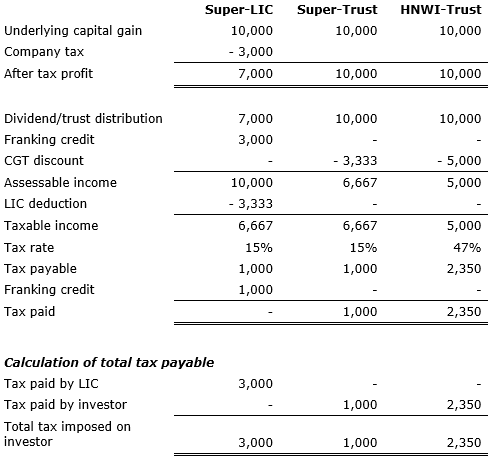
Currently, they receive a refund of the excess tax paid by the LIC above their tax rate after the tax deduction for the CGT discount. Denying the refund of excess franking credits results in the shareholder paying 30% tax on the dividend. This is a 27% higher rate of tax on a capital gain than is paid by someone on the top marginal rate of tax. This means a super fund will pay at least three times that rate of tax on a capital gain distributed by a LIC when compared to a capital gain it earns itself or via a trust and 27% more tax than an individual on the highest rate of tax.

(That is, a HNWI pays $2,350 on a $10,000 capital gain. A super fund in accumulation phase pays $3,000 on a capital gain earned by a LIC. The difference is $650 divided by the tax paid by the HNWI of $2,350 gives 27% more tax payable by the super fund).

Given that a large percentage of investors in LICs are super funds and that many investors in LICs are not wealthy, this is an inequitable result that will need to be addressed.


Howard Badger is a Partner in Tax Consulting at Pitcher Partners. This article is general information that does not consider the circumstances of any individual.


  •   5 April 2018
  • 5
  •      
  •   
5 Comments
Frankie
April 06, 2018

Another unintended consequence for the new policy to fix.

Don McLennan
April 08, 2018

Shorten's original plan was to only allow Franking Credits to used to pay tax.
Bill quickly changed so now SMSF in the pension phase are about the only sector to be hit by
this measure.
Most members of a SMSF in the pension phase with a balance below $1.6m could lose their "credits". In my case i will lose 20% of my income. In fact i would be better off paying the 15% tax which those in the accumulation phase
Most high wealth individuals that Labor aims to target probably have over $3m in "super".
As an adviser i would advise them to reduce their holdings of companies paying fully franked dividends in their $1.6 section Holding these in their section paying 15% tax
Many will be able to use all their franking credits in this section
So it seems that some of the middle class who have saved hard & are now self funded retirees will be the group mostly hit.

D Ramsay
April 12, 2018

Well said.
Additionally why doesn't the Labour party be honest and only go after the ones they really want - namely the folks in SMSF's that have >$1.6M in super and put in a means test that exempts those that are below the above threshold from losing their franking credits.
I believe the figures are such that 97% of folks receiving franking credits are on annual taxable incomes of <$87K.
Labour discourages people from being self funded in retirement.

Daryl Wilson (Affluence Funds)
April 09, 2018

Listed Investment Trusts such as recent IPO Magellan Global Trust (MGG) are a much better structure than an LIC. A LIT pays no tax, just passes on any taxable income (plus any franking credits received) to the end investor in the same way as an unlisted managed fund.

This is a much more efficient system and avoids the situation described above. In addition, it means any discounted capital gains can also be passed directly through - in our experience very few LICs actually state the capital gain portion of dividends and thus investors get very little advantage from the tax deduction.

Michael Newman
April 13, 2018

So why did Costello change it from Keating's original purpose and at what cost to revenue since and how did it work before the changes?


Leave a Comment:

RELATED ARTICLES

The missing 30%: how LIC returns are understated, and why it matters

Why LICs may be close to bottoming

The fascinating battle between Nick Bolton and Magellan

banner

Most viewed in recent weeks

Want your loved ones to inherit your super? You can’t afford to skip this one step

One in five Australians die before retirement and most have not set up their super properly so their loved ones can benefit from all their hard work and savings. 

Super is catching up, but ageing is a triple-threat

An ageing Australia is shifting the superannuation system’s focus from accumulation to the lifecycle of retirement. While these pressures have been anticipated for decades, they are now converging at scale and driving widespread industry change.

Has Australia wasted the last 30 years?

The 20 years after Peter Costello left Treasury have been deemed wasted...by Peter Costello. The missed opportunities for Australia began long before.  

The 5% deposit scheme is bad for homeowners and Australia

An ‘affordability’ scheme making the county more vulnerable to economic shocks and contributing to the deteriorating financial situation of everyday Australians.

3 ways to defuse intergenerational anger

With the upcoming budget increasingly likely to include bold proposals to alter the tax code I’ve outlined three incremental steps with fewer unintended consequences.

Navigating the next stage of life in retirement

Retirement planning is more than just saving enough money. Long-term care needs, housing choices, and social networks are just as critical for a happy and enjoyable life.

Latest Updates

Superannuation

Indexation implications – key changes to 2026/27 super thresholds

Stay on top of the latest changes to superannuation rates and thresholds for 2026, including increases to transfer balance cap, concessional contributions cap, and non-concessional contributions cap.

Economy

Central banks need higher inflation targets

In a shift away from solely targeting low inflation, central banks are considering raising inflation targets to combat economic challenges, but face potential drawbacks and conflicts in policy implementation.

Exchange traded products

The missing 30%: how LIC returns are understated, and why it matters

The perceived underperformance of LICs compared to ETFs is due to existing comparison data excluding crucial information, highlighting the need for proper assessment and transparent reporting.

Latest from Morningstar

Alpha isn’t dead. You’ve just been measuring it wrong

New research shows smarter portfolio construction—not new factors—is the real edge in the hunt for alpha. However, finding it requires a fundamentally different mindset.

Investment strategies

The diversification illusion: why 'balanced' portfolios may be exposed

Many 'diversified' portfolios are increasingly driven by the same narrow set of forces. As concentration builds beneath the surface, understanding how portfolios behave - not just how they’re constructed - is critical for investors.

Investment strategies

The case for staying the course in credit

Current market volatility is likened to Lenin's quote on rapid change. Rising oil prices and interest rates impact bond and corporate yields, with a potential economic downturn ahead. Maintaining interest rate duration is advised.

Investment strategies

One risk after another

Investors often focus on front-of-mind risks, reacting to each headline event without considering long-term impacts. Cass Sunstein and Timur Kuran define this as an "availability cascade," affecting financial decision-making.

Sponsors

Alliances

© 2026 Morningstar, Inc. All rights reserved.

Disclaimer
The data, research and opinions provided here are for information purposes; are not an offer to buy or sell a security; and are not warranted to be correct, complete or accurate. Morningstar, its affiliates, and third-party content providers are not responsible for any investment decisions, damages or losses resulting from, or related to, the data and analyses or their use. To the extent any content is general advice, it has been prepared for clients of Morningstar Australasia Pty Ltd (ABN: 95 090 665 544, AFSL: 240892), without reference to your financial objectives, situation or needs. For more information refer to our Financial Services Guide. You should consider the advice in light of these matters and if applicable, the relevant Product Disclosure Statement before making any decision to invest. Past performance does not necessarily indicate a financial product’s future performance. To obtain advice tailored to your situation, contact a professional financial adviser. Articles are current as at date of publication.
This website contains information and opinions provided by third parties. Inclusion of this information does not necessarily represent Morningstar’s positions, strategies or opinions and should not be considered an endorsement by Morningstar.