Register For Our Mailing List

Register to receive our free weekly newsletter including editorials.

Home / 651

Levered credit: A late cycle ingredient for drawdown pain

In 2025, with credit spreads normalising, and in some segments moving below long-term averages, a number of yield hungry credit investors responded by adding risk to meet investment objectives. The approach taken to sustain portfolio yields of 6%+ varied from increasing credit risk, interest/spread duration and/or leverage.

While mostly still at manageable levels, increased debt funding of credit securities is nonetheless a throwback to the heady pre-GFC (Global Financial Crisis) era where synthetic and physical leverage was more commonplace. Indeed, we are now also hearing of less sustainable practices once again creeping into the credit investment lexicon.

From our discussions in the marketplace towards the tail-end of 2025, the use of leverage is principally occurring through the use of repurchase agreements (repo) of eligible collateral up to an eye watering 15-times for AAA rated securities, as well as via placement of senior secured leverage to enhance portfolio yields in both private and public credit portfolios.

New levered investment products that have recently entered the market offer a floating rate running yield from a portfolio likely comprised of major bank T2 hybrids (T2s) and investment grade (IG) corporate bonds. Products such as these typically seek to enhance yield by deploying 3-3.5-times leverage.

Leverage enhances yields and amplifies performance (both positively and negatively) from changes in spreads and any impairments/defaults. Working off current pricing, an IG portfolio yielding ~5.0-5.5% p.a. with ~3-times leverage moves what is an already enhanced yield into a yield in the 7%+ range (refer Chart 1).
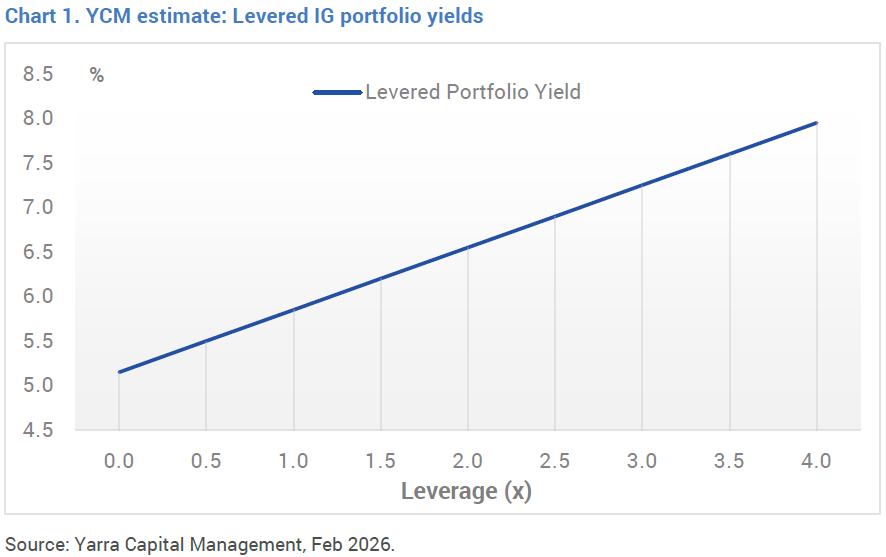
The use of leverage to enhance returns can work very effectively in environments of stable or contracting credit spreads. It is a double-edged sword, however, with the combination of widening credit spreads and leverage usually resulting in significant drawdowns.

For instance, working off an estimated credit spread duration of ~5 years, a widening spread environment would quickly overwhelm underlying yields, with a ~100bp spread expansion on 3-times leverage generating a negative total return in the range of 10-15% from what is an underlying low risk IG credit portfolio (refer Chart 2).
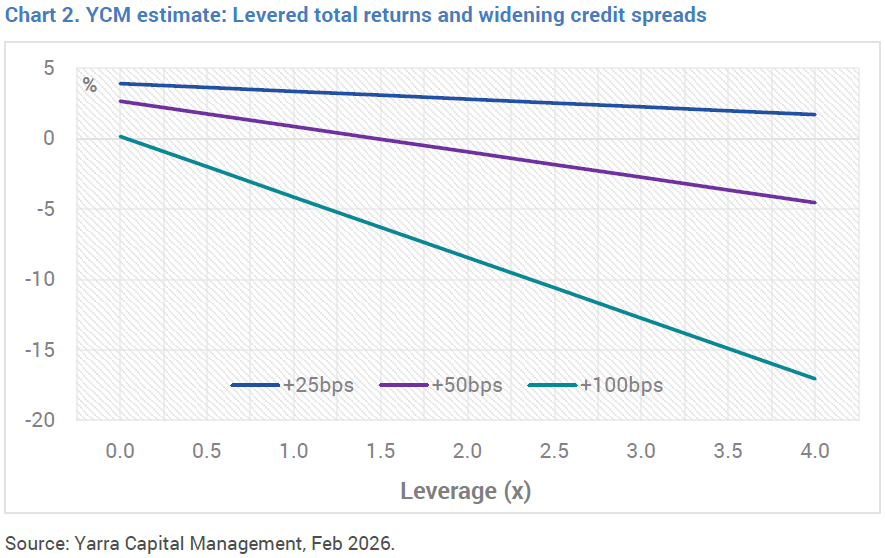
Given fixed income investors generally have a low tolerance for negative returns over a 12-month period, the use of significant leverage to enhance returns could be somewhat of a dubious exercise, especially when you consider today’s starting point. As evidenced by major bank T2s, credit spreads have performed over the last 2-3 years and now sit around their long-term averages across most segments of Australian credit and significantly below the previous peak in 2022 (refer Chart 3).
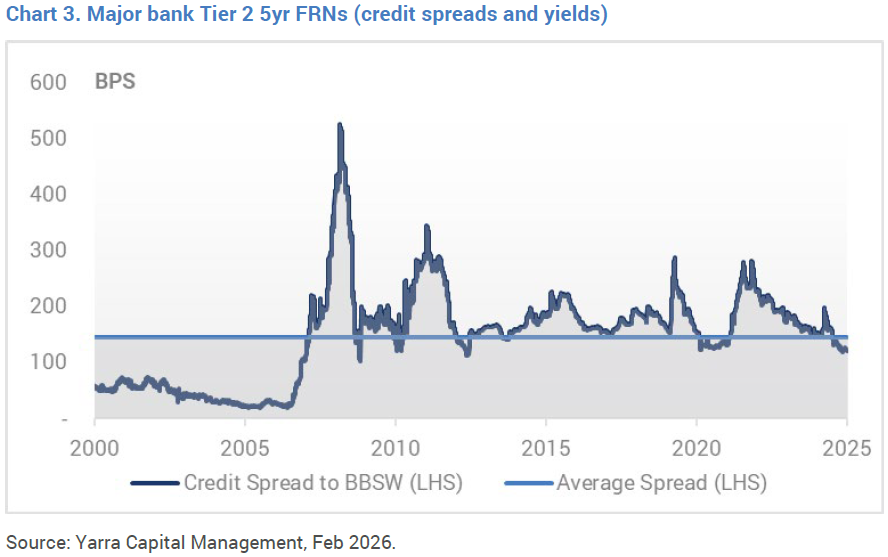
At current spread levels, the probability of a +/-100bp move is weighted to the positive and in the current macroeconomic environment is entirely possible over the near to medium term. In such an event, which can occur two to three times each decade, the prospect of equity like drawdowns from levered credit funds should give credit investors pause for thought.

Put more simply, credit investors in these levered structures should be thinking hard about whether they are comfortable taking what is effectively equity drawdown risk for a miserly 1-2% in additional yield. We would suggest that this represents incredibly poor compensation for the risk assumed at this point in the cycle.

In contrast to levered credit funds, there are some credit funds still providing attractive 6%+ yields with precisely zero leverage. Moreover, while it is true that a 100bps widening in credit spreads would lead to value diminution for such funds, high unlevered yields combined with active management generally protect against negative returns over any 12-month period. We do not believe the same can be said of most levered credit funds.


Phil Strano is Head of Australian Credit Research at Yarra Capital Management, a sponsor of Firstlinks. This article contains general financial information only. It has been prepared without taking into account your personal objectives, financial situation or particular needs. Both the Yarra Enhanced Income and Higher Income Funds are zero leverage funds, providing attractive yields.

For more articles and papers from Yarra Capital, please click here.


  •   25 February 2026
  •      
  •   


Leave a Comment:

RELATED ARTICLES

AI’s debt binge draws European telco parallels

Australia’s moment? De-dollarisation gains momentum

Where to find value in a multi-asset portfolio

banner

Most viewed in recent weeks

How cutting the CGT discount could help rebalance housing market

A more rational taxation system that supports home ownership but discourages asset speculation could provide greater financial support to first home buyers.

Is there a better way to reform the CGT discount?

The capital gains tax discount is under review, but debate should go beyond its size. Its original purpose, design flaws and distortions suggest Australia could adopt a better, more targeted approach.

Want your loved ones to inherit your super? You can’t afford to skip this one step

One in five Australians die before retirement and most have not set up their super properly so their loved ones can benefit from all their hard work and savings. 

Super is catching up, but ageing is a triple-threat

An ageing Australia is shifting the superannuation system’s focus from accumulation to the lifecycle of retirement. While these pressures have been anticipated for decades, they are now converging at scale and driving widespread industry change.

Meg on SMSFs: Last word on Div 296 for a while

The best way to deal with the incoming Division 296 tax on superannuation is likely doing nothing. Earnings will be taxed regardless of where the money sits, so here are some important considerations.

Has Australia wasted the last 30 years?

The 20 years after Peter Costello left Treasury have been deemed wasted...by Peter Costello. The missed opportunities for Australia began long before.  

Latest Updates

Taxation

3 ways to defuse intergenerational anger

With the upcoming budget increasingly likely to include bold proposals to alter the tax code I’ve outlined three incremental steps with fewer unintended consequences.

Economy

Why an extended US-Iran war will punish mortgage holders

The impact of the Iran War is far more than expensive petrol. Higher oil prices have secondary inflationary impacts that reverberate throughout the economy which could be bad news for Australians with mortgages.

Infrastructure

Don’t forget the yield

Global Listed Infrastructure dividends are forecast to grow 5-6% p.a over the next two years. After a hiatus, share buybacks are back on the agenda and will play an integral role in shareholder returns.

Iran war hands politicians free ticket to blame oil prices for inflation

Past oil shocks offer lessons for investors dealing with the fallout from the Iran War and the ongoing impact on inflation.

Economy

Japan 2026: A new PM heralds a new golden age?

Former Australian Prime Minister, Paul Keating, once said "When you change the government, you change the country." We're about to see whether that holds true in Japan.

Investment strategies

Why are central banks moving from US Treasuries to gold?

Central banks now hold more gold reserves than US Treasuries, signalling a shift in safe-haven asset strategy and portfolio diversification as geopolitical risks increase.

Strategy

Has global human wellbeing peaked? What the data reveals

Historically economic progress is measured by GDP growth but there is an increasing body of work that explores quantitative measures of wellbeing.

Sponsors

Alliances

© 2026 Morningstar, Inc. All rights reserved.

Disclaimer
The data, research and opinions provided here are for information purposes; are not an offer to buy or sell a security; and are not warranted to be correct, complete or accurate. Morningstar, its affiliates, and third-party content providers are not responsible for any investment decisions, damages or losses resulting from, or related to, the data and analyses or their use. To the extent any content is general advice, it has been prepared for clients of Morningstar Australasia Pty Ltd (ABN: 95 090 665 544, AFSL: 240892), without reference to your financial objectives, situation or needs. For more information refer to our Financial Services Guide. You should consider the advice in light of these matters and if applicable, the relevant Product Disclosure Statement before making any decision to invest. Past performance does not necessarily indicate a financial product’s future performance. To obtain advice tailored to your situation, contact a professional financial adviser. Articles are current as at date of publication.
This website contains information and opinions provided by third parties. Inclusion of this information does not necessarily represent Morningstar’s positions, strategies or opinions and should not be considered an endorsement by Morningstar.