Register For Our Mailing List

Register to receive our free weekly newsletter including editorials.

Home / 26

Once in a lifetime returns from US shares

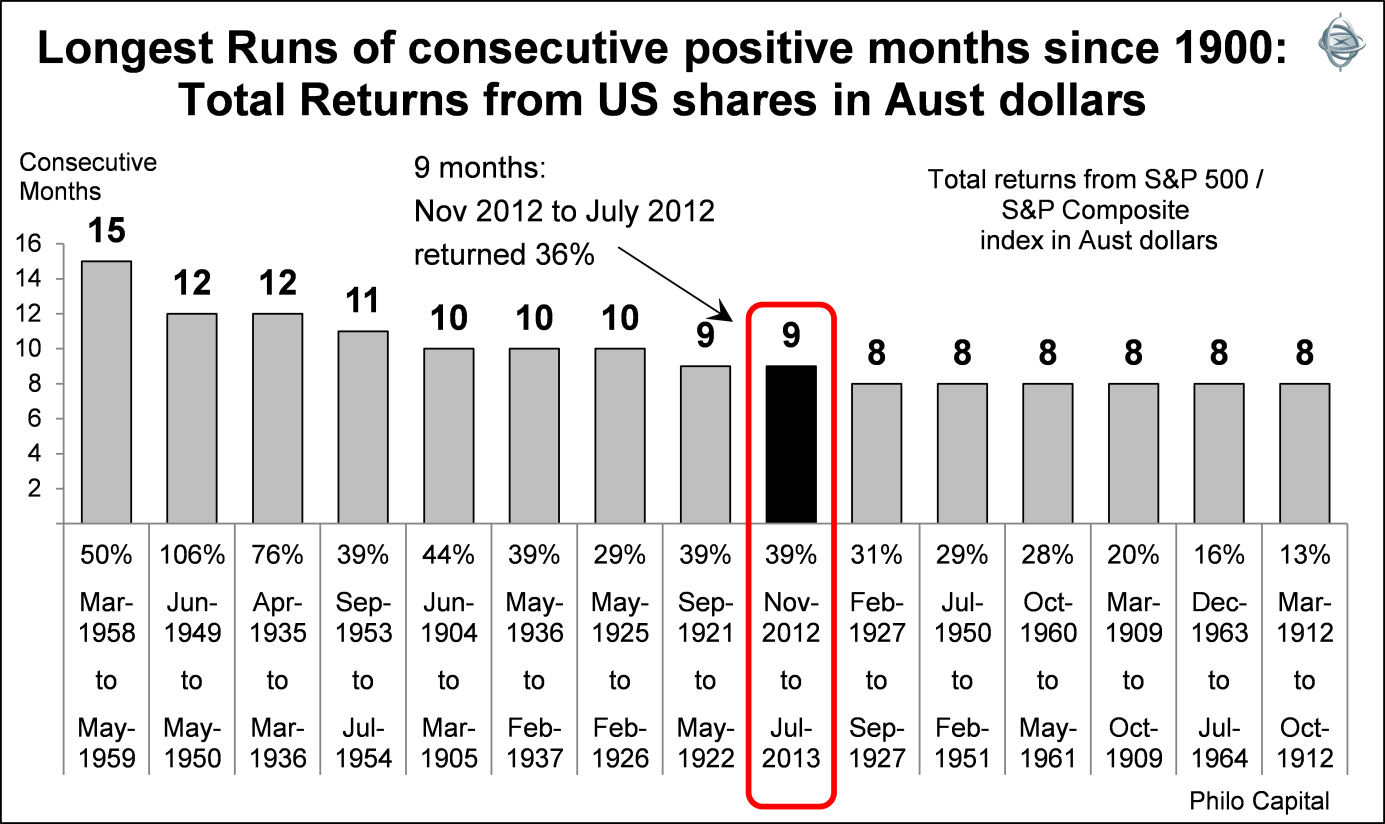
Investors look for high returns as well as consistency. That is what the US stock market has delivered this year for Australian investors. The S&P500 index has generated positive total returns in Australian dollars for nine consecutive months from November last year to July 2013.

This run of 9 positive months makes it into the list of top 10 longest runs of positive returns from US shares in Australian dollars since 1900. It has been the longest positive run since 1958-59, which ran for a record 15 months. There have been only three positive runs longer than 8 months since WW2 but they were all before I was born (just!), so I never saw them.

Not only has the US market returned 39% in Australian dollars over the past 9 months, volatility has not been lower since the mid-2000s. It has been the best run of consistent, high returns in my lifetime. So much for the so-called ‘high volatility, low return, new normal!’

This does not imply that the run will continue of course, but it does show the value of ignoring the media hype and focusing on the facts.

The currency effect helped the performance. The Australian dollar fell by a total of 13% against the US dollar during the period, including declines in six of those nine months – in December, February, April, May, June and July. This currency effect greatly assisted in keeping the returns positive for Australian investors, especially when the US market fell in US dollar terms during the great Bernanke ‘QE-taper’ scare in May and June. Australian investors in US shares sailed through the crisis because the falls in US share prices were more than offset by falls in the Aussie dollar, leaving un-hedged Aussie investors ahead.

Contrary to popular myth, this foreign exchange component of investing in foreign shares actually lowers portfolio volatility and helps smooth returns for Australian investors in un-hedged foreign shares.
 

  •   8 August 2013
  •      
  •   


Leave a Comment:

RELATED ARTICLES

How will stocks fare with a smaller US government?

How much will you risk to feel comfortable?

Residential investment property fails simple valuation test

banner

Most viewed in recent weeks

2 billion reasons to fix retirement income

A proposal to address Australia's 'stranded balances' in retirement by requiring super funds to transition members to pension phase at 65, boosting retirement income and reframing super as a source of income.

The ultimate superannuation EOFY checklist 2026

Here is a checklist of 28 important issues you should address before June 30 to ensure your SMSF or other super fund is in order and that you are making the most of the strategies available.

Do super funds need a massive wake up call?

UK retirement expert, Guy Opperman, believes super funds are failing at supporting members in deaccumulation. Here is what Australia should do about it. 

Two months into retirement

A retirement researcher's take on retirement and her focus on each of her six resource buckets to stay engaged during the transition and beyond.

Welcome to Firstlinks Edition 662 with weekend update

The debate over the budget is increasingly shaped by frustration and perceptions of unfairness, rather than clear-eyed assessment of policy outcomes.

Reforming the taxation of wealth and wealth transfers

As the budget approaches debate continues about the need and method for addressing wealth inequality. Could reinstating wealth transfer taxes be the answer?

Latest Updates

Back to the future - Why indexing CGT is a good idea

A return to indexation of capital gains would be a fairer way to compensate households for the effects of inflation than the current discount. Importantly, it opens the door to future, broader reforms to stop the taxation of inflation.

Australia has no death duties. Technically.

Australia may not levy formal death duties, but a growing web of tax measures is quietly shaping what wealth passes between generations. Now, the 2026 budget adds another layer.

Strategy

The folly of the Iran war

From oil shocks to fractured alliances, the Iran war carries the hallmarks of a historic policy misstep - one that could tip an already fragile global economy into crisis.

Taxation

Noel Whittaker’s take on the budget

Marketed as a fix for inequality and housing affordability, the latest budget instead delivers a tangle of tax changes that leave everyday Australians worse off.

Investment strategies

The red metal's long game

Copper has had a rough few weeks but investors should not ignore the potential for future price increases as supply increasingly falls behind demand.

Taxation

The lesser-known effects of changed property taxes

The budget’s property tax reforms are being framed as fairness measures, but they risk splitting the housing market, penalising lower‑income investors and introducing distortions that may prove costly.

Latest from Morningstar

Why stocks sometimes fall for no obvious reason

The vast and opaque world of private assets is a powerful gravitational force - and when trouble hits, it's the more liquid public equities that often the feel it first.

Sponsors

Alliances

© 2026 Morningstar, Inc. All rights reserved.

Disclaimer
The data, research and opinions provided here are for information purposes; are not an offer to buy or sell a security; and are not warranted to be correct, complete or accurate. Morningstar, its affiliates, and third-party content providers are not responsible for any investment decisions, damages or losses resulting from, or related to, the data and analyses or their use. To the extent any content is general advice, it has been prepared for clients of Morningstar Australasia Pty Ltd (ABN: 95 090 665 544, AFSL: 240892), without reference to your financial objectives, situation or needs. For more information refer to our Financial Services Guide. You should consider the advice in light of these matters and if applicable, the relevant Product Disclosure Statement before making any decision to invest. Past performance does not necessarily indicate a financial product’s future performance. To obtain advice tailored to your situation, contact a professional financial adviser. Articles are current as at date of publication.
This website contains information and opinions provided by third parties. Inclusion of this information does not necessarily represent Morningstar’s positions, strategies or opinions and should not be considered an endorsement by Morningstar.