Register For Our Mailing List

Register to receive our free weekly newsletter including editorials.

Home / 646

The long-term case for compounders

In brief

  • Market booms often lure investors into cyclical businesses, but history shows these cycles can be short-lived and expose investors to severe drawdowns and difficult recovery math.
  • Compounders tend to deliver steadier, more durable profit growth across full cycles, making them better suited for long-term investors.
  • Selectivity is especially important given the unique, negative economies of scale of some AI businesses.

In the heat of a market boom, the siren song of cyclical businesses can be almost impossible for investors to ignore. Whether it was the credit-fueled surge of the mid-2000s, the post-lockdown commodity spike, or the current frenzy surrounding hardware-heavy technology cycles, the narrative is always the same: this time, the scale is different.

History is filled with 'must-own' stories that were cycles in disguise. In the 1720s, it was the South Sea Company, where investors rushed to own a global trade monopoly, only to see their capital evaporate when profits failed to meet expectations. A century later, railways were going to change the world — and they did. However, excess competition and overcapacity wiped out the investors who funded them.

The lesson history teaches us is that cycle booms are finite. While the 'up cycle' provides the dopamine hit of outperformance, it’s the full cycle that determines total return on capital.

This informs why we at MFS structurally lean away from 'cyclicals' and towards 'compounders'. To put this into greater context as we head into 2026 and navigate the heat of a technology “up cycle,” we offer a hypothetical look at the hard math of losses during a full cycle.

A tale of two P&Ls

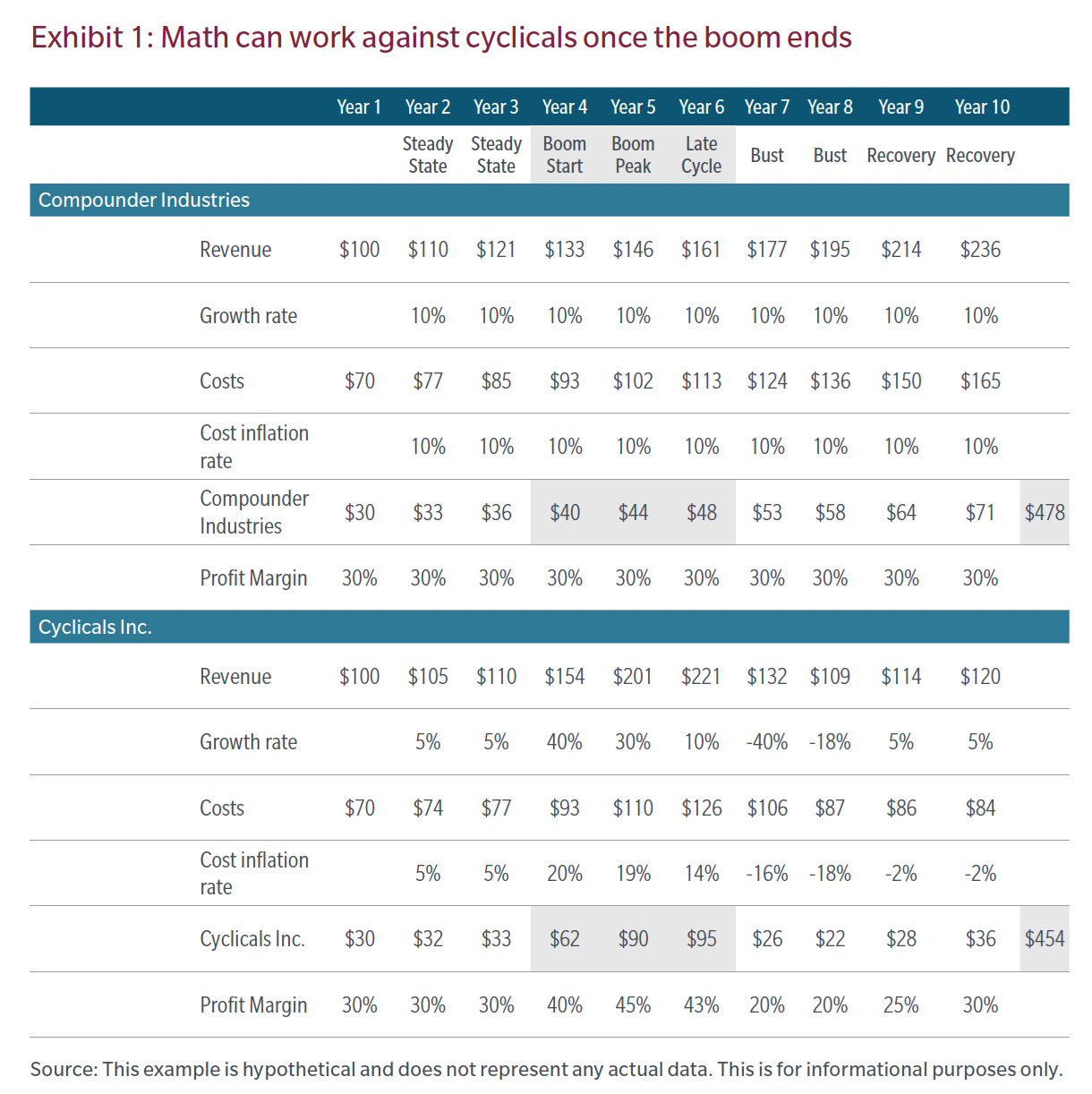
Consider a hypothetical 10-year window involving two businesses: Compounder Industries and Cyclicals Incorporated. 

As shown in Exhibit 1, both start at the same place: $100 million in revenue and a healthy 30% profit margin. For the first few years, Compounder Industries raises revenue and costs at a steady 10% clip, maintaining its margin. It follows the mantra of “build it once, sell it a bunch,” utilizing high operating leverage and differentiated products to generate consistent profits.

Then comes the 'boom'. A new technology or economic shift emerges, directly benefiting Cyclicals Inc. Revenues explode by 40%. Investors, captivated by the sudden margin expansion to 45%, rotate out of shares of Compounder Industries and into Cyclicals Inc. For the next three years, Cyclicals Inc.’s margins and profits materially outpace the market. 
The asymmetry of the bust

By Year 7, the cycle peaks as new competition saturates the market with supply. Cyclical Inc.’s sales fall by 40%. Despite aggressive cost-cutting and layoffs, profit margins are halved. 

Though this scenario is hypothetical, the assumptions are rooted in history and designed to expose the mathematical trap that investors often overlook: to recover from a 40% drop in revenue and return to its Year-6 peak, Cyclicals Inc. doesn’t just need a 'good' year — it needs to grow by 67% in a single year just to get back to even. That is an enormous hurdle that Compounder Industries never has to face.

The full-cycle experience

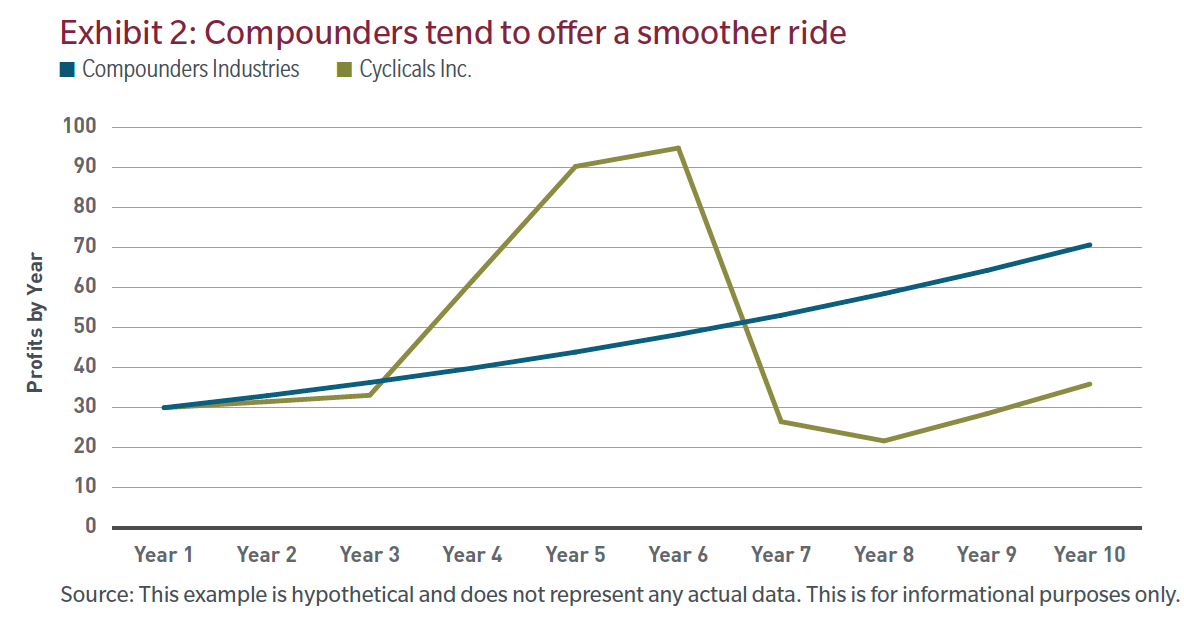
So, while both companies reach approximately the same total profits of just over $450 billion, their pathways are different. Compounder Industries’ annual returns were almost double and with less volatility, as illustrated below.
Conclusion

In recent years, we’ve seen a massive rotation into companies tethered to product cycles — specifically technology hardware driven by AI. Some of today’s AI models operate with negative economies of scale: every query triggers expensive compute costs that exceed revenue. This is the antithesis of the Internet 2.0 era, in which network effects created monopolies with historic profit growth. We believe these changed fundamentals warrant selective, rather than broad-based, exposure to today’s technology businesses. 

'Quality' is a term used so often in this industry that it has lost its teeth. At its core, quality isn’t about a label; it’s about the ability to avoid the 'math of the bust'.

We favor companies that we think can compound earnings through differentiated products and scalable structures. While the compounder might be a laggard during a boom, like today, they are often the ones delivering better financial outcomes for the patient, long-term investor who possesses a deep, fundamental framework.


Robert M. Almeida is a Global Investment Strategist and Portfolio Manager at MFS Investment Management. This article is for general informational purposes only and should not be considered investment advice or a recommendation to invest in any security or to adopt any investment strategy. It has been prepared without taking into account any personal objectives, financial situation or needs of any specific person. Comments, opinions and analysis are rendered as of the date given and may change without notice due to market conditions and other factors. This article is issued in Australia by MFS International Australia Pty Ltd (ABN 68 607 579 537, AFSL 485343), a sponsor of Firstlinks.

For more articles and papers from MFS, please click here.

Unless otherwise indicated, logos and product and service names are trademarks of MFS® and its affiliates and may be registered in certain countries.


  •   21 January 2026
  • 4
  •      
  •   
4 Comments
Kevin
January 23, 2026

There's no point in explaining compounding,it will never register with people .They would much rather hear about the stupidity of time machines and what about the Japanese market.

Buffett's letter of 1992 or 1993 is a good explainer for compounding,it gives the reasons behind the purchase of Coke and why it is such a good compounder. A $40 share that fell 50% in the first year,yet with dividends reinvested by 1992 or 93 you had just over $2 million worth of coke shares.

At the time he was very happy buying shoe businesses,Dexter and a few others,then dancing in to work singing "there's no business like shoe business". I wonder if the owners that got shares in BRK in exchange for Dexter had the patience to wait and do nothing for decades,or did their children destroy it thinking,time machines and the Japanese market,there's investing genius for you.

I think Wrigley's gum is mentioned in that one,an excellent compounder.When I sent off for their investor pack in the late 1990s they gave you their full history in the excellent pack they posted back to you. A full history of profit,dividends paid out etc. A table of what happened if you bought 1 share and left it alone and just collected the dividends,or what happened if you reinvested the dividends. The first 20 years or so it looked as if nothing happened,but you don't know what wages in the US were at the time. Then suddenly,don't stand in front of that snowball,it will kill you if it hits you. Gillette got a mention as one of his wonderful compounders that he expected would create so much for shareholders.

Proctor and Gamble now own Gillette ,P + G of course have been an excellent compounder for 140 years or so,something like increasing their dividends every year for 65 or 70 years. Mars own Wrigley,if Mars is ever floated that could be a very interesting company to look at.

2
Dudley
January 23, 2026


Without a time machine, future rates of compounding are unknowable / unrealised.
Without records of Japanese market and the like, past rates are unknowable.

How to calculate rate of compounding:
= (ValueAtTime2 / ValueAtTime1) ^ (1 / (Time2Year - Time1Year)) - 1

Nikkei 225 Total Return index:
= (97727.20 / 11683.40) ^ (1 / (2026.060 - 2012.016)) - 1
= 16.3% / y

3
Kevin
January 25, 2026

Couldn't resist the laugh.That book I read 30 years ago , The dividend rich investor ( Standard and Poor's ).Checked it on Amazon,it was only printed once in 1996,so it would probably come into the library system here in 1997.So not far short of 30 years ago. Amazon have it listed as Standard and Poo's .

The septics call them dividend kings,increased dividends every year for at least 50 years. Coke have paid a dividend every year since 1920,and increased that dividend every year for the last 63 years ( source KO investor relations ). So we have the dividend kings and the stupidity kings.Which path to choose?

Sit on your arse doing nothing for 105 years and just collect all that cash across the generations,or reinvest it across various periods of time . That's just not complicated enough so it couldn't be true.

That $40 share ( or $20 share if you caught a falling knife ) after splits is now just over 9,000 shares. Call it 9,000 shares @ $73 each . So 9 X $73 and move the decimal point over. That couldn't be right,it needs a bit of the greek alphabet and more brackets than you can poke a stick at. Investing has to be made as complicated as possible.

I'll have a ride into the state library on Tuesday and see if they have in the stack,I would doubt it though .

1
Dudley
January 26, 2026


"doing nothing for 105 years":

But not before buying a 1920 Saint-Gaudens $20 Double Eagle gold coin, taking the time machine to 1921, buying a share at the smallest price
Then either:
. grow old managing the share splits and dividends and taxes, or,
. return to the present on the time machine stopping off on the way to collect share splits and dividends and paying taxes when due.

'After going public in 1919 at $40 per share, the stock dropped significantly in 1920-1921 due to post-WWI economic issues, including a sharp rise in sugar prices.'
In 1921, Coca-Cola (KO) shares trading at a low of $19.
'By the end of the 1920s bull market, the share price had recovered and was trading at $140.'


Leave a Comment:

RELATED ARTICLES

Blue skies for consumers, caution for investors

banner

Most viewed in recent weeks

Ray Dalio on 2025’s real story, Trump, and what’s next

The renowned investor says 2025’s real story wasn’t AI or US stocks but the shift away from American assets and a collapse in the value of money. And he outlines how to best position portfolios for what’s ahead.

Making sense of record high markets as the world catches fire

The post-World War Two economic system is unravelling, leading to huge shifts in currency, bond and commodity markets, yet stocks seem oblivious to the chaos. This looks to history as a guide for what’s next.

3 ways to fix Australia’s affordability crisis

Our cost-of-living pressures go beyond the RBA: surging house prices, excessive migration, and expanding government programs, including the NDIS, are fuelling inflation, demanding bold, structural solutions.

Is there a better way to reform the CGT discount?

The capital gains tax discount is under review, but debate should go beyond its size. Its original purpose, design flaws and distortions suggest Australia could adopt a better, more targeted approach.

How cutting the CGT discount could help rebalance housing market

A more rational taxation system that supports home ownership but discourages asset speculation could provide greater financial support to first home buyers.

Welcome to Firstlinks Edition 648 with weekend update

This is my last edition as Editor of Firstlinks. I’m moving onto a new role though the newsletter will remain in good hands until my permanent replacement is found.

  • 5 February 2026

Latest Updates

Property

The 5% deposit scheme is bad for homeowners and Australia

An ‘affordability’ scheme making the county more vulnerable to economic shocks and contributing to the deteriorating financial situation of everyday Australians.

Investment strategies

Is defensive the new offensive?

Relatively boring, unglamorous, defensive stocks like Kroger and Allstate have quietly outperformed gilded tech giants, offering steady growth, visibility, and resilient returns in a market captivated by AI and flashier industries.

Shares

How the RBA scores on its inflation goal

The Reserve Bank continues to face criticism from all sides. A reminder of the RBA's mandate and a review of their track record in maintaining price stability since the early 1990s.

Investment strategies

Levered credit: A late cycle ingredient for drawdown pain

As credit spreads normalised through 2025, yield‑hungry investors have turned to leverage for high returns, uncomfortably echoing pre‑GFC behaviours. Investors need to be careful to understand the true risk‑return trade‑off.

Planning

The more things change… longevity just goes on increasing

Australia needs a major shift in longevity awareness, attitudes and behaviour if, as a community, we are to reap the benefits of increasing longevity. Adopting a national strategy is well overdue.

Property

The improving outlook of Australian commercial real estate

The sector is positioned to benefit from defensive and resilient income streams supported by embedded rental increase opportunities. 

Property

Seize hidden opportunities among 50+ home buyer schemes in Australia

There is a laundry list of government schemes to help Australian's struggling with housing affordability. Savvy buyers should take advantage to break into the property market.

Sponsors

Alliances

© 2026 Morningstar, Inc. All rights reserved.

Disclaimer
The data, research and opinions provided here are for information purposes; are not an offer to buy or sell a security; and are not warranted to be correct, complete or accurate. Morningstar, its affiliates, and third-party content providers are not responsible for any investment decisions, damages or losses resulting from, or related to, the data and analyses or their use. To the extent any content is general advice, it has been prepared for clients of Morningstar Australasia Pty Ltd (ABN: 95 090 665 544, AFSL: 240892), without reference to your financial objectives, situation or needs. For more information refer to our Financial Services Guide. You should consider the advice in light of these matters and if applicable, the relevant Product Disclosure Statement before making any decision to invest. Past performance does not necessarily indicate a financial product’s future performance. To obtain advice tailored to your situation, contact a professional financial adviser. Articles are current as at date of publication.
This website contains information and opinions provided by third parties. Inclusion of this information does not necessarily represent Morningstar’s positions, strategies or opinions and should not be considered an endorsement by Morningstar.