Register For Our Mailing List

Register to receive our free weekly newsletter including editorials.

Home / 653

The overlooked driver of energy inflation

While economists increasingly identify public spending as a major driver of inflation in Australia, the impact of energy policy and the renewables transition is a significant yet under analysed source of inflation.

The cost of energy flows through to the cost structure of the whole economy. Elevated energy costs inflate unit labour costs and weigh on productivity growth. This causes supply constraints to be reached sooner with relatively modest economic growth, which lowers the economy’s inflation tolerance. Government spending compounds the problem, sustaining demand close to those constraints, making disinflation more difficult and requiring interest rates to remain higher for longer.

Energy is central to the productivity-inflation equation

Reliability is core to any electricity system, and in order to maintain it when a growing share of energy generation is intermittent, there are two broad paths that can be taken.

One is ’substitution’, where intermittent generation, together with dedicated firming, replaces firm generation one-for-one. The other is ‘duplication’[1], where some existing firm generation must remain for reliability, with intermittent generation layered on top.

And the crux of the problem in Australia is not that we are in an energy transition phase, but that firm capacity in coal is exiting without adequate replacement. Duplication occurs to compensate.

Further planned exits are delayed, gas backup is added, transmission networks expand, storage is added through short-duration batteries, the grid requires stabilisation[2], and demand response may be required in periods of high energy demand. Clearly this is not substitution, it is stretching the system. Layers are added, much of which only runs some of the time and is therefore unproductive and costly. More capital is required to meet the same energy demands.

Electricity prices must therefore rise under a path of duplication, to reflect higher total system costs. And when energy is more expensive, business invests less in technology, and research and development, meaning fewer efficiency gains, rising unit labour costs, and slower productivity growth.

Like persistent public sector spending, duplication crowds out private sector activity by absorbing scarce capital and capability. It not only saps productivity within the energy system, but lowers productivity and inflation tolerance across the entire economy.

A ‘substitution’ path on the other hand, swaps out exiting firm capacity in coal, for combined renewables plus dedicated firm replacement such as nuclear, hydro, or gas. The key is that capacity is replaced and not accumulated. Replacement is orderly and well sequenced such that reliability is in place before the original generator exits. Temporary duplication will be necessary until full replacement is operational, unlike a duplication path where supplementary infrastructure comes into the system permanently, with the original firming never fully replaced.

Even under a substitution pathway, the addition of renewables requires investment in transmission and grid stabilisation, but these costs are bounded by bringing firm capacity into the system. Whereas under duplication, over-building is usually required to fill the firming void such that costs can be limitless. Substitution replaces capacity, while duplication accumulates it.

The path Australia is on is not an explicit choice. While pursuing a renewables-only agenda with backup and storage, we also seek to shut down coal as soon as possible, exclude nuclear energy, and constrain domestic gas supply. Such barriers make duplication unavoidable.

Coal is exiting primarily because it is targeted politically and ideologically. It is also ageing and virtually uninvestable under current frameworks and policies. Shutting down plants early scraps productive capital that is largely depreciated, to be replaced with new capital that must earn a full rate of return and still requires backup and firming. Meanwhile, coal-fired power is efficient and reliable, with low marginal operating costs.

Excluding nuclear energy from the mix matters significantly because it substitutes coal directly. It is ‘firm’, meaning it is guaranteed to be available to the grid 24/7, and it has a high-capacity factor of up around 90% (ratio of actual energy output to maximum potential output). It would greatly reduce system duplication. Australia’s objection to nuclear removes a long-term substitution option and effectively locks in long-term system layering.

Finally, gas could be the saviour. It is able to be built quickly (comparatively), is highly scalable (can be expanded with less constraints), can complement renewables effectively by being able to be ramped up or down rapidly, and would lower capital duplication. But restricting it domestically means we end up exporting gas cheaply and importing it expensively, which raises costs and electricity prices. And that’s very unproductive.

These barriers explain why duplication is not shrinking in Australia, but instead, is becoming permanent. It is a system laden with defensive investment to underpin weather-dependent energy, instead of productive investment that lowers the cost of delivering firm energy.

Figure 1: Australian electricity generation fuel mix
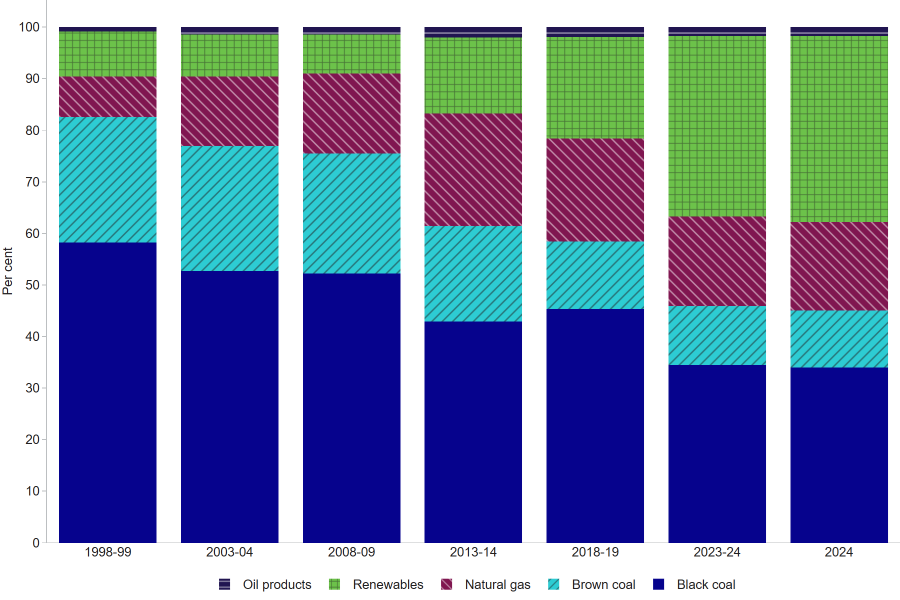
Source: Department of Climate Change, Energy, the Environment and Water (DCCEEW) (2025) Australian Energy Statistics, Table O

In the end, consumers buy firm, reliable, deliverable electricity, not generated electricity. They pay for the system that makes that energy useable. While renewable energy generation may be cheap, total system costs keep prices elevated. Which is why the “renewables are cheap” mantra is misleading.

If structural inflation is to be avoided in Australia, energy policy must target productivity and not just emissions reduction. Success should not be measured in terms of emissions reduced or megawatts installed. Rather, the focus should be on reliability per unit of capital, cost per unit of energy, and energy efficiency, because these are the measures that will define productivity, and ultimately inflation.


[1] In a previous article, I referred to ‘energy addition’ as new capacity required to meet higher energy demand, such as that arising from AI data centres, electrification, and population growth. Not to be confused with ‘energy duplication’, which as described here refers to the extra system layers required to maintain reliability as intermittent energy sources replace firm supply. The two go hand in hand in meeting energy demand, but where ‘addition’ is about the quantity of energy, ‘duplication’ is about the quality and reliability of energy.

[2] Stabilising the grid is a layer that is often overlooked. Our electricity system is an alternating current (AC) network operating at 50 Hz, historically stabilised naturally by coal, gas, and hydro generators. That inherent system stability is progressively lost with an increasing share of renewables generation, requiring conversion and synchronisation, which adds complexity and cost to the system.


Tony Dillon is a freelance writer and former actuary. This article is general information and does not consider the circumstances of any investor.


  •   11 March 2026
  • 9
  •      
  •   
9 Comments
Grant Allison
March 18, 2026

Excellent article that explains the true facts from someone who has done their homework.
I believe the general public highly value these articles as we are tired of seeing our energy bills going up and up to only hear from the Labour party that renewable is the cheapest option.
Great work,

4
john
March 13, 2026

Off topic but still very relevant
In regard to electricity and productivity. This issue is also worth debate and is just a fact.

The power retailers are ‘rent seekers’ who are basically ‘clipping the ticket’. Overall, thousands of personnel who do nothing to ‘get power to the door’. Such as; marketing, sales forces, advertising, large call centres, trading, tactical analysis, directors, CEOs, managements, administrations, I.T. depts, purchasing, personnel depts, safety, legal depts., multiple new plush CBD city offices. Having to 'lawyer up'. These ongoing costs are added to the actual flow from the generators to the user. Multiply the number of retailers by their internal departments. The costs are 'mind-blowing'. Many repetitions add enormous costs for the users with no added practical value.

A good idea to reduce electricity bills. Just do generation and transmission. Maybe redeploy staff into extra transmission for renewables.

Also I have seen householders' power bills where there is an extraordinary markup between the miniscule amount retailers pay per kwh in solar feed-in tariffs compared to what they charge the same people in the opposite direction. I know some that are receiving only 3 cents kwh feed in. Looks like the largest markup in the history of mankind

6
Jim Bonham
March 12, 2026

"Coal is exiting primarily because it is targeted politically and ideologically." You must be joking!

"Finally, gas could be the saviour". Another joke?

It is just ludicrous to pretend that continued atmospheric emission of carbon dioxide, methane etc has no financial or social consequences.

3
Tony Dillon
March 12, 2026

Hi Jim, your comment is a fairly common one in energy debates, reframing the argument as if the article denies climate consequences, when it is actually about policy design and economic trade-offs.

The article doesn’t dismiss the consequences of emissions but instead puts Australian energy policy in a global context. Climate change is global, and the effectiveness of national policy should be assessed not only against emissions targets but also as to whether it supports an efficient and reliable energy system, and whether it imposes large economic costs without materially affecting global emissions.

When it comes to coal, deliberate economic irrationality in policy making does suggest an element of ideology as a driver. Positions such as rapid decarbonisation should be prioritised at any cost, that fossil fuels should be phased out as a matter of principle, and that certain technologies such as nuclear are unacceptable regardless of economics, places beliefs and ideals before commonsense.

And when it comes to gas, its flexibility as a low emissions energy source is without doubt. And in fact, many mainstream energy transition models actually include gas as a transition fuel, so my point there is hardly radical. Cheers

8
Jim Bonham
March 12, 2026

Hi Tony,
Thanks for the article, it's an important topic.

I am not trying to reframe the argument. But it is important that the primary driver to exit coal is neither politics nor ideology. They are both consequences of the understanding that continued atmospheric pollution from fossil fuel use will have very significant environmental, social and economic costs.

Glossing over this point, as the first sentence I quoted does, invites misinterpretation and will lead some to think the whole exercise is pointless. Incorporating some discussion (however imprecise) of the costs we are trying to avoid would add context and enhance, rather than reframe, the argument.

Fossil fuels are essentially addictive, because they are easy to use and well established. That applies in spades to natural gas (even if it does generate less carbon dioxide per MWH then coal, it's hardly clean). So, there is a real danger that too much reliance on gas as a transition fuel will simply entrench it, thus perpetuating the problem it is supposed to help cure.


3
Tony Dillon
March 13, 2026

Hi Jim, thanks for the comments. You’re right, it’s an important topic and healthy debate is essential to influencing better policy outcomes.

You can’t escape politics and ideology because governments will respond to voter sentiment, activist groups, electoral cycles, and beliefs and ideals. An emissions reduction objective will ensure these forces will always be present in energy policy. The question is, what weighting is given to emissions reduction against the competing objectives of energy affordability and reliability?

Energy policy is interesting because the electorate would overwhelmingly agree that these are all worthwhile objectives. But where opinion differs and debate occurs is around the weight that each of these objectives should carry when setting policy. My article argues that excessive weight is given to emissions reduction, particularly when considered in a global context, which explains why we are exiting reliable and affordable systems before we have adequate replacement ready to go. Which is why we are heading down a path of energy ‘duplication’, and which is unfavourable economically and reliability wise compared to a path of genuine energy ‘substitution’. Cheers

7
Gavin Hewitt
March 12, 2026

Groups such as the UN, DCCEEW, Climate Change Authority, etc are operating on the science of increased carbon based climate change acting as a "risk multiplier," with projected global GDP reductions ranging from 0.7% to 2.5%. And that the cost of inaction is that later adaption costs, once climate impacts are far worse, will be significantlly higher. So while you may have some valid points about the methodology of our renewables roll-out, to suggest we don't move ahead because of a short term (relatively) minor cost to electricity, I don't agree with.
These energy time of day issues are already spurring investment into better mass battery and energy smoothing technologies. Short term higher electricity costs (while we get the new infrastructure up and running) should also be seen as a price signal to move electricity use to cheaper times of the day and use electricity more efficiently. The old days of burning brown coal with no thought of the wider global impact are behind us.
In my opinion anyway :-)

2
Steven Jackson
March 12, 2026

Has legislation been adopted that outlaws gas and coal power generation?? Would you Tony invest in a new coal fired power station with return on investment in the future somewhere possibly? You have used brown field cost price analysis to suggest coal is cheaper than renewables and not researchers greenfield pricing, I believe you are being disingenuous or showing extreme bias in doing this then you use an even worse example of nuclear which first is only being successfully built by untouchable terrorist (sic) countries like Russia and China. If constructed by high profit Western accepable(sic) countries the completion date is unsure if at all and price is prohibitive, hence kwh prices would rise steeply for consumers.
Also something you did not take account of is tge desire for renewables by home owners or retail consumer and large scale industries who are not building their own power stations but renewable generation.
China has the world's lowest kwh price for power and it uses renewables extensively alongside nuclear and coal due to it size which allows for such a mix. If our own minuscule system were to build a large reactor then the existing renewable would have to be shut down or prohibited to make the reactor a financial success.
I look forward to being corrected in any assumptions I have made from people specialist to the particular.

2
 

Leave a Comment:

RELATED ARTICLES

Why an extended US-Iran war will punish mortgage holders

Energy policy must prioritise the economy

Where Australia is an energy outlier

banner

Most viewed in recent weeks

How cutting the CGT discount could help rebalance housing market

A more rational taxation system that supports home ownership but discourages asset speculation could provide greater financial support to first home buyers.

Want your loved ones to inherit your super? You can’t afford to skip this one step

One in five Australians die before retirement and most have not set up their super properly so their loved ones can benefit from all their hard work and savings. 

Super is catching up, but ageing is a triple-threat

An ageing Australia is shifting the superannuation system’s focus from accumulation to the lifecycle of retirement. While these pressures have been anticipated for decades, they are now converging at scale and driving widespread industry change.

Has Australia wasted the last 30 years?

The 20 years after Peter Costello left Treasury have been deemed wasted...by Peter Costello. The missed opportunities for Australia began long before.  

Meg on SMSFs: Last word on Div 296 for a while

The best way to deal with the incoming Division 296 tax on superannuation is likely doing nothing. Earnings will be taxed regardless of where the money sits, so here are some important considerations.

The 5% deposit scheme is bad for homeowners and Australia

An ‘affordability’ scheme making the county more vulnerable to economic shocks and contributing to the deteriorating financial situation of everyday Australians.

Latest Updates

Investment strategies

The thin line between investing and gambling

Prediction markets are blurring the line between investing and speculation and savvy investors can profit from this trend by heeding the advice of famed investor, Benjamin Graham.

Strategy

The refinery problem: A different kind of energy crisis in 2026

The Strait of Hormuz closure due to US-Iran conflict severely disrupted global energy supply chains. While various emergency measures mitigated the crude impact, the refined product market faces unprecedented stress.

Gold

Are we running out of gold?

Geopolitical instability and challenges with new gold discoveries mean we may be approaching a structural shortage of mineable gold, but what does this mean for gold's overall long-term availability?

Investment strategies

ETF investors adding to portfolios during recent volatility

In the face of recent market volatility investors continue to add to their ETF portfolios with these ETFs getting notable inflows, indicating that long-term fundamentals remain solid.

Strategy

Policy setting in democracies

Democracies aren’t a given, and policymakers need to be mindful not to alienate communities and instead be more aligned with mainstream ideas and attitudes. 

Investment strategies

Take my money and lie to me… again

As private funds increasingly show signs of cracking and buckling under a complete lack of liquidity, the salespeople do their best to keep the cash pouring in from new investors. 

Economy

Australia was once a world leader in innovation, now the system is ‘broken’

Ambitious Australia joins a long line of reports examining research and development, finding Australia has fallen behind its peers on many fronts. It urges bold reform to address declining productivity and research spending.

Sponsors

Alliances

© 2026 Morningstar, Inc. All rights reserved.

Disclaimer
The data, research and opinions provided here are for information purposes; are not an offer to buy or sell a security; and are not warranted to be correct, complete or accurate. Morningstar, its affiliates, and third-party content providers are not responsible for any investment decisions, damages or losses resulting from, or related to, the data and analyses or their use. To the extent any content is general advice, it has been prepared for clients of Morningstar Australasia Pty Ltd (ABN: 95 090 665 544, AFSL: 240892), without reference to your financial objectives, situation or needs. For more information refer to our Financial Services Guide. You should consider the advice in light of these matters and if applicable, the relevant Product Disclosure Statement before making any decision to invest. Past performance does not necessarily indicate a financial product’s future performance. To obtain advice tailored to your situation, contact a professional financial adviser. Articles are current as at date of publication.
This website contains information and opinions provided by third parties. Inclusion of this information does not necessarily represent Morningstar’s positions, strategies or opinions and should not be considered an endorsement by Morningstar.