Register For Our Mailing List

Register to receive our free weekly newsletter including editorials.

Home / 383

Welcome to Firstlinks Edition 383

  •   12 November 2020
  • 8
  •      
  •   

Weekend market update: The S&P500 rose another 1.4% on Friday to close at a record high, and with NASDAQ adding 1%, confidence in the Pfizer vaccine pushed most global stock markets higher. Australia was up 3.5% for the week and Europe a heady 6.4%. The market is looking through the worsening virus numbers in the US, and there was the first hint from Donald Trump that he realises there will be no second term. On Friday, he said:     

"Ideally, we won't go to a lockdown. I will not go, this administration will not be going to a lockdown. Hopefully the, the - uh - whatever happens in the future - who knows which administration it will be. I guess time will tell." 

It really seemed as if he were about to say "Biden administration" but stopped himself and fell back on "who know which administation", but it looked like reality was dawning on him.

***

One of the downsides of Donald Trump commanding the headlines is that we overlook more significant issues. Many Australians now know more about how the US Electoral College system works and its magic 270 threshold than they do about our own Preferential Voting system. But more important, few people have read the coverage of the China Daily News this week where statements are terrifying Australian producers. It says:

"It is Canberra that has undermined what were previously sound and mutually beneficial ties by prejudicially fueling anti-China sentiment at home, baselessly sanctioning Chinese companies and aggressively sending warships to China's doorsteps ... Canberra should realize it will get nothing from Washington in return for its collusion in its schemes, while Australia will pay tremendously for its misjudgment." (my bold emphasis).

That's a bigger story for Australia than Trump, highlighted in our election update last weekend. The article goes on to quote Wang Wenbin, a spokesman for the Foreign Ministry, showing it is an official Chinese view. The article continues:

"With Australia mired in its worst recession in decades, it should steer clear of Washington's brinkmanship with China before it is too late.

To put it simply, if Canberra continues to go out of its way to be inimical to China, its choosing sides will be a decision Australia will come to regret as its economy will only suffer further pain as China will have no choice but to look elsewhere if the respect necessary for cooperation is not forthcoming."

Dennis Richardson, former ASIO Director-General, speaking at an event for the Minerals Council of Australia this week, warned:

"I think at the moment the Australia-China relationship has got caught up with domestic politics in Australia ... we are going to be in the dog house I think for a good two to three years."

The other side of the brinkmanship is that China needs Australian products, and its much easier to ban lobsters, wine and barley than it is iron ore. How the new US administration deals with China carries implications for Australian trade.

On a more optimistic note, amid a pandemic, high unemployment and lockdowns, Australia's recovery in retail business conditions is a welcome surprise. It is supported by massive government spending, but nonetheless, few expected the best retail conditions in over a decade any time soon.
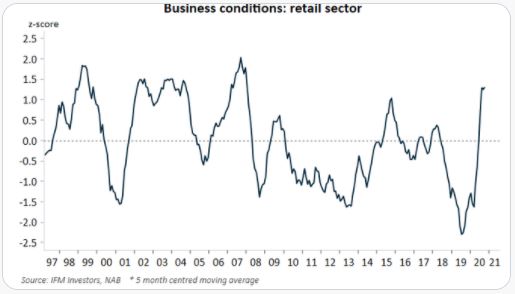
CBA Economics reports an equally optimistic measure:

"Consumer sentiment: The Westpac/MI measure of consumer sentiment showed another solid rise of 2.6% in November after a very strong lift in October. The consumer sentiment index now sits at 107.7 and well above the 100 level that separates optimists from pessimists. A reading of 107.7 is also comfortably above the long run average of 99.2. Confidence around current conditions and expected conditions continued to lift in November."

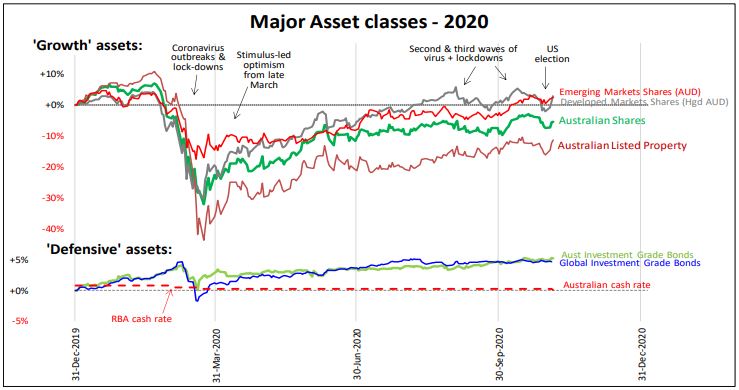
Drawing on a chart from the CIO of Stanford Brown, Ashley Owen, shows the stock market recovery, although Australian shares and listed property remain well below their levels at the start of 2020.
In this week's articles ...

We dive into the success of Exchange Traded Funds (ETFs) with Alex Vynokur of BetaShares, and explore how they performed during the pandemic and what the future brings.

Then two articles on retirement spending. First is an interview by Michael Kitces with the originator of the '4% withdrawal rule', Bill Bengen. It has become a retirement planning standard but does it still work?

Josh Funder checks the three pillars of our retirement planning system with an emphasis of the role the family home can play in meeting spending needs. He suggests a '3%+1%' as a variation on Bengen.

And while on latter-life planning, Christine Benz provides an intriguing list of seven estate planning items you may have missed which can make life easier for the people left behind.

Investors continue to seek alternatives to the miserable rates on cash and term deposits, which is giving bonds and hybrids a boost. Jon Lechte from a new sponsor of Firstlinks, Bond income, gives examples of new bonds available to people who qualify as 'wholesale', plus a summary of three recent hybrid opportunities. See also the announcement of the first fund in a sister business, Fund income.

Gold has found a place in more portfolios than ever in 2020, and Jordan Eliseo describes the political impact of Democrat or Republican administrations, and why gold rose then fell during the election process.

The announcement by Pfizer of successful vaccine trial results gave the market a kick up, but regardless of its success, in a highly competitive field, Robert M. Almeida finds another way to make money from the pandemic theme.

This week's White Paper from Franklin Templeton studies our most precious resource, water, and how it affects economic policy, population growth, climate change and the day-to-day operation of companies.

Note also a wide range of updated reports on ETFs, LICs and listed investments generally in our Education Centre, linked below.


Graham Hand, Managing Editor


Latest updates

PDF version of Firstlinks Newsletter

Australian ETF Review for October 2020 from BetaShares

ETF Quarterly Report for September 2020 from Vanguard

ASX Listed Bond and Hybrid rate sheet from NAB/nabtrade

Monthly market update on listed bonds and hybrids for October from ASX

Indicative Listed Investment Company (LIC) NTA Report from Bell Potter

Monthly Investment Products update for October 2020 from ASX

Plus updates and announcements on the Sponsor Noticeboard on our website


  •   12 November 2020
  • 8
  •      
  •   
8 Comments
Dave Roberts
November 11, 2020

Hi Graham,
China appears to be developing a new iron mine in Africa that some think will replace their reliance on Australia. If correct our economy could be in for a lot of hurt in 5 to 10 years time.

Michael2
November 11, 2020

Hopefully some fair and polite discussion this week, we don't want to drive away our article contributors which will make us the lesser for it.

GM
November 11, 2020

Nice cover letter today – esp your points re China. In fact, China’s five year plan came out the week before the US election and many people missed it. I was speaking to a Federal politician and they said they hadn’t seen it. Don’t those folks send such important items around to all of them?!

MFH
November 11, 2020

Graham, it sounds like you prefer to support the CCP than slowly exiting from a communist and repressive régime. I went through communist East Berlin in the 70s and the CCP seems far worse than the Soviet Union, but are you saying let's make money anyway? Profits before freedom. I feel that it is best Australia redirects its energies and the Australian economy away from the CCP rather than be beholden to them because very simply, there is no rule of law. Morally, I feel very sorry for the Chinese people as I did in 1970 for the German people under the Soviet Union.

DougC
November 11, 2020

Re foreign interference in Australian affairs, we should not forget Australia's bugging of the East Timor Parliament Building (under the pretence of an Aid project), to be able to gain the East Timor off-shore oil fields; the bugging of the personal mobile phones of the Indonesian President and his wife; and presumably other "foreign interferences" by Australia that have not been discovered.
China has a totalitarian government (so, effectively, has Singapore). India's government is close to an autocracy. Australia has a democracy. It all depends on what is the most productive form of government for a country given its stage of development and magnitude of its various problems and what each form of government can achieve. We have not a single km of highspeed rail despite 20 years of debate about it. In the same timeframe China has a highspeed rail network of 35,000km linking most major cities. In 2 generations, China raised the life expectancy of its population by approximately 45 years to 77. No democracy has done this. India certainly has not – and I doubt a democratic China would have achieved such developments.
The present anti-China sentiment by governments and media appears to result from the embarrassment of the US and its "partners" with the progress, industry and achievements of China compared with that of the western democracies (what a wonderful example the EU has turned out to be!). Eg. one steel company in Pudong Shanghai produces more steel than the entire US steel industry (and there are many other similar steel companies in China).
There are many repressive regimes around the world that Australia does not criticize (certainly not openly). For example, we are happy to trade (and not criticize) India (with its multi-tiered caste system and endemic corruption and nepotism at all levels including government). Today, China is criticized for its chauvinism re Hong Kong – isn’t it the response of Spain vs Catalonia recently ? I'm not promoting China over any other country or government, but judgements made on moral disdain and acrimony should also recognize facts and realities.

CC
November 11, 2020

We in Australia only hear the negative things about China. China imposed anti-dumping duties on barley in May 2020 is a typical example. According to THE STRATEGIST, an organization located in Canberra, with authors such as Tony Abbott and Kevin Andrews, there were eleven anti-dumping actions against Chinese products between February and July (2020). Some of the punitive tariffs imposed on Chinese products were as high as 78%. Australia has been the world’s third most prolific user of anti-dumping measures over the past six years, having initiated 84 actions (a third targeting China) , with only India and the United States doing more, according to the World Trade Organization. The vastly larger European Union economy, by contrast, initiated 67 actions over that period while Japan initiated just six.

Lobsters is another example. In Australia, we have a very stringent biosecurity to protect Australian and our environment. When it comes to China, they are restricting the trade when they discovered heavy metal in the lobsters.

It is extremely difficult for ordinary Australian, me included to have a balanced view towards other countries, especially China. How do we work with our largest trading partner when our view is often swayed by the politicians and media?

Dudley.
November 14, 2020

"anti-dumping measures":

If dumpers believe they are hard done by then they can request a review to which they can submit evidence.

If they don't then either they don't care to correct any mistakes or they were caught dumping.

Sentinel
November 11, 2020

The article from China Daily News is no idle threat. China would prefer to use the 'carrot' approach but does not hesitate to use the 'stick' when deemed necessary. China is in the process of transitioning to domestic led growth and diversifying its sources of natural resources in anticipation of future trade embargoes. To this end Xi Xinping's Belt and Road Initiative will achieve several goals: 1) Secure China's access to the world's resources, 2) Encourage markets for China's manufactures, 3) Provide employment for Chinese-speaking employees of the world's 5 largest construction companies and supporting industries, 4) Access cheaper labour markets when Chinese workers achieve middle income status, 5) Encourage favourable votes by host countries at the U.N., 6) Provide ports for possible future use by the People's Liberation Army Navy. There has been an event unfolding over the last half century that has already resulted in a transfer of significant wealth from the USA and other western countries to help lift hundreds of millions of Chinese citizens out of poverty. What is planned for the next 3 decades will likely have a profound effect on future generations and, although the USA may be headed for a serious reckoning, sooner or later citizens of the world will need to make a choice between economic interests and values of humanity. Readers are advised to become acquainted with a look at the bigger picture as indicated on another post:
'The Hundred-Year Marathon' by Michael Pillsbury: https://www.youtube.com/watch?v=7HnNEIkxzCc
'Stealth War' by Brig. Gen. Robert Spalding: https://www.youtube.com/watch?v=h8IEtlOVzq4
'Trumps Biggest Failure' by Kraut: https://www.youtube.com/watch?v=hhMAt3BluAU
'The China Syndrome': https://www.youtube.com/watch?v=AGl3HxEMJhI


Leave a Comment:

banner

Most viewed in recent weeks

Ray Dalio on 2025’s real story, Trump, and what’s next

The renowned investor says 2025’s real story wasn’t AI or US stocks but the shift away from American assets and a collapse in the value of money. And he outlines how to best position portfolios for what’s ahead.

Making sense of record high markets as the world catches fire

The post-World War Two economic system is unravelling, leading to huge shifts in currency, bond and commodity markets, yet stocks seem oblivious to the chaos. This looks to history as a guide for what’s next.

3 ways to fix Australia’s affordability crisis

Our cost-of-living pressures go beyond the RBA: surging house prices, excessive migration, and expanding government programs, including the NDIS, are fuelling inflation, demanding bold, structural solutions.

Is there a better way to reform the CGT discount?

The capital gains tax discount is under review, but debate should go beyond its size. Its original purpose, design flaws and distortions suggest Australia could adopt a better, more targeted approach.

How cutting the CGT discount could help rebalance housing market

A more rational taxation system that supports home ownership but discourages asset speculation could provide greater financial support to first home buyers.

Welcome to Firstlinks Edition 648 with weekend update

This is my last edition as Editor of Firstlinks. I’m moving onto a new role though the newsletter will remain in good hands until my permanent replacement is found.

  • 5 February 2026

Latest Updates

Property

The 5% deposit scheme is bad for homeowners and Australia

An ‘affordability’ scheme making the county more vulnerable to economic shocks and contributing to the deteriorating financial situation of everyday Australians.

Investment strategies

Is defensive the new offensive?

Relatively boring, unglamorous, defensive stocks like Kroger and Allstate have quietly outperformed gilded tech giants, offering steady growth, visibility, and resilient returns in a market captivated by AI and flashier industries.

Shares

How the RBA scores on its inflation goal

The Reserve Bank continues to face criticism from all sides. A reminder of the RBA's mandate and a review of their track record in maintaining price stability since the early 1990s.

Investment strategies

Levered credit: A late cycle ingredient for drawdown pain

As credit spreads normalised through 2025, yield‑hungry investors have turned to leverage for high returns, uncomfortably echoing pre‑GFC behaviours. Investors need to be careful to understand the true risk‑return trade‑off.

Planning

The more things change… longevity just goes on increasing

Australia needs a major shift in longevity awareness, attitudes and behaviour if, as a community, we are to reap the benefits of increasing longevity. Adopting a national strategy is well overdue.

Property

The improving outlook of Australian commercial real estate

The sector is positioned to benefit from defensive and resilient income streams supported by embedded rental increase opportunities. 

Property

Seize hidden opportunities among 50+ home buyer schemes in Australia

There is a laundry list of government schemes to help Australian's struggling with housing affordability. Savvy buyers should take advantage to break into the property market.

Sponsors

Alliances

© 2026 Morningstar, Inc. All rights reserved.

Disclaimer
The data, research and opinions provided here are for information purposes; are not an offer to buy or sell a security; and are not warranted to be correct, complete or accurate. Morningstar, its affiliates, and third-party content providers are not responsible for any investment decisions, damages or losses resulting from, or related to, the data and analyses or their use. To the extent any content is general advice, it has been prepared for clients of Morningstar Australasia Pty Ltd (ABN: 95 090 665 544, AFSL: 240892), without reference to your financial objectives, situation or needs. For more information refer to our Financial Services Guide. You should consider the advice in light of these matters and if applicable, the relevant Product Disclosure Statement before making any decision to invest. Past performance does not necessarily indicate a financial product’s future performance. To obtain advice tailored to your situation, contact a professional financial adviser. Articles are current as at date of publication.
This website contains information and opinions provided by third parties. Inclusion of this information does not necessarily represent Morningstar’s positions, strategies or opinions and should not be considered an endorsement by Morningstar.