Register For Our Mailing List

Register to receive our free weekly newsletter including editorials.

Home / 677

Welcome to Firstlinks Edition 677 with weekend update

  •   27 August 2026
  • 20
  •      
  •   

Few issues generate as much heat in Australia as housing. The focus tends to revolve around who possesses the assets and what one generation owes the next.

Earlier this year, we published an article titled '13 million spare bedrooms: Rethinking Australia's housing shortfall'. The piece challenged conventional thinking about housing affordability, suggesting that the issue is not simply a shortage of dwellings but the way existing housing is distributed.

The assertion is based on 2021 Census data which shows millions of rooms sit unused across the country, largely in homes occupied by older Australians. If housing is scarce and spare capacity exists, the argument naturally follows that perhaps better utilisation of existing housing stock should form part of the solution.

Should people take in boarders? Should vacant dwellings be brought back into the market? In practice, the debate almost always circles back to one group and one idea - downsizing.

For years, policymakers and property developers have anticipated a great downsizing wave. The expectation was that as baby boomers moved into retirement, they would gradually trade large family homes for smaller properties, freeing up housing stock in the process.

A recent finding suggests the downsizing wave may be far smaller than many expected. Most older Australians appear remarkably attached to where they live. Rather than embarking on a mass migration to apartments and townhouses, many are choosing to remain in the homes they've occupied for decades.
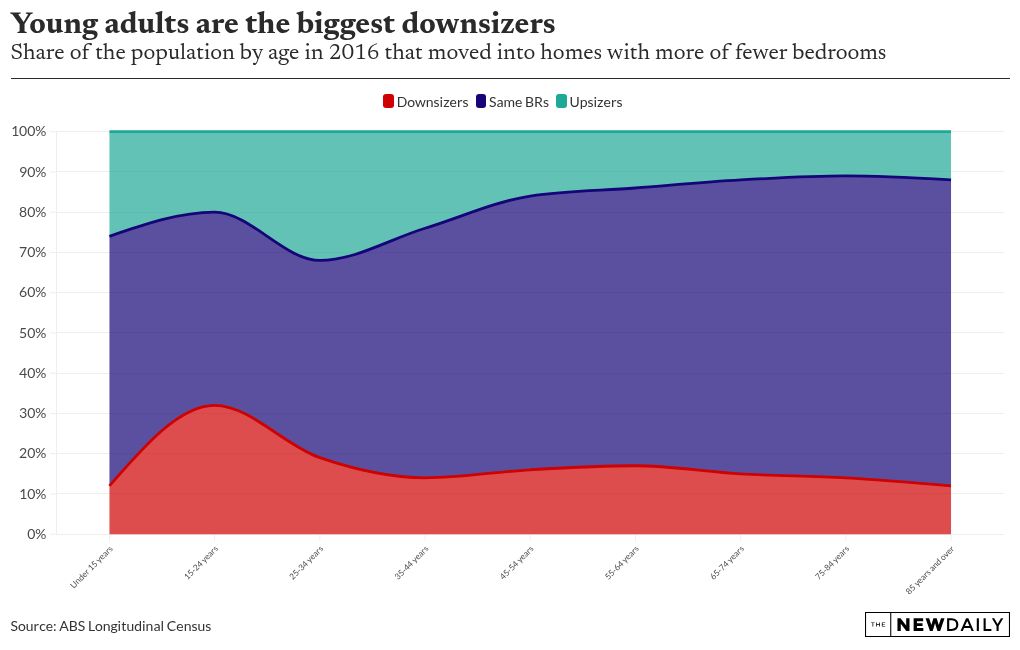
This doesn't surprise me. I think the downsizing argument raises a deeper question. At what point does a person's home cease to be simply their home and become a public policy asset?

We don't often lament over the size of people's gardens, nor do we question whether someone is driving a vehicle larger than necessary. Yet housing has become different because of its scarcity. The existence of millions of underutilised bedrooms has led some to view older homeowners as custodians of a resource that should be allocated more efficiently.

Viewed purely through an economic lens, perhaps the argument has merit. But this is only part of the story. Behavioural finance tells us that people rarely assess such decisions objectively. We become overly attached to what we own and feel losses more acutely than equivalent gains. Some forms of value cannot be easily quantified.

In this sense, economists, policymakers and homeowners are talking about entirely different things. The economist sees an asset. The policymaker sees housing stock. The homeowner sees something else altogether.

Besides the financial and administrative burden of downsizing, the family home (no matter the size) carries an extraordinary amount of emotional capital. Perhaps that is why the debate feels so fraught. It asks one generation to surrender something deeply personal in order to solve a problem created by forces much larger than itself. Perhaps that is why the great downsizing wave remains more theory than reality.

Simonelle Mody

***

Weekend Update

From Diana Mousina, AMP

Sharemarkets generally pushed higher this week on further signs of a progress in oil shipments through the Strait of Hormuz, more blockbuster US tech earnings, continued solid US economic data, lower bond yields and signs that US inflation pressures are not reaccelerating. This is despite a new economic phase of the US/Iran war and re-escalation in trade tensions between the US and Canada. US shares were 0.7% higher with a big rise in tech stocks and increases in utilities and financials while energy, health care and consumer discretionary were down. Japanese and Korean shares had another solid week after some recent underperformance. Australian shares lagged and were basically flat over the week as domestic profit growth just can’t compete with blockbuster US outcomes and on signs that another RBA rate hike may come sooner than expected.

The world’s largest chipmaker, Nvidia reported strong earnings this week - sales growth up 106%, earnings increased 110% and revenue is expected to be up by 70% in the 2027 calendar year. Better outlook for software firms helped stocks like Salesforce and CrowdStrike. Nvidia remains an outperformer and outlook (given the earnings outcome) seem like the outperformance against the broad index will continue.

Oil prices declined this week and are just over $80/barrel, still above the ~$60 pre-Middle East conflict but well above their recent highs. Some positive news this week was a sign of some agreement between Iran and Oman to a “revenue sharing agreement” on the Strait of Hormuz. But there was little detail and we don’t have any specifics about what the fees would be. But it’s a step in the right direction, which is how markets took it. The “futures” oil market which basically predicts where prices will trade suggests prices will average out around $80/barrel.

Treasury’s efforts to cap rising bond yields are working (so far anyways). US 10-year bond yields are just under 4.7% and moved a tad lower after last week’s US Treasury Secretary announcement about the government’s intention to increase buybacks of long-term bonds in an effort to reduce bond yields.

The end of the crypto winter? This move from Treasury could give fire to the “debasement trade” – a fall in the US dollar versus rises in assets with finite supply like Gold and Bitcoin (i.e. alternative to fiat money). Bitcoin had a good rally this week and is back up over $80K, having rallied nearly 30% in recent weeks – maybe the Bitcoin winter is over!

Reserve Bank of Australia board minutes for the August meeting contained a very detailed discussion about the two decisions presented to the Board: keep the cash rate steady or increase the cash rate by 0.25% from 4.35% to 4.6%. The main argument for a hike was that there are still too many upside inflation risks at a  time when inflation has been above target over a long period. And perhaps it is better to mitigate these risks by tightening monetary policy pre-emptively. The case to leave rates on hold was because there had already been earlier increases to interest rates and that the economy was already moving towards more optimal levels of inflation and full employment (and home prices had declined more than expected and the unemployment rate was a little higher). But overall the Board seemed willing to raise rates if  “upside [inflation] risks materialise”. The flow of data this week, particularly on inflation, suggests that these upside risks may already be playing out.

The July monthly inflation figures showed a 1% rise, or 3.5% over the year – down from 3.8% last month. The bigger issue was trimmed mean at 3.6% which was the same as last month and above expectations. Importantly, the trimmed mean measure is now running above the RBA’s forecast for the September quarter of 3.5%. This will be problematic for the Board who is so laser-focused on upside inflation risks.

Other data this week was mixed. Construction project work fell by 2.1% in the June quarter with engineering down but building up (good news for residential construction). Capital expenditure also fell after a huge rise last quarter in data centre spending so its more like a normalisation in usual business investment, rather than underlying weakness in business investment. And buildings capital spending rose in the June quarter. Taken together, construction activity looks like it will add to June quarter GDP growth but there will be some weakness in engineering and plant and equipment.

Australian reporting season is 90% complete. Profit growth has finally rebounded after three financial years of falls which is good news. The consensus estimate is for FY26 growth of 11.6% (which is ~0.5% lower than at the beginning of reporting season). The negative is that the improvement is narrowly based. Take out mining and energy and its more like 5.3%. FY27 earnings is around 10% - which is also solid. However, these numbers just pale in comparison to the blockbuster tech earnings from the US.

There have been some encouraging results, like in healthcare (companies like CSL and Cochlear) as well as Super Retail Group, Universal Store, Mirvac and REA but these were all basically “less bad than feared” rather than signs of outright strength. Around 36% of earnings have been above expectations (lower than the usual 40%) with more results being “in line” with expectations.

Dividend announcements have been positive with 59% announcing an increase in dividends from a year ago. And it’s good to see that 67% of earnings are up from a year ago. But the message is still that while profits are improving, the rebound is narrow and lacks the scale of what is occurring in countries like the US or Asia that have large tech exposures. 67% of companies have increased their dividends this earnings season, the highest since 2021, which is a good sign as it shows that companies have confidence in their cash flows to do so! But it’s lower than the percentage of reported companies which have seen historical earnings rise at 80%.

Also in this week's edition...

Reversionary pensions have long been a staple of SMSF estate planning, Meg Heffron is back to discuss whether they are still the best option.

Rising age dependency is frequently treated as a warning sign for economies, but Cameron Murray argues the ageing crisis will not happen.

The 4% rule has long been retirement's gold standard. Amy Arnott suggests a more conservative approach.

Most Australians gear into property but ignore shares. Alex Cousley from Russell Investments explains how a moderate level of gearing can support retirement goals

Matt Reynolds from Capital Group shares four charts that expose market concentration risk.

Australia has just hit $1 trillion in debt. Ashley Owen evaluates whether this may create challenges.

For decades, GDP has been the benchmark for economic success. Tony Dillion asks whether this has made us materially happier?

Curated by Simonelle Mody and Leisa Bell

A full PDF version of this week’s newsletter articles will be loaded into this editorial on our website by midday.

Latest updates

PDF version of Firstlinks Newsletter

Listed Investment Company (LIC) Indicative NTA Report from Bell Potter

ASX Listed Bond and Hybrid rate sheet from NAB/nabtrade

Plus updates and announcements on the Sponsor Noticeboard on our website


  •   27 August 2026
  • 20
  •      
  •   
20 Comments
John Wilson
August 27, 2026

We would like to downsize to reduce costs of maintenance, property value related charges (such as council rates, water rates, emergency services levy, insurance etc).
We bought our house on a large block in a leafy inner suburb in 1983. in 1986-87, we extended from 2BR to 4BR (5 if include our stable), but really only need 2BR for us plus guest. That would free up 2 or 3 BR. Great, but.....
The downsize property must have equivalent access to public transport, shopping, medical services, community amenities, and aesthetic environment.
Importantly, it must also have (or have potential to be upgraded to have) accessibility features such as absence of steps, door and corridor widths, space to manoeuvre wheelchairs, bathroom facilities, grab rails, door handles, switch locations etc). These are rarely possible in existing buildings.
For us, downsizing would cost $200k for agent selling fee, stamp duty on buying, move cost, and minor expenditure on tarting up the present house and rectifying issues on the new house. That would not fully address the accessibility issues. We would be ahead on cash, but don't have a worthwhile way to use those surplus funds: no debt to pay off, no need for cash, can't add to super. How long might the downsizer be useful? Dunno! We might die in the next year or two, or 10, or 20! Why bother?
We have an alternative. Even though there is ample room and access, council does not allow us to subdivide our block. I'm considering converting our stable to an independent "granny flat", downsizing to ten metres away, and renting the existing house. That would free up 4 bedrooms. However, building cost estimates for the granny flat are ridiculous: over $1m or $9000/sq metre (with no land cost), driven by excessive building regulation, taxes on labour and materials, and shortage of labour. The likely project time would be well over 1 year, allowing for approvals and construction time: we might be dead by then! Why bother?

30
Dauf
August 27, 2026

It’s a lot to do with stamp duty, which was supposed to go under GST reforms but is now one of the big 3 incomes for states. It costs too much to downsize. If government was serious it would reduce these costs. Instead they just lie and try and fleece more money off people, the obvious targets are SUPER (tick), the family home (watch out its coming) and god knows what else next

20
Greg Williams
August 27, 2026

I'm inclined to think there is a far more fundamental question: When does private property no longer remain private? At that point, depending on the answer, we might well move directly into the socialist "utopia" with all of its other "benefits".

18
Robert G
August 27, 2026

Like Richard C above, we "downsized" 5 years ago. went from a standard 4-bed, 2-bathroom, double garage stand-alone house on a large block to a 3-bed, 2-bathroom, double garage apartment.
Would we do it again ?
No way Jose. Too many out-of-pocket $$$$$.
The major costs were stamp duty ( horrendous ) and agent's fees ( almost as bad )
By comparison, those very important legals (conveyancing costs ) were a very small proportion of the agent's fees.
In hindsight, should have stayed where we were.

18
Juel Briggs
August 27, 2026

That's a good article, thank you. So true. The love of one's home is not just an emotional thing, it's a major part of one's life, one's marriage, where one's children grow up. Through decades, a full life-span. "Life" writ large in fact. Read novels, literature, biographies, history........and understand why one's home is so important.
We also know that people suffer enormous stress when they have to move to care. And it seems that once removed from their beloved home they often die. So why why make able bodied older people do it? As for the thought sharing my home with strangers........what could go wrong I wonder?
I have a suggestion, if politicians, activists and policy makers want this to happen, they should set the right example and all of them do it first, and make their parents do it, and publicly report on this.
We citizens should not be held accountable for governments who have set policies and regulations that have made housing unaffordable and restricted. They have incentivised university education over trades training such as for the building industry, restricted land-release, added on massive regulatory/labour/environmental/energy costs, delays and restrictions to new builds and to products used in construction.
We all work hard to pay off our homes or are paying them off, no-one has a right to tell us what to do our hard earned private property. To do that is not just socialism, it's Communism.

14
Richard C
August 27, 2026

We recently downsized to a house with half the yard and less rooms. After stamp duty and agent costs we were out of pocket with no actual spare cash to contribute to downsizer contribution but were able to access it for one of us as part of a recontribution strategy. Most people wish to remain in the suburb they are in, its familiar, but are challenged by the lack of suitable "smaller housing" ie that is not a unit with no yard or a so called retirement village shut off from life, or that needs major reno to bring up to standard for living in later life, hence 'why move at all?' being a decision to put off till later for many . We moved suburbs to be nearer the family but the lack of local alternatives was also part of the decision mix. Government could look at reduced stamp for downsizers or would the government entering the real estate sale industry potentially increase productivity through the simple medium of having fair fees?

10
Dac
August 27, 2026

The issue of how to best utilise housing stocks is universal, as far as I am concerned, my parents live in VN with five spare bedrooms and they are not in a million years to let a stranger to move in. I have developed the same mindset since I own a property in Australia. The numbers all look good in theory and I am a proponent of sharing my spare rooms but my utmost concern is whether that person is gonna slice my throat. The risk/reward here is skewed, therefore, millions of bedrooms are empty. It's just common sense.

8
Ian Radbone
August 27, 2026

When riding my bicycle on narrow roadways, I often question whether someone is driving a vehicle larger than necessary!

6
Brian Cabot
August 28, 2026

My wife and I moved out of a 4 bedroom house in Sydney to a 3 bedroom townhouse with ocean views in a coastal town when we were in our 50s. Not long afterwards we found that we needed to rent a self storage unit to use as a workroom for our hobbies, and to store lifestyle items (kayak etc.). In 2021, when we were in our early 70s, we upsized to a house in the Adelaide Hills. We did this for a number of reasons. Firstly, to be near one of our sons and his family to assist with school pickups, child minding etc. Secondly to have spaces in the house for our hobbies and working from home. Thirdly, to eliminate the fees and negotiations that are an annoying and expensive aspect of strata plan life.
Our house has 4 bedrooms and an office, which we have configured as 2 bedrooms (main and guest), 2 workrooms/offices and one spare bed/storage/workroom. Two living areas are fully used when our grandchildren (from 4 years to teens) visit.
Rather than the simplistically adding up the advertised number of bedrooms in dwellings and declaring that they are underutilised, planners should become better acquainted with the lifestyles of families, and do some useful research into how people configure the rooms of their dwellings to meet their needs.
It is a mistake to believe that our "primary dwellings" are investment assets. They are in fact, like cars, furniture and boats, lifestyle assets that we purchase as part of our lifestyle choices. I think that the current housing affordability problem has come about because the belief that house ownership is a road to wealth, and that continual house price growth above the rate of inflation is a good thing has become embedded in Australian culture. Decades of greed and stupidity have caused this problem, and it will take decades of discipline and common sense to solve it.

6
JohnC
August 29, 2026

By the time you've paid stamp duty, legal, selling and moving costs the price of your downsizer in an acceptable area is the price you sold for, so why move?

6
David Rohr
August 27, 2026

I agree with your comments on downsizing. Many people don't want to move. It is also very costly, especially because of stamp duty. However, many people do want to unlock capital from their existing home. One way to facilitate that would be to allow larger secondary dwellings to be built in backyards and for the secondary dwelling site to be subdivided and sold or leased. Owners could stay in their home or move into the secondary dwelling, without stamp duty being payable. Many backyards are underutilised assets from a more expansive zoning era and an unnecessary luxury in an era of a critical shortage of real estate in established and well serviced areas.

5
Graham W
August 28, 2026

It is easy to unlock capital from your home by using the Centrelink Home Equity Acess Scheme. Available to seniors of age pension age whether getting a pension or not. Just choose the extra income that you want and it is a loan against your property. The interest rate is reasonable and no cost to set up.
If you want ,say ,an extra $1,000 a month to spend, it is an ideal easy way to stay in your own home. By the end of the year you owe a little over $12,000 to Centrelink, less than 1% of the home value, so even if prices modify it should not be an issue. Worth a look and works for folk that I know.

5
CC
August 30, 2026

disagree. owning backyards is what sets Australia's capital cities apart from concrete jungles overseas and provide a much better lifestyle.

Michael James
August 28, 2026

I'm "downsizing" and retiring early next year, going from a 3 bedroom home to a 4 bedroom new home but a smaller yard to maintain. I'll have room in the house for friends and family to stay and also the possibility of my aging Dad to come and live rather than prematurely have to go to Aged Care.

4
Trevor
August 28, 2026

Sounds like an excellent plan

Nabley
August 28, 2026

The census and most rational discussions on housing forget that housing is not a discussion about commodities. While most developers are attempting to make the commodity argument real with the boxes they build, they miss the point that people don't live in boxes. They live in homes. A home takes on its own life that is only marginally related to how many bedrooms.

3
Bill
August 29, 2026

Dac, I don't think anyone is suggesting that excess rooms should be rented out, but rather become available for larger families to occupy when they buy the house, and the original occupants have moved to smaller premises.

2
Cam
August 30, 2026

Many view people driving vehicles much bigger than they need.
Loss of age pension is a big factor stopping downsizing. Including the family home as an asset removes that influence. For my parents the current system delays a reverse mortgage by around 4 years, so a bigger inheritance.

john
August 30, 2026

There can be 100s of costs associated with downsizing which means it is not practicable. I am really serious if you look into properly and most people find out after the fact

Wildcat
August 30, 2026

Government is the biggest impediment. Not only stamp duty, aged pension rules, aged care requirements etc.

They are also responsible for the the supply issues, development restrictions, gst, infrastructure levies certification costs etc.

Then to top it off public housing went from circa 20k pa a the 70’s when the population was half what it now to only circa 4K today.

It’s100% the governments fault across the board


Leave a Comment:

banner

Most viewed in recent weeks

Why have Australian living standards 'fallen' and how do we fix it?

For the last few years there has been much talk of a 'cost-of-living' crisis in Australia and of 'falling living standards'. Lately this has flared up again with the pickup in inflation resulting in a renewed fall in real wages.

Will you run out of money in retirement?

Fear of running out has become a defining retirement anxiety. Why do some retirees die with substantial wealth while others deplete their nest egg? Evidence suggests the answer is more complicated than we think. 

Four options for an income investor’s next dollar

What if Australia’s golden age of dividends is ending? Rather than overhaul your portfolio, it may be worth considering where new capital can work harder. I discuss four income strategies and the trade-offs behind each.

The investment that sidesteps the new tax traps

Tax rules have changed, but many investors are still using yesterday’s strategies. Insurance bonds may offer advantages for those seeking greater control, tax efficiency and certainty about their wealth.

Welcome to Firstlinks Edition 672 with weekend update

How does Australia measure up to the rest of the world?

  • 23 July 2026

Welcome to Firstlinks Edition 674 with weekend update

What begins as appetite, grows into excess and ultimately ends in spectacle. Millions of investors just discovered this the hard way.

  • 6 August 2026

Latest Updates

Retirement

Why spending more in early retirement can improve lifetime income

Conventional wisdom encourages retirees to preserve superannuation. But if those likely to qualify for the Age Pension later in life spend a little more today, it may deliver higher lifetime income and a more stable retirement.

SMSF strategies

Who really loses from the SMSF borrowing ban?

The ban on borrowing to buy residential property inside a self-managed super fund was framed as closing a loophole for the wealthy. Yet ATO data suggests its effects may be felt more heavily on members with moderate balances.

Investment strategies

The investing rule that explains the next market crash

What if investment success depends less on picking the right assets and more on understanding the decisions of other investors? A principle borrowed from game theory offers a different perspective on markets.

Investment strategies

Gold: should you own the metal or the miners?

Gold is back in the headlines but investors may be asking the wrong question. Before deciding where prices are headed next, it's worth considering whether the investment you choose will deliver the outcome you're actually seeking.

Fixed interest

Global bonds markets are hiccupping

For decades, investors looked the other way as government debt ballooned. But a reckoning may be beginning. Bond markets are stirring and the consequences could reach far beyond markets into everyday life.

Property

Why investors are looking beyond traditional property sectors

A little-known corner of the property market may be quietly benefiting from powerful demographic and healthcare trends. Could this specialised sector offer investors something increasingly difficult to find: enduring demand?

Retirement

Retirement in reality - 6 months in

Is retirement really an identity crisis, or is something else at play? New insights challenge conventional thinking and reveal why some retirees struggle to fully embrace life after work.

Sponsors

Alliances

  • ASA-Logo-RGB-ActiveGreen-web.png

© 2026 Morningstar, Inc. All rights reserved.

Disclaimer
The data, research and opinions provided here are for information purposes; are not an offer to buy or sell a security; and are not warranted to be correct, complete or accurate. Morningstar, its affiliates, and third-party content providers are not responsible for any investment decisions, damages or losses resulting from, or related to, the data and analyses or their use. To the extent any content is general advice, it has been prepared for clients of Morningstar Australasia Pty Ltd (ABN: 95 090 665 544, AFSL: 240892), without reference to your financial objectives, situation or needs. For more information refer to our Financial Services Guide. You should consider the advice in light of these matters and if applicable, the relevant Product Disclosure Statement before making any decision to invest. Past performance does not necessarily indicate a financial product’s future performance. To obtain advice tailored to your situation, contact a professional financial adviser. Articles are current as at date of publication.
This website contains information and opinions provided by third parties. Inclusion of this information does not necessarily represent Morningstar’s positions, strategies or opinions and should not be considered an endorsement by Morningstar.