Register For Our Mailing List

Register to receive our free weekly newsletter including editorials.

Home / 569

Why certainty is so important in retirement

Extensive research has been conducted into retiree concerns, with three key concerns consistently coming out on top:

  1. running out of money
  2. facing unexpected health and aged care costs
  3. not being able to maintain a comfortable standard of living in retirement.

In other words, not knowing what’s waiting for us in the future – or uncertainty.

Uncertainty is impacting quality of life in retirement

The investment strategies and products that have served so well in accruing assets via super don’t necessarily provide the kind of financial certainty Australians want (and need) in retirement.

It doesn’t help that super has long been framed as a ‘nest egg’ to fund our retirement – a label that is hard to shake off in the retirement phase. After being told all our working lives to grow our savings for retirement, studies show that many retirees are reluctant to draw it down, opting instead to spend less and preserve as much of it as possible in the face of an uncertain retirement timeframe.

The upheavals of recent years have also played a significant role in the diminishing drawdown of savings that we are seeing. Uncertainty about market volatility, about inflation and the cost of living, uncertainty about unplanned future expenses – all of these influence a person’s financial confidence going into retirement.

Ultimately, this has a tangible impact on the quality of life in retirement; not only is uncertainty depriving many older Australians of a lifestyle they can actually afford, but the considerable financial concerns carried into post-work life impacts their physical, mental and emotional wellbeing.

The current approach to retirement income

Today, more than ever, retirees want the confidence to spend and enjoy the continuity of their lifestyle. For this, they need certainty and flexibility from their investment strategies, as well as solutions to the unpredictable financial outcomes they’ll likely face in retirement.

At one end of the spectrum, account-based pensions provide flexibility but can leave retirees shouldering significant investment and longevity risk and fail to fully address the financial fears held by retirees.

At the other end, traditional lifetime annuities involve trade-offs between income certainty and flexibility and are often limited in terms of how one can invest, withdraw or use their money.

The Age Pension, upon which many Australians rely once their retirement savings are exhausted, barely provides enough income to sustain a subsistence level of retirement.

As life expectancies increase and living costs rise, the strategies and products currently available are becoming less effective in addressing the need for certainty. With the retirements of 4.2 million plus Australians1 at stake, new and innovative income solutions are urgently needed to complement existing products and strategies. Next-generation income solutions that provide certainty.

Rethinking income sources in retirement

A 2022 Actuaries Institute report2 noted that combining traditional products with innovative solutions could lead to a remarkable 30% increase in retirement income.

Further, the report noted that methods, such as using investment-linked lifetime income streams, have been shown to lift retirement income without increasing longevity risk: a win-win outcome that would see Australian retirees benefit from larger payments and a better quality of life without increasing the likelihood of outliving their savings2.

The next generation of retirement products must improve on earlier efforts, with outcome-oriented solutions designed around core features, including:
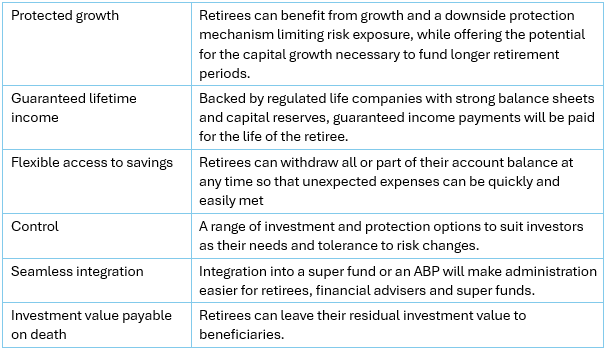
Recently, we have seen an emergence of innovative retirement solutions designed to pay a guaranteed income for life with more flexibility in their design. These next-generation lifetime income solutions have been designed to provide income certainty, flexibility, and the ability to access capital whenever needed.

Australians should be able to live their lives with certainty and not have to worry about tomorrow’s ‘what ifs’, market volatility or whether they’ll have enough money for the future.


Justine Marquet is Head of Technical Services at Allianz Retire+, a sponsor of Firstlinks. This article is for general information only and does not take into account your objectives, financial situation or needs. For personal financial advice please speak to your financial adviser.

Allianz Guaranteed Income for Life (AGILE) is a next-generation retirement income solution that delivers certainty in the form of a guaranteed income for life. To learn more, visit www.allianzretireplus.com.au/about-us/certainty.


1 Australian Institute of Health and Welfare, ‘Older Australians’, 20 November 2023.
2 Actuaries Institute, ‘Actuaries develop a framework for maximising retirement income’, 26 April 2022.

  •   17 July 2024
  • 10
  •      
  •   
10 Comments
Dudley
July 19, 2024

Black box, innards not government guaranteed?

How is Allianz Retire+ superior to government guaranteed Term deposits?

Denial
July 27, 2024

Its generally not as Life Insurance companies are for profit and clip the ticket first. They're guaranteed returns to shareholders. Run the IRR on any lifetime and it rarely comes out better than TD. The benefit is only accrued by those that are lucky enough to live past ~93 years of age. Yes there are potential Age Pension benefits, but this is just tax scheming subject to change and not a standalone or direct benefit.

Steve
July 19, 2024

The old style defined benefit plans offered members income security in retirement with no concerns about market volatility. Whilst they still existence in one form or another for the lucky few, primarily long-serving public servants, a generation of retirees would have gained much enjoyment and satisfaction in retirement phase from the availability of defined benefit plans. Alas, for most Australians, the less desirable defined contribution plan is what we are left to navigate; a plan that has meant that the investment process has been democratised into the hands of the unwary member who is left to carry all the risks associated with that process and in pension phase, is required to drawdown his/her accumulated savings which are susceptible to market gyrations. How antiquated is that system?

Hardly the sort of system that a retiree wants to navigate in their less productive years.

Disgruntled
July 20, 2024

The defined benefit funds were too good. So good that they likely would have failed in the future.

Kevin
July 21, 2024

I always found the "system" was simple and obvious.No young people to pay for the old people,that seemed reasonable all those years ago.

CBA floated,OK,,if I compound $10K @ 12% for 40 years that will be a good sum of money.The 1990s were a great time for bank shares,bought all of them.They provide a 6 figure net income now in dividends.The first big crash teaches you a great lesson,50% can disappear in 12 months,the dividends were pretty much constant.The GFC is a long time ago now.Taught me a wonderful lesson,my fanatical don't over leverage worked.A few scary days but it worked.

CBA is @ $130 now.I can't break that habit of planning ahead,that goes down to $100 I'm buying. I'm not buying though,my days of white line fever and get out there on the pitch are over. 10,000 shares of CBA are worth $1.3 million today, if they go down they'll be worth $1 million,who cares,where is the problem. That will continue forever.I expect the dividend to increase,it may fall slightly,who cares. 50% of income could disappear and it is still more than we can spend.

A lifetime of people telling me you can't do that.The days of buy and hold are over.They always have at least 100 hypotheticals. Leave it alone to compound,pay the loan off as fast as you can,don't worry about how much tax you pay,don't worry about,"they might take $5 of pension off me".

If people can think of something that is easier than that I wish they would tell me.They seem to spend an entire lifetime saying that compounding does not exist.What about concentration risk.What about $ cost averaging into a well diversified portfolio.

For me,what about reality,if they lose 50% sell the lot,walk away with with say $2 million.That will last for the 10 or 15 years ( or less) of life left.

Listen to people ringing up radio stations and saying my parents have died.They have left me a house worth $1 million I'm terrified.I'm 70 years old and they will take some of my pension off me.

Rob
July 21, 2024

Good on you Kevin, I'm with you!

Paul
July 21, 2024

This how the uk pensions works

Rob
July 22, 2024

The fears outlined - "....running out of money, unexpected costs, being unable to maintain a reasonable standard of living...."

With respect to Allianz, the proposed solution is about a "guaranteed" income stream - a "replacement salary" if you like, that will hit the Bank once a month or so. To provide that income stream, Allianz and others, will have to back their "future liability" with " conservative assets" and loaded with Bonds. If markets turn against them they will need to top up Capital

For some retirees, such products may appear " worry free" and that is ok but it pays to "look under the hood" at the underlying rate of return which, almost certainly, will be significantly under long term Super returns

Stephen
July 22, 2024

I congratulate Allianz on creating and supporting this innovative product but the most effective way to promote it is to have real customers who have been using it for at least 5 years endorse it. The theory is one thing, the “is it delivering what I needed/wanted” is another.

David Williams
July 24, 2024

The ongoing product developments for retirement income are really welcome. However, decisions about their personal application (and other investment decisions) really hinge on each person and their partner having longevity plans to frame their future along with their chosen immediate and longer term actions to make the best of their longevity. As their longevity evolves, they are well placed to re-optimise their investment decisions and adapt to changing health and estate planning considerations. Personal longevity planning enables ongoing and properly informed commitment on all fronts.


Leave a Comment:

RELATED ARTICLES

Love them or hate them, it's worth understanding annuities

Ranking three common retirement strategies

5 charts every retiree must see…

banner

Most viewed in recent weeks

How to minimise tax with a will

Inheritance tax implications in Australia may surprise some, as poor estate planning without proper wills or trusts can lead to costly tax bills and delays for beneficiaries.

Testamentary trusts post-budget: Estate planning, tax reform and the ‘death tax’ debate

Proposed Budget changes to taxation are casting new uncertainty over testamentary trusts, prompting closer scrutiny of estate planning structures and the real implications of reforms still taking shape.

Meg on SMSFs: The CGT changes don’t impact super but what about Div 296 tax decisions?

New CGT rules could tip the scales in the super vs non-super debate. For those facing the Division 296 tax, the case for withdrawing has gotten more complex. A "comparison rate" tool may help assess decisions.

High quality businesses are on sale

Beneath the dominance of the ASX's largest stocks, much of the market has been left behind. High-quality companies are now trading at levels rarely seen, offering opportunities for investors willing to look deeper.

The strange effect of the 30% minimum capital gains tax

The 30% minimum tax on capital gains sits at the heart of the budget's proposed reforms. Yet the mechanics reveal anomalies that introduce unexpected distortions that raise questions about its design.

Welcome to Firstlinks Edition 667 with weekend update

The downfall of the giant and three lessons for investors.

  • 18 June 2026

Latest Updates

Latest from Morningstar

Ranking three common retirement strategies

The defining challenge of retirement isn't just about building wealth, it's about converting your lifetime savings into sustainable income. A holistic understanding of different strategies can improve long-term outcomes.

Economy

Was life really better in the good old days?

Are we worse off than previous generations? Lately, there seems to be a heightened level of angst that economic conditions are getting harder and that the two-party political system (and maybe democracy too) is failing voters.

Retirement

Australia has saved $4.5 trillion for retirement. Here's what matters more

Most Australians approaching retirement can tell you the exact dollar value of their super account. But success depends on more than a sizeable balance. Here's four key questions to ask yourself at the start of the financial year. 

Who gains in an AI-supercharged economy?

AI is already reshaping the economy, but companies building transformative technologies rarely capture the greatest long-term value. Instead, those benefits accrue to the users. We may well see this pattern reproduced. 

Taxation

Div 296's million-dollar reset worth $25,000

The 'cost base reset' for the new super tax is being sold as protection for pre-July gains. A worked example shows $1M of protection is worth about $25,000, and the real deadline has not passed.

Latest from Morningstar

The forecasting fix that Wall Street missed

Asking whether markets are overpriced may be the wrong question. New research suggests that traditional valuation metrics used to forecast returns may have been misread. Here are five takeaways for investors.

Investment strategies

Should a fund manager invest their own money differently?

Investors often like the idea that fund managers should invest client money exactly as they invest their own. But reality is more complicated. Unique circumstances make a different approach rational and, at times, beneficial.

Sponsors

Alliances

© 2026 Morningstar, Inc. All rights reserved.

Disclaimer
The data, research and opinions provided here are for information purposes; are not an offer to buy or sell a security; and are not warranted to be correct, complete or accurate. Morningstar, its affiliates, and third-party content providers are not responsible for any investment decisions, damages or losses resulting from, or related to, the data and analyses or their use. To the extent any content is general advice, it has been prepared for clients of Morningstar Australasia Pty Ltd (ABN: 95 090 665 544, AFSL: 240892), without reference to your financial objectives, situation or needs. For more information refer to our Financial Services Guide. You should consider the advice in light of these matters and if applicable, the relevant Product Disclosure Statement before making any decision to invest. Past performance does not necessarily indicate a financial product’s future performance. To obtain advice tailored to your situation, contact a professional financial adviser. Articles are current as at date of publication.
This website contains information and opinions provided by third parties. Inclusion of this information does not necessarily represent Morningstar’s positions, strategies or opinions and should not be considered an endorsement by Morningstar.