When is a niche not really a niche? How about when it’s almost 20% of the population, and most of the elderly. The Australian Bureau of Statistics (ABS) states, “Four million people in Australia (18.5%) reported having a disability in 2009, according to the results of the Survey of Disability, Ageing and Carers … The rate of disability increased with age. Almost nine in ten people aged 90 and over (88%) had a disability, compared with 3.4% of those aged four years and under.”
Many people hope disability is an inconvenience that happens to other people, but of course it can hit anyone at any age. In particular, we have an ageing population where most people can expect to live to 90 years of age or longer. So 88% of us can expect to live with our own disability, and add to that our ageing parents and the reality of this issue will confront nearly everyone at some time in their lives.
That’s certainly not a niche. It should be considered as part of every financial plan.
Disability is not easy to define. The four million number includes problems such as loss of sight that is not corrected by glasses, arthritis which causes difficulty dressing, and advanced dementia that requires constant help and supervision. A stricter definition, being people who require assistance with core daily activities because of severe or profound restrictions, gives about 1.2 million. They are supported by an estimated 2.6 million carers. The number of Australians 65 and over with a severe or profound disability is expected to grow to 1.5 million in 2031.
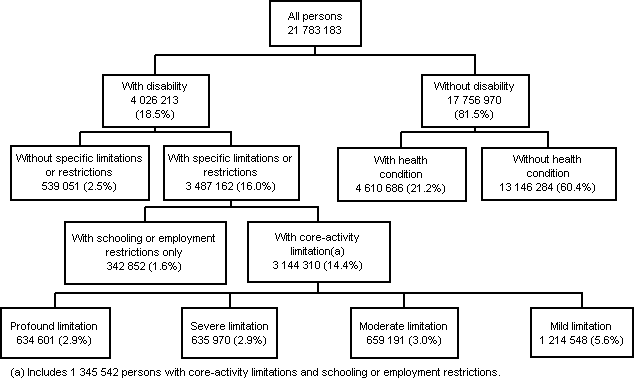
Source: ABS 4430.0 - Disability, Ageing and Carers, Australia: Summary of Findings.
Special legislation relating to people with a disability
The regulations designed to assist people with a disability and their families should be better known by advisers and their clients. It would be unacceptable for any financial adviser to overlook the basic rules of a financial topic like superannuation. It is part of the required knowledge set which influences every Statement of Advice. It is equally unacceptable that there is not widespread understanding of special regulations applying to people with a disability of all ages, including the very young. While there are issues of eligibility and definition, there are significant opportunities to improve the financial outcomes of a large proportion of the population.
Some important regulatory issues relating to disability include:
1. Ability to access superannuation at an early age
The Australian Taxation Office provides conditions of early release of super under the Superannuation Industry Supervision Act 1993 for a person with a ‘permanent incapacity’. This is called a ‘disability super benefit’. The superannuation trustee must be reasonably satisfied that the person is unlikely to engage again in gainful employment for which they are reasonably qualified by education, training or experience. At least two medical practitioners must certify this, and there is no limit on the amount that can be released where the person is permanently incapacitated.
Clearly, such a release may alter the traditional planning horizons. Early access means the money may run out quicker. Traditional thinking around retirement ages of 60 or 65 may not apply, and a release may affect other support payments. It’s certainly a step which should only be taken after considering many options.
2. Excepted person for tax purposes
Disabled children may be taxed as adults and have access to adult tax-free thresholds and tax scales. Parents of children with disabilities may be able to reduce their tax payments by saving money or earning income in the name of the child without the usual low tax thresholds applying to children. Financial planners often warn people not to invest in their children’s names, but this advice may need modifying for a family supporting a child with a disability.
Generally, a minor is an excepted person if they are:
- disabled and likely to suffer from that disability permanently or for an extended period
- working full-time, or had worked full-time for three months or more in a year (full-time work that was followed by full-time study)
- entitled to a disability support pension or rehabilitation allowance, or someone was entitled to a carer allowance to care for them
- entitled to a double orphan pension and received little or no financial support from relatives, or
- unable to work full-time because of a permanent mental or physical disability and received little or no financial support from relatives.
3. Special Disability Trusts
Special Disability Trusts (SDT) carry exemptions from gifting and assets test rules under social security legislation, and certain expenses relating to care can be charged to the SDT. These rules encourage people to set up trusts for the future care needs of children with disabilities. The Department of Social Security answers more questions on the operation of SDTs here.
People with disabilities and their financial advisers should consider these rules in the design of a financial plan for the client, their carers and their family.
Benefits include a gifting concession of up to $500,000 combined for one or more eligible family members. There is also an assets test assessment exemption of up to $609,500 (as at 1 July 2013 indexed annually) for the beneficiary, which might assist retention of other entitlements. Plus all trust income is excluded from the income test assessment of the beneficiary.
The beneficiary must be deemed as severely disabled and the Trust Deed, Contributor and beneficiary must comply with certain conditions. A particularly restrictive rule is that the beneficiary can only work up to seven hours per week. While the SDT is primarily required to spend its earnings on the care and accommodation needs of the beneficiary, up to $10,750 per year (indexed) can be spent on other items.
Eligibility is not straightforward, and a Centrelink Special Disability Trust team will assess the beneficiary against the legislated criteria for medical impairment, care needs and work capacity.
4. Disability support pensions
These pensions provide support for people with a disability that either prevents them from working, or earning above a minimum threshold. Eligibility includes:
- aged 16 years or more and under age pension age
- permanently blind or have been assessed as having a physical, intellectual, or psychiatric impairment
- unable to work, or to be retrained for work, for 15 hours or more per week at or above the relevant minimum wage within the next two years because of the impairment
More details are available on the Department of Human Services website. The pension is means tested on income and assets. There may also be eligibility for a pension supplement and a mobility allowance.
For anyone thinking disabled people do not have much money because of their difficult employment circumstances, there’s a large group of litigation lawyers, insurance assessors and medical practitioners who know one large subset needing top quality financial advice.
Planning for disability support
People with a disability have complex financial needs, especially after a volunteer care giver can no longer provide support. These needs are not addressed simply by buying a large life insurance policy for the primary care giver and hoping money lasts through the life of the person with a disability. They often require lifelong guardianship and financial assistance. Protecting government benefits while still assuring financial support are paramount.
These issues are heightened by longer life expectancy and longer term dependence on expensive medical care. Caring for older people with disabilities will present challenges for families, friends, volunteers and paid service providers. There will be insufficient paid carers, residential aged-care facilities and community services as government departments will be slow to recognise the demographic changes. The prevalence of profound disability which results in a need for residential care increases from about 5% at age 70 years to 50% at age 90 years. In other countries with rapidly ageing populations (for example, Germany and Japan), the response has been to introduce insurance for long-term care. In Australia, we are having our own debate about products such as deferred annuities. Such approaches need to be considered. The best solution, if it can be afforded, is to build enough financial resources to withstand the cost (if not the emotional turmoil) of whatever life throws at you.
(And there’s an entire article on disability services without mentioning the National Disability Insurance Scheme. That’s for another day).
This information is general in nature and only summarises some of the relevant legislation. It takes no account of personal circumstances and financial advice should be sought before taking any action.