Register For Our Mailing List

Register to receive our free weekly newsletter including editorials.

Home / 151

Dividends: more is less, less is more

Over the past five years, the MSCI All Countries (AC) World index, representing equities for the global investor, has delivered a return of just 3.8% per annum, excluding dividends. Fortunately, the Australian share market offers partial compensation by offering the world's highest yield from equities, on average.

No wonder investor attention is so much focused on dividends and yield these days. It's what is required in order to achieve reasonable returns, or so it appears.

Dividends: the trend has been your friend

In the MSCI AC World index, the average dividend yield over the past five years has been 2.9%, implying a contribution to total returns of more than 40% over the period. In Australia, the average dividend yield is usually around 4.5% but recent cuts, predominantly by resource companies, have lowered average yield for the ASX200 to circa 4%.

For superannuants in retirement phase trying to live off annual income from investments, 4% probably is not enough, so they have gone searching for higher-yielding alternatives. 6%. 7%. 8%. To those hunting for yield, it's all available in the Australian share market. The key consideration is: can companies continue to pay at least the same dividends in years to come?

Despite high profile dividend cuts by the likes of BHP Billiton (BHP) and Woodside Petroleum (WPL), the answer in the overwhelming number of cases has been: yes, the company can deliver. Thus far, dividend-oriented investors have had the trend on their side. Faced with tougher growth and lower returns, companies have increasingly succumbed to satisfying growing demand for income by jumping on the bandwagon themselves.

Australia has a long tradition in this field, but, for example, in 1998 only 35% of companies in ASEAN countries paid out dividends to shareholders. Today the percentage is a whopping 95%. The average payout ratio throughout the region has steadily lifted over the period to 50% today.

But this is not an opportune moment to become complacent. There's a fair argument that the first cracks in the global dividend theme have started to appear. With growth tepid and payout ratios often at elevated levels, investor attention should focus on ‘sustainability’ and on ‘growth’.

While the absence of the latter might seem less important to income-only seeking investors, absence of growth can translate into capital losses in the short to medium term, and impact on sustainability in the longer term.

Why less is (often) more

Share markets are not always efficient or right, but they do have a sixth sense for separating the strong from the weak, in particular when it comes to dividend-paying companies. Remember when BHP was supposedly offering double digit yield? A few months later, after the board succumbed to the inevitable, BHP shares are trading on yield of circa 3%, ex-franking.

The share market provides investors with insights on a daily basis. Consider Graph 1 below, taken from my eBook "Change. Investing in a Low Growth World", published in December 2015. The number represents the forward-looking yield, excluding the value of franking.

Graph 1: Estimated dividend yield (ex-franking) and implied market risk assessment
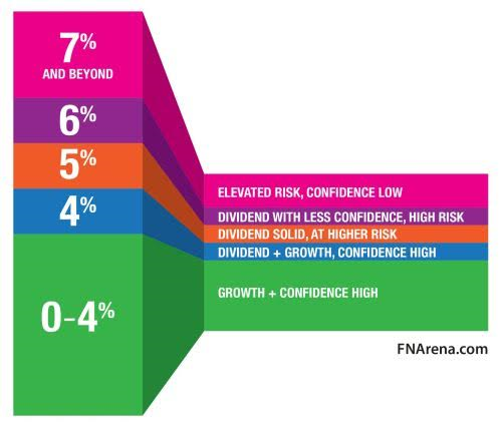
When it comes to deriving yield or income from the share market, ‘more’ is seldom best while ‘less’ might generate a lot more in total return over time.

The practical application of this market observation is probably best illustrated through my list of personal yield favourites: APA Group (APA), Goodman Group (GMG), Sydney Airport (SYD) and Transurban (TCL). All offer yields between 3.5%-4.5%. All remain in positive territory thus far in 2016, dividends not included, and all generated positive returns in 2015 as well as in the recent years prior.

In contrast, ANZ Bank, whose implied forward-looking yield has now risen above 7% (franking not included), has not managed to add any capital gains on top of the annual payout in dividends both in 2014 and 2015. With the share price down significantly since January, 2016 might become the third year in succession that total shareholder return will be less than the yield on offer.

The principle also applies among the banks with both CBA and Westpac offering lower yield but significantly outperforming their higher-yielding peers ANZ Bank and National Australia Bank.

A smorgasbord of possibilities

Investing in yield stocks is not a static concept. Changes in the economic cycle lead to shifts in investor preferences, impacting on share price momentum and, ultimately, on total investment return.

Let's take a look at the alternative types of yield stocks and strategies investors can choose from:

Bond proxies - defensive stocks with plenty of cash flows (hence the potential to offer yield) but often with low to no growth. Think REITs and infrastructure owners and operators, and perhaps Australian banks at the moment.

Growth at a Reasonable Yield (GARY) - reasonable yield, backed by growth which is not yet priced at too high a Price-Earnings (PE) multiple. GARY often leads investors to industrial companies trading on mid-to-low teen PEs while offering 4-5% yield. In today's context, this could include the likes of Pact Group (PGH), Lend Lease (LLC) and Smartgroup (SIQ).

Dividend champions - companies which have a long history of not cutting dividends. In Australia, Telstra (TLS) would be such an example and arguably the major banks. The obvious warning here is the legacy from the past doesn't count for much when things turn dire. Companies including BHP, Metcash (MTS), Fleetwood (FWD) and GUD Holdings (GUD) that had an enviable track record have been forced to reduce or to scrap dividends.

Cash proxies - companies swimming in cash but with low ‘beta’. Genworth Mortgage Insurance Australia (GMA) just announced a special distribution of 34c per share plus consolidation of its outstanding capital.

Yield at low risk - see Graph 1 and my favourite yield stocks mentioned above (APA Group, Goodman Group, Sydney Airport and Transurban).

High dividend yield – companies such as Monadelphous (MND) and Duet Group (DUE) seem to have high yields but are they sustainable?  Investors should be aware that share markets do not offer free lunches.

Low yield with strong growth - investors who bought Blackmores (BKL) shares three years ago are this year enjoying a forward yield of 6.7% on their original purchase, plus franking.

Current preferred strategies

As financial conditions tighten amid slower growth, payouts (including buybacks and dividends) will become unsustainable for many companies. My preference in the current market is for stocks with GARY and ‘Dividend champions’ characteristics when it comes to yield strategies.

For Developed Markets in general, GARY and ‘Yield at low risk’ are likely to generate the best results.


Rudi Filapek-Vandyck is Editor of FNArena. This article is for educational purposes and does not consider the circumstances of any individual.


  •   14 April 2016
  • 5
  •      
  •   
5 Comments
SMSF Trustee
April 14, 2016

Disagree completely. I'd much rather be paid all the earnings of the companies whose shares I own. If they think they have some profitable investment opportunities, they can come to me and the other shareholders and ask us to contribute more capital to help grow our future earnings. If we believe the company is onto something and it suits our investment portfolios, we'll cough up; if not, then the company can go and look for something else.

Maybe Woolworths would have avoided the Masters debacle if it had had to explain the strategy to its shareholders and get their support first. I for one would have told them not to waste their time or my money.

Gary M
April 14, 2016

People who look primarily at dividends would never have bought into the companies that have generated most of the wealth in the world – eg Apple, Google, Microsoft, Berkshire Hathaway, etc. When the great wealth building companies start paying dividends it is a sure sign they are running out of ideas and running out of room for growth. I would much rather invest in a business that retains its earnings because its ROE is greater than its cost of equity. Paying dividends is just the board saying “Buggered if we know what to do with the money! Here you take it back because you can do better than we can!”. Investors demand high dividends because they simply don’t trust boards and CEOs not to waste spare cash on value-destroying ego-driven acquisitions and pet projects.

SMSF Trustee
April 14, 2016

I'm not as opposed to Gary M's view as you might think.

I don't look primarily at dividends, because I know that my preferred approach is not the way the markets actually work. I also do think that too many SMSF investors look too much at dividends and not at earnings (retained and distributed). If you want more income from your stocks than they are paying, then you can supplement dividends by selling shares to generate the cash they would otherwise pay you. Not enough people manage their investments properly in that way.

As to whether the companies listed by Gary M have literally "generated most of the wealth in the world", well I think that's just silly. Most of the wealth in the world was generated way before those companies got started!

Fundie
April 14, 2016

Let's not perpetuate the notion that retirees should rely on income from their investments. Retirees should focus on total returns, not dividends.

Vishal Teckchandani
April 18, 2016

Great article Rudi.

Speaking from a personal investment perspective, I wouldn't like to see companies pay out all their money as dividends as I feel that's hubris. That's like saying "nothing will ever go wrong tomorrow, so why not just spend everything today?" What happens if there's a sudden crisis or massive litigation? Companies can't be spending money on lawyers to raise funds each time they need it - that's a bit unrealistic.

I agree half way with Gary M. I think there needs to be a balance between reinvesting for growth and paying a steady stream of increasing dividends to provide surety to investors that the company's growth initiatives are working and translating into higher payouts. That's friendly to both growth and income seekers.

Note my views are personal and not of my employer's.


Leave a Comment:

RELATED ARTICLES

Doubling down on dividends

Don’t forget the yield

LICs vs ETFs – which perform best?

banner

Most viewed in recent weeks

Are you making these SMSF mistakes?

After four decades advising investors, there are a few common mistakes I've seen SMSF investors make. From holding too much cash and chasing yield to overtrading and trusting tips. Are these errors costing you?

Why have Australian living standards 'fallen' and how do we fix it?

For the last few years there has been much talk of a 'cost-of-living' crisis in Australia and of 'falling living standards'. Lately this has flared up again with the pickup in inflation resulting in a renewed fall in real wages.

Will you run out of money in retirement?

Fear of running out has become a defining retirement anxiety. Why do some retirees die with substantial wealth while others deplete their nest egg? Evidence suggests the answer is more complicated than we think. 

Retirement spending is not one-size-fits-all

New data challenges the idea that Australians are underspending their super. The bigger issue may be helping retirees navigate complexity, make confident decisions and use their savings to support security, wellbeing and choice.

Four options for an income investor’s next dollar

What if Australia’s golden age of dividends is ending? Rather than overhaul your portfolio, it may be worth considering where new capital can work harder. I discuss four income strategies and the trade-offs behind each.

The missing link in the CGT debate

A little-noticed consequence of Labor’s tax changes could have implications well beyond investors’ tax bills. The issue raises bigger questions about incentives, capital allocation and the drivers of long-term economic growth.

Latest Updates

SMSF strategies

Meg on SMSFs: What do we think about reversionary pensions these days?

Reversionary pensions have long been a staple of SMSF estate planning, but are they still the best option? Meg Heffron revisits a once-clear favourite and asks whether changing super rules have shifted the balance.

The ageing ‘crisis’ has not and will not happen

Rising age dependency is frequently treated as a warning sign for economies. But when actual workforce participation is examined, a strikingly different picture emerges about ageing, productivity and economic sustainability.

Retirement

How does the 4% rule stack up?

The 4% rule has long been retirement's gold standard. But after a difficult period for investors, fresh analysis suggests a more conservative approach may significantly improve the chances of making savings last.

Shares

Four charts that expose market concentration risk

Investors have recently been rewarded for backing market leaders, but history suggests this eventually comes at a cost. Now may be the time to review whether your portfolio is carrying unintended risks beneath the surface.

Investment strategies

The case for gearing beyond property

Most Australians gear into property but ignore shares. That may be a mistake. Used carefully, geared equity strategies can enhance long-term returns, reduce cash tied up in growth assets and support retirement income goals.

Economy

Australia's $1 trillion debt pile

The headlines exclaiming that Australian government debt has hit A$1 trillion and US government debt has hit $40 trillion has turned heads, but how serious are they really? Will Australia's mix of debt create challenges?

Economy

Has 100 years of growth made us any happier?

For decades, GDP has been the benchmark for economic success, but has it made us materially happier? If happiness does not rise in lockstep with prosperity, are we overlooking what constitutes a successful society?

Sponsors

Alliances

  • ASA-Logo-RGB-ActiveGreen-web.png

© 2026 Morningstar, Inc. All rights reserved.

Disclaimer
The data, research and opinions provided here are for information purposes; are not an offer to buy or sell a security; and are not warranted to be correct, complete or accurate. Morningstar, its affiliates, and third-party content providers are not responsible for any investment decisions, damages or losses resulting from, or related to, the data and analyses or their use. To the extent any content is general advice, it has been prepared for clients of Morningstar Australasia Pty Ltd (ABN: 95 090 665 544, AFSL: 240892), without reference to your financial objectives, situation or needs. For more information refer to our Financial Services Guide. You should consider the advice in light of these matters and if applicable, the relevant Product Disclosure Statement before making any decision to invest. Past performance does not necessarily indicate a financial product’s future performance. To obtain advice tailored to your situation, contact a professional financial adviser. Articles are current as at date of publication.
This website contains information and opinions provided by third parties. Inclusion of this information does not necessarily represent Morningstar’s positions, strategies or opinions and should not be considered an endorsement by Morningstar.