Register For Our Mailing List

Register to receive our free weekly newsletter including editorials.

Home / 172

Insights into LICs trading at a discount

Research company Independent Investment Research (IIR) produces a monthly report on Listed Investment Companies, which Cuffelinks regularly publishes.

In addition to the usual updates on new issues and fund activity, it includes an extensive database on LICs covered in their research.

This week, there is a useful article on LICs trading at a discount to their Net Tangible Assets (NTA) value. This does not necessarily make them a 'buy', as explained by IIR:

"LICs can often trade at a discount for a prolonged period and there is no guarantee that share prices will eventually move towards NTA. Before buying LICs at a discount we need to understand why they are trading at a discount and the likely catalysts to move them closer to NTA."

Here is a sample. Despite some of the LICs being managed by prominent fund managers, for various reasons, some LICs fall out of favour.
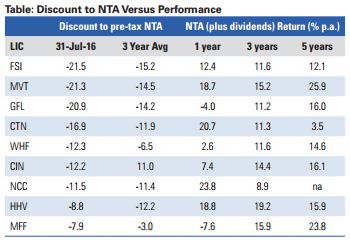
For example, the portfolio of a LIC such as Flagship Investments (ASX:FSI) has outperformed its index but it has a long history of trading at a discount, in this case over 20%, partly due to its relatively small size (about $40 million). As IIR writes on FSI:

"Large-cap stocks account for around half the portfolio, with the rest split between mid, small and micro-cap stocks. The portfolio (pre-tax NAV plus dividends) has outperformed the ASX All Ordinaries Accumulation Index over one, three and five-year periods. Performance has been helped by exposure to the better performing small cap sector of the market. Tracking error is slightly higher than some of the large cap focused LICs but beta is below one. FSI was at a 21.5% discount to pre-tax NTA at 31 July 2016. This looks an attractive entry point, but the shares have historically traded at a large discount. If the company is able to sustain outperformance this may lead to a rerating over time."

There is no slow down in the number of LICs coming to the market, with total funds under management reaching the $30 billion level. Given there is now a choice of over 80 LICs, it's a segment of the market worth understanding.


Graham Hand is Editor of Cuffelinks. Disclosure: Graham is on the board of the Listed Investment Company, Absolute Equity Performance Fund Limited (ASX:AEG), and holds an investment in FSI. This article is general information and does not consider the circumstances of any individual.  


  •   8 September 2016
  • 1
  •      
  •   

RELATED ARTICLES

It’s time for LICs to die

Four options for an income investor’s next dollar

The missing 30%: how LIC returns are understated, and why it matters

banner

Most viewed in recent weeks

Why spending more in early retirement can improve lifetime income

Conventional wisdom encourages retirees to preserve superannuation. But if those likely to qualify for the Age Pension later in life spend a little more today, it may deliver higher lifetime income and a more stable retirement.

It’s time for LICs to die

A high-profile dividend cut and a prominent fund manager’s apology have reignited a long-running debate. If investors can access similar exposures more cheaply and efficiently elsewhere, what exactly is keeping LICs alive?

Is it time to bail on Australian stocks?

For generations, Australian investors have backed banks, miners and dividends. But has that loyalty come at a cost? A look at the numbers raises an uncomfortable question about where future returns will come from.

Testamentary trusts survived the trust tax. The drafting battle has just begun.

The fight over testamentary trusts looked settled. Then the draft legislation arrived. Hidden in a technical detail is a question that could force many families to rethink wills they thought were already future-proof.

The new capital gains tax trap for your portfolio

Investors have long accepted one portfolio rule without much question. A major tax shift could change that calculation entirely, forcing difficult trade-offs between risk, discipline and an overlooked cost lurking beneath.

The investing rule that explains the next market crash

What if investment success depends less on picking the right assets and more on understanding the decisions of other investors? A principle borrowed from game theory offers a different perspective on markets.

Latest Updates

Fixed interest

Higher yields are creating opportunities in global bonds

Bond markets are adjusting to a new reality, but not in the ways investors expect. With markets repricing and capital competing for attention, investors may need to rethink where resilience and opportunity lie. 

Economy

Are we in a recession?

What if the warning signs are already everywhere? From supermarket aisles to company failures, investors are being bombarded with recession signals. But most face a different risk that can be just as dangerous for portfolios. 

SMSF strategies

Meg on SMSFs - Division 296 actuarial certificates

The tax bill might be yours, but the event that caused it may not be. A key Division 296 calculation can sometimes attribute earnings in ways that many SMSF trustees won't instinctively expect or fully appreciate.

Property

The first impact of negative gearing reform is not the tax bill

Negative gearing changes formally begin in 2027, but the first consequences may already be here. A subtle shift is quietly influencing who can borrow, how much they can access and which property strategies still stack up.

Economy

The oil market is running out of easy answers

The biggest threat to markets may not be what investors are watching. The numbers have stopped adding up and supply is harder to measure, with forecasts becoming simple guesses. A more fragile reality is being masked.

Investment strategies

The state of investor knowledge in Australia

Australians are investing more than ever, yet a surprising divide is emerging between those building wealth effectively and those making costly mistakes. Surprisingly, the gap has little to do with income, age or starting capital.

Taxation

Complexity and capital gains

A case study shows that the ‘30% minimum CGT’ is a poorly conceived tax that adds significant complexity to an already over-complex system. A less complicated model would create a much fairer progressive tax scale.

Sponsors

Alliances

  • ASA-Logo-RGB-ActiveGreen-web.png

© 2026 Morningstar, Inc. All rights reserved.

Disclaimer
The data, research and opinions provided here are for information purposes; are not an offer to buy or sell a security; and are not warranted to be correct, complete or accurate. Morningstar, its affiliates, and third-party content providers are not responsible for any investment decisions, damages or losses resulting from, or related to, the data and analyses or their use. To the extent any content is general advice, it has been prepared for clients of Morningstar Australasia Pty Ltd (ABN: 95 090 665 544, AFSL: 240892), without reference to your financial objectives, situation or needs. For more information refer to our Financial Services Guide. You should consider the advice in light of these matters and if applicable, the relevant Product Disclosure Statement before making any decision to invest. Past performance does not necessarily indicate a financial product’s future performance. To obtain advice tailored to your situation, contact a professional financial adviser. Articles are current as at date of publication.
This website contains information and opinions provided by third parties. Inclusion of this information does not necessarily represent Morningstar’s positions, strategies or opinions and should not be considered an endorsement by Morningstar.