Few issues generate as much heat in Australia as housing. The focus tends to revolve around who possesses the assets and what one generation owes the next.
Earlier this year, we published an article titled '13 million spare bedrooms: Rethinking Australia's housing shortfall'. The piece challenged conventional thinking about housing affordability, suggesting that the issue is not simply a shortage of dwellings but the way existing housing is distributed.
The assertion is based on 2021 Census data which shows millions of rooms sit unused across the country, largely in homes occupied by older Australians. If housing is scarce and spare capacity exists, the argument naturally follows that perhaps better utilisation of existing housing stock should form part of the solution.
Should people take in boarders? Should vacant dwellings be brought back into the market? In practice, the debate almost always circles back to one group and one idea - downsizing.
For years, policymakers and property developers have anticipated a great downsizing wave. The expectation was that as baby boomers moved into retirement, they would gradually trade large family homes for smaller properties, freeing up housing stock in the process.
A recent finding suggests the downsizing wave may be far smaller than many expected. Most older Australians appear remarkably attached to where they live. Rather than embarking on a mass migration to apartments and townhouses, many are choosing to remain in the homes they've occupied for decades.
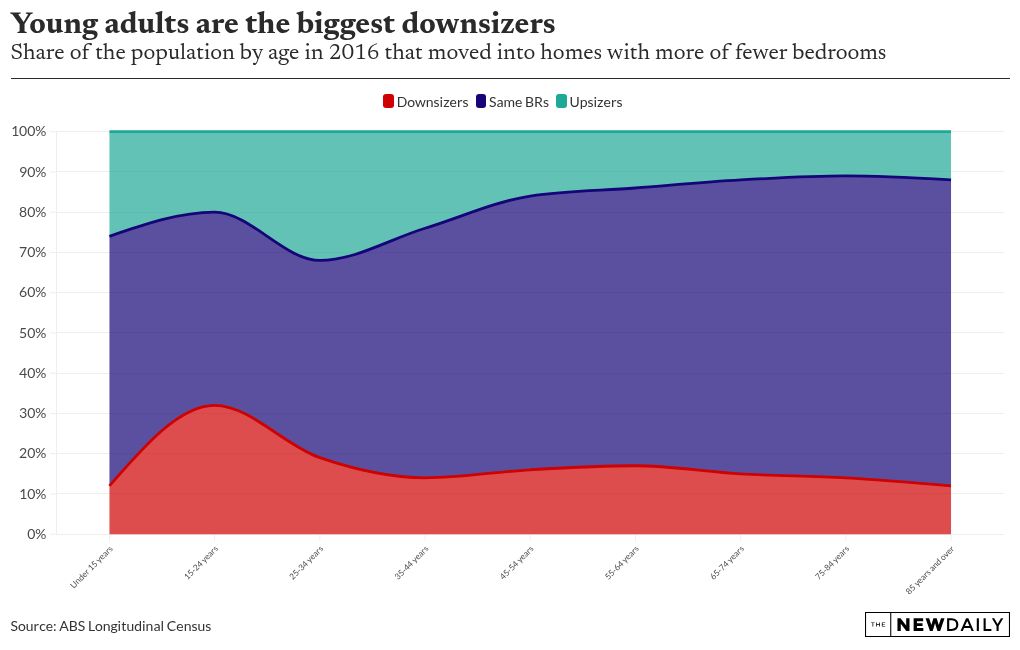
This doesn't surprise me. I think the downsizing argument raises a deeper question. At what point does a person's home cease to be simply their home and become a public policy asset?
We don't often lament over the size of people's gardens, nor do we question whether someone is driving a vehicle larger than necessary. Yet housing has become different because of its scarcity. The existence of millions of underutilised bedrooms has led some to view older homeowners as custodians of a resource that should be allocated more efficiently.
Viewed purely through an economic lens, perhaps the argument has merit. But this is only part of the story. Behavioural finance tells us that people rarely assess such decisions objectively. We become overly attached to what we own and feel losses more acutely than equivalent gains. Some forms of value cannot be easily quantified.
In this sense, economists, policymakers and homeowners are talking about entirely different things. The economist sees an asset. The policymaker sees housing stock. The homeowner sees something else altogether.
Besides the financial and administrative burden of downsizing, the family home (no matter the size) carries an extraordinary amount of emotional capital. Perhaps that is why the debate feels so fraught. It asks one generation to surrender something deeply personal in order to solve a problem created by forces much larger than itself. Perhaps that is why the great downsizing wave remains more theory than reality.
Simonelle Mody
***
Weekend Update
From Diana Mousina, AMP
Sharemarkets generally pushed higher this week on further signs of a progress in oil shipments through the Strait of Hormuz, more blockbuster US tech earnings, continued solid US economic data, lower bond yields and signs that US inflation pressures are not reaccelerating. This is despite a new economic phase of the US/Iran war and re-escalation in trade tensions between the US and Canada. US shares were 0.7% higher with a big rise in tech stocks and increases in utilities and financials while energy, health care and consumer discretionary were down. Japanese and Korean shares had another solid week after some recent underperformance. Australian shares lagged and were basically flat over the week as domestic profit growth just can’t compete with blockbuster US outcomes and on signs that another RBA rate hike may come sooner than expected.
The world’s largest chipmaker, Nvidia reported strong earnings this week - sales growth up 106%, earnings increased 110% and revenue is expected to be up by 70% in the 2027 calendar year. Better outlook for software firms helped stocks like Salesforce and CrowdStrike. Nvidia remains an outperformer and outlook (given the earnings outcome) seem like the outperformance against the broad index will continue.
Oil prices declined this week and are just over $80/barrel, still above the ~$60 pre-Middle East conflict but well above their recent highs. Some positive news this week was a sign of some agreement between Iran and Oman to a “revenue sharing agreement” on the Strait of Hormuz. But there was little detail and we don’t have any specifics about what the fees would be. But it’s a step in the right direction, which is how markets took it. The “futures” oil market which basically predicts where prices will trade suggests prices will average out around $80/barrel.
Treasury’s efforts to cap rising bond yields are working (so far anyways). US 10-year bond yields are just under 4.7% and moved a tad lower after last week’s US Treasury Secretary announcement about the government’s intention to increase buybacks of long-term bonds in an effort to reduce bond yields.
The end of the crypto winter? This move from Treasury could give fire to the “debasement trade” – a fall in the US dollar versus rises in assets with finite supply like Gold and Bitcoin (i.e. alternative to fiat money). Bitcoin had a good rally this week and is back up over $80K, having rallied nearly 30% in recent weeks – maybe the Bitcoin winter is over!
Reserve Bank of Australia board minutes for the August meeting contained a very detailed discussion about the two decisions presented to the Board: keep the cash rate steady or increase the cash rate by 0.25% from 4.35% to 4.6%. The main argument for a hike was that there are still too many upside inflation risks at a time when inflation has been above target over a long period. And perhaps it is better to mitigate these risks by tightening monetary policy pre-emptively. The case to leave rates on hold was because there had already been earlier increases to interest rates and that the economy was already moving towards more optimal levels of inflation and full employment (and home prices had declined more than expected and the unemployment rate was a little higher). But overall the Board seemed willing to raise rates if “upside [inflation] risks materialise”. The flow of data this week, particularly on inflation, suggests that these upside risks may already be playing out.
The July monthly inflation figures showed a 1% rise, or 3.5% over the year – down from 3.8% last month. The bigger issue was trimmed mean at 3.6% which was the same as last month and above expectations. Importantly, the trimmed mean measure is now running above the RBA’s forecast for the September quarter of 3.5%. This will be problematic for the Board who is so laser-focused on upside inflation risks.
Other data this week was mixed. Construction project work fell by 2.1% in the June quarter with engineering down but building up (good news for residential construction). Capital expenditure also fell after a huge rise last quarter in data centre spending so its more like a normalisation in usual business investment, rather than underlying weakness in business investment. And buildings capital spending rose in the June quarter. Taken together, construction activity looks like it will add to June quarter GDP growth but there will be some weakness in engineering and plant and equipment.
Australian reporting season is 90% complete. Profit growth has finally rebounded after three financial years of falls which is good news. The consensus estimate is for FY26 growth of 11.6% (which is ~0.5% lower than at the beginning of reporting season). The negative is that the improvement is narrowly based. Take out mining and energy and its more like 5.3%. FY27 earnings is around 10% - which is also solid. However, these numbers just pale in comparison to the blockbuster tech earnings from the US.
There have been some encouraging results, like in healthcare (companies like CSL and Cochlear) as well as Super Retail Group, Universal Store, Mirvac and REA but these were all basically “less bad than feared” rather than signs of outright strength. Around 36% of earnings have been above expectations (lower than the usual 40%) with more results being “in line” with expectations.
Dividend announcements have been positive with 59% announcing an increase in dividends from a year ago. And it’s good to see that 67% of earnings are up from a year ago. But the message is still that while profits are improving, the rebound is narrow and lacks the scale of what is occurring in countries like the US or Asia that have large tech exposures. 67% of companies have increased their dividends this earnings season, the highest since 2021, which is a good sign as it shows that companies have confidence in their cash flows to do so! But it’s lower than the percentage of reported companies which have seen historical earnings rise at 80%.
Also in this week's edition...
Reversionary pensions have long been a staple of SMSF estate planning, Meg Heffron is back to discuss whether they are still the best option.
Rising age dependency is frequently treated as a warning sign for economies, but Cameron Murray argues the ageing crisis will not happen.
The 4% rule has long been retirement's gold standard. Amy Arnott suggests a more conservative approach.
Most Australians gear into property but ignore shares. Alex Cousley from Russell Investments explains how a moderate level of gearing can support retirement goals.
Matt Reynolds from Capital Group shares four charts that expose market concentration risk.
Australia has just hit $1 trillion in debt. Ashley Owen evaluates whether this may create challenges.
For decades, GDP has been the benchmark for economic success. Tony Dillion asks whether this has made us materially happier?
Curated by Simonelle Mody and Leisa Bell
A full PDF version of this week’s newsletter articles will be loaded into this editorial on our website by midday.
Latest updates
PDF version of Firstlinks Newsletter
Listed Investment Company (LIC) Indicative NTA Report from Bell Potter
ASX Listed Bond and Hybrid rate sheet from NAB/nabtrade
Plus updates and announcements on the Sponsor Noticeboard on our website