Register For Our Mailing List

Register to receive our free weekly newsletter including editorials.

Home / 640

AI’s debt binge draws European telco parallels

Certainly 2025 will go down as yet another year dominated by the growth of the major technology companies, with AI themed investments headlining a surge in equity and debt capital market activity. Much of this activity is funding burgeoning AI capital expenditures with further significant growth expected in coming years as the major technology players make an almost 5x increase in combined capital outlays over the 7 years to 2028 (refer Chart 1).

Chart 1. AI ‘Hyperscalers’ – Annual Capex Expenditures (Actuals and Estimates, $USbn)
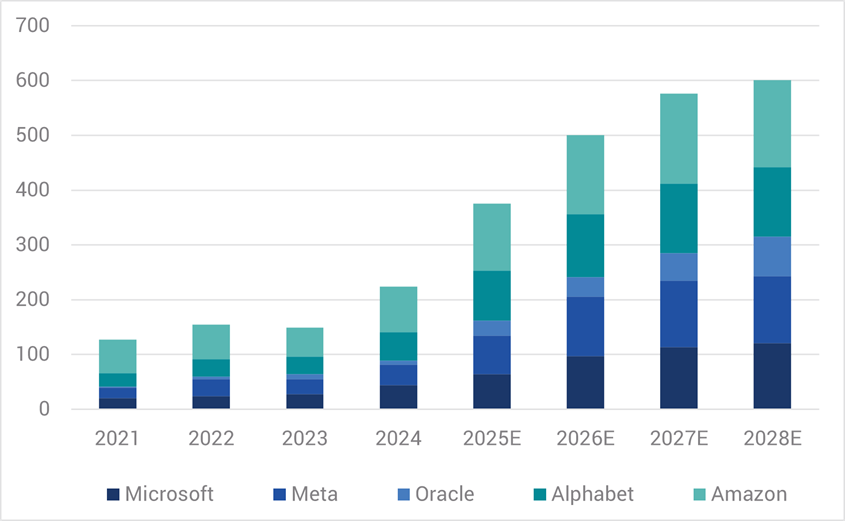
Source: Bloomberg/Yarra, Nov 2025.

Aside from growth in capital expenditure fuelling equity prices and underpinning US economic growth, the major global technology players are increasingly turning to debt markets for funding. Mega debt deals this year are already many multiples of previous annual totals, with the prospect of much more debt issuance to come (refer Chart 2).

Chart 2. AI Tech Giants – Borrowings (Bonds and Loans, $USbn)
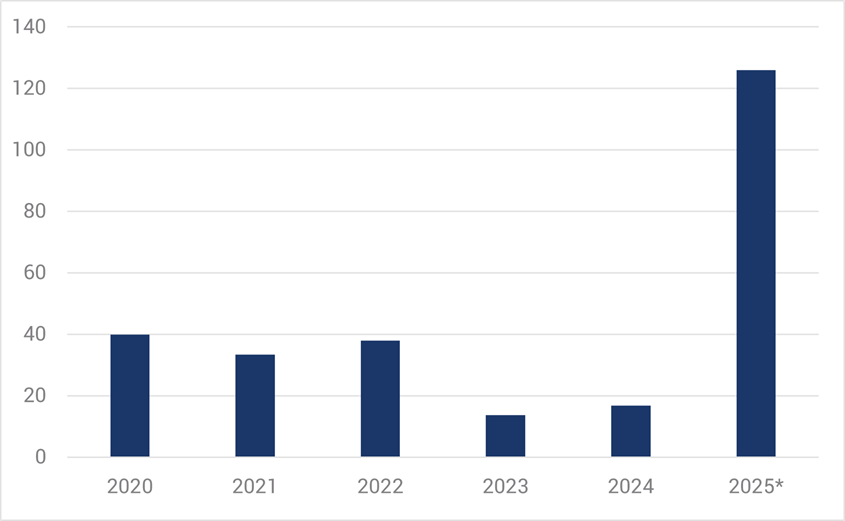
Source: Bank of America/Yarra, Nov 2025. * New borrowings to Oct 2025.

Renowned for their credit worthiness and strong cash flow generation, the AI hyperscalers appear very well placed to manage increased debt on their balance sheet. But everything, including even AI, has its limit. Given capital expenditures are expected to accelerate further over the outlook, we may very well reach the theoretical limits of debt funding in the years ahead without significant downgrades in credit quality, even for such illustrious names as Amazon, Google, Meta, and Microsoft etc.

To date, credit markets have absorbed large sums of new debt from AI companies, but higher Credit Default Swap (CDS) pricing is beginning to reflect some indigestion across the sector. This especially the case for triple B rated Oracle (refer Chart 3). Going forward, further debt capital issuance is likely to further pressure credit spreads.

Chart 3. CDS Spreads – US Technology Companies (bps)
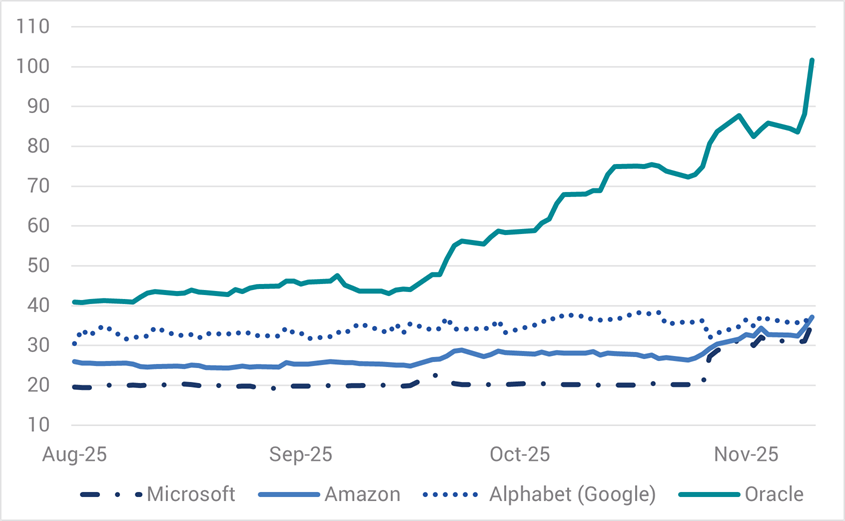
Source: Bloomberg/Yarra, Nov 2025.

For those of us in credit markets, major events can often be eerily similar to historical periods. From our perspective, highly rated AI companies increasingly tapping debt markets to fund burgeoning capital expenditures bears an uncanny resemblance to the early 2000s, where similarly rated European telcos (massively) overpaid for 3G spectrum licenses and associated infrastructure. In the second half of 2000, the likes of Deutsche Telekom (DT), Orange S.A. (France Telecom), British Telecom and Vodafone etc., used debt funding to pay European governments more than $US100 billion for 3G spectrum licenses on the lucrative early promise of the ‘Internet of Things’ (IOT) age.

As we now know, those roads to 3G riches were more potholed than expected, with associated debt issuance and lower-than-expected returns leading to significant negative credit migration and much higher credit spreads. For instance, the spreads of Credit Default Swap – insurance against default – for DT peaked at 400bps in 2002 (refer Chart 4) and its credit rating declined from a high of AA- in 2000 to a low of BBB+ in 2004. It still resides there some 20 years later.

Chart 4. CDS Spreads – CDS Spreads – European Telcos (bps)
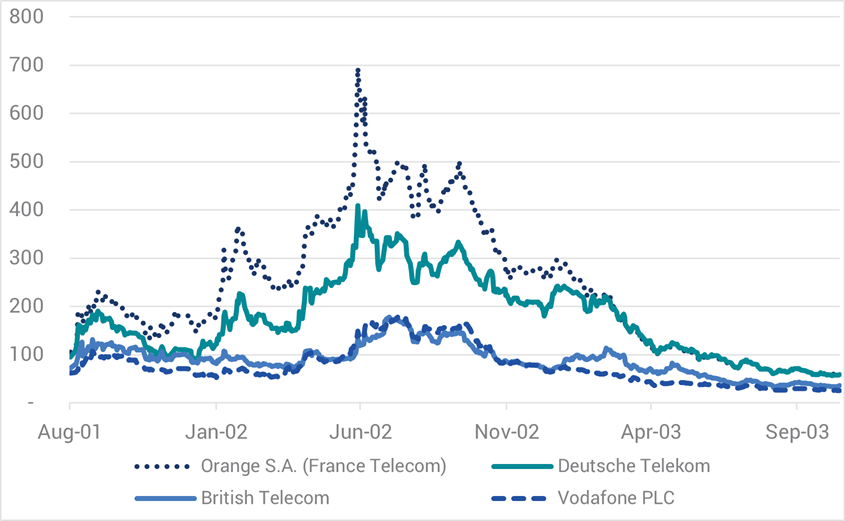
Source: Bloomberg/Yarra, Nov 2025.

The history books confirm that credit investors incurred significant marked-to-market losses funding Europe’s 3G capital expenditure binge in the 2000s, with a sense of Déjà vu now on the horizon for AI investors. While current credit quality – as assessed by S&P – for the likes of Meta (AA-), Amazon (AA), Alphabet (AA+) and Microsoft (AAA) is unquestionably pristine, if the past experience of the European telcos are anything to go by, their credit quality is unlikely to remain so. We believe the credit ratings of hyperscalers in the years ahead are likely to migrate down to single A and maybe even triple B categories.

Credit investors buying the bonds of hyperscalers should clearly be factoring in future credit migration risk into new issuance credit spreads, which for the most part does not appear to be occurring. For instance, Meta recently issued $US13bn (total) across 10 and 30-year tranches at Treasuries +78 and 98bps respectively. While you can debate whether the 10-year securities represent good value, we struggle to make any coherent argument in support of the relative value of the 30-year tranche, with any negative credit migration in the years ahead likely to lead to steep mark-to-market losses.


Phil Strano is Head of Australian Credit Research at Yarra Capital Management, a sponsor of Firstlinks. This article contains general financial information only. It has been prepared without taking into account your personal objectives, financial situation or particular needs.

For more articles and papers from Yarra Capital, please click here.


  •   3 December 2025
  • 1
  •      
  •   

RELATED ARTICLES

Dotcom on steroids Part II

3 reasons the party in big tech stocks may be over

The quiet winners of AI competition

banner

Most viewed in recent weeks

Warren Buffett's final lesson

I’ve long seen Buffett as a flawed genius: a great investor though a man with shortcomings. With his final letter to Berkshire shareholders, I reflect on how my views of Buffett have changed and the legacy he leaves.

The housing market is heading into choppy waters

With rates on hold and housing demand strong, lenders are pushing boundaries. As risky products return, borrowers should be cautious and not let clever marketing cloud their judgment.

Why it’s time to ditch the retirement journey

Retirement isn’t a clean financial arc. Income shocks, health costs and family pressures hit at random, exposing the limits of age-based planning and the myth of a predictable “retirement journey".

Australia's retirement system works brilliantly for some - but not all

The superannuation system has succeeded brilliantly at what it was designed to do: accumulate wealth during working lives. The next challenge is meeting members’ diverse needs in retirement. 

Australian stocks will crush housing over the next decade, 2025 edition

Two years ago, I wrote an article suggesting that the odds favoured ASX shares easily outperforming residential property over the next decade. Here’s an update on where things stand today.

The 3 biggest residential property myths

I am a professional real estate investor who hears a lot of opinions rather than facts from so-called experts on the topic of property. Here are the largest myths when it comes to Australia’s biggest asset class.

Latest Updates

Investment strategies

Australian stocks will crush housing over the next decade, 2025 edition

Two years ago, I wrote an article suggesting that the odds favoured ASX shares easily outperforming residential property over the next decade. Here’s an update on where things stand today.

Property versus shares - a practical guide for investors

I’ve been comparing property and shares for decades and while both have their place, the differences are stark. When tax, costs, and liquidity are weighed, property looks less compelling than its reputation suggests.

Investment strategies

What if Trump is right?

Trump may be right on two trends: nations are shifting from aspiration to essentials and from global dependence to self-reliance, pushing capital toward security, infrastructure, and energy.

Gold

After a stellar 2025, can gold shine again next year?

Gold has had a remarkable 2025, with the spot price likely to post its strongest return since 1971. This explores the key factors that will shape the outlook for the yellow metal next year, and long-term.

Superannuation

Critics of Commonwealth defined benefit schemes have it wrong

Critics like Clime's John Abernethy have questioned many aspects of defined benefit pensions for public servants. This is an attempted rebuttal, suggesting these pensions aren't the problem they're made out to be.

Infrastructure

Why airport stocks deserve a place in long-term portfolios

Aircraft constraints are holding back global air travel. Those constraints should soon ease which combined with a structural boom in travel demand could be a boon for global airport stocks.

Investment strategies

What is the future of search in the age of AI?

Search is changing fast. AI tools like ChatGPT and Google’s Gemini are reshaping how we find information, opening new opportunities for innovation, user engagement, and future revenue growth.

Sponsors

Alliances

© 2025 Morningstar, Inc. All rights reserved.

Disclaimer
The data, research and opinions provided here are for information purposes; are not an offer to buy or sell a security; and are not warranted to be correct, complete or accurate. Morningstar, its affiliates, and third-party content providers are not responsible for any investment decisions, damages or losses resulting from, or related to, the data and analyses or their use. To the extent any content is general advice, it has been prepared for clients of Morningstar Australasia Pty Ltd (ABN: 95 090 665 544, AFSL: 240892), without reference to your financial objectives, situation or needs. For more information refer to our Financial Services Guide. You should consider the advice in light of these matters and if applicable, the relevant Product Disclosure Statement before making any decision to invest. Past performance does not necessarily indicate a financial product’s future performance. To obtain advice tailored to your situation, contact a professional financial adviser. Articles are current as at date of publication.
This website contains information and opinions provided by third parties. Inclusion of this information does not necessarily represent Morningstar’s positions, strategies or opinions and should not be considered an endorsement by Morningstar.