Register For Our Mailing List

Register to receive our free weekly newsletter including editorials.

Home / 645

13 million spare bedrooms: Rethinking Australia’s housing shortfall

When we talk about Australia’s housing crisis, the focus tends to fall on two things: supply versus demand. This article looks at one aspect of supply which is often (well frankly almost always) overlooked – spare bedrooms.

Now the headlines cry “Build more homes,” and yes - in many cases, that’s the right answer.

But what if – just what if – we already had a massive, underutilised stockpile of housing hiding in plain sight? Not in paddocks, not in construction pipelines, but behind closed doors. But in homes already built.

Bedrooms already plumbed, insulated, and sitting idle.

The latest estimates suggest Australia has over 13 million spare bedrooms – across both occupied and unoccupied dwellings. It’s the biggest untapped housing asset in the country - and it’s been quietly ignored for decades.

Let’s take a closer look.

The scale of the surplus

Let’s start with the numbers. From the 2021 Census:

  • There were 10.85 million private dwellings across Australia
  • Of these, 1.04 million were completely unoccupied on Census night
  • The remaining 9.81 million were occupied - and more than 75% of those had at least one spare bedroom

Using a conservative benchmark – that households only ‘need’ one bedroom for every two people (rounded up) – we estimate that between 9.8 and 11 million bedrooms in occupied homes are surplus to need.

Now let’s add in the unoccupied homes. Here we have assumed that the unoccupied stock on average holds two bedrooms on average. Why? Because most unoccupied dwellings are apartments, holiday lets, or modest second dwellings – not suburban homes or even townhouses.

So: 1.04 million unoccupied dwellings × 2 bedrooms = 2.08 million spare bedrooms

That brings our revised national total to between 11.9 to 13.1 million ‘spare’ bedrooms across Australia.
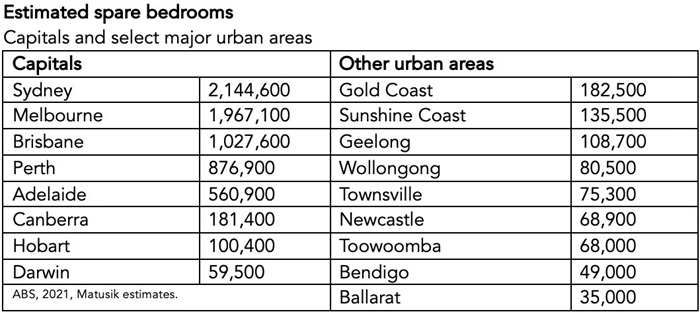
That’s one empty bedroom for every two people in the country.

We don’t have a housing shortage. We have a housing misallocation problem and one that’s literally hiding behind closed doors.

How does this happen?

The short version is that we’ve built our housing around a vision of the nuclear family that no longer reflects how we live.

  • Older Australians are staying put in large homes long after their children have moved out.
  • Young people are priced out of renting anything beyond a share house, let alone buying.
  • Solo living is rising, but zoning and planning rules still prefer traditional housing solutions.
  • Empty nesters with 3 or 4 bedrooms often want to downsize – but can’t find or afford anything nearby to move into.

And so, we end up with one part of the population rattling around in too much space - while others (too many) can’t find a place to sleep.

Why aren’t spare bedrooms being used?

It’s not as simple as blaming homeowners. There are real barriers to putting those rooms to work:

  • Tax disincentives – Rent out a room, and you might affect your pension, trigger CGT, or face complex ATO reporting.
  • Legal uncertainty – Residential tenancy laws are geared toward full leases, not shared arrangements.
  • Safety/privacy concerns – Homeowners are wary about inviting strangers into their personal space.
  • Insurance and liability issues – Many home insurers don’t cover shared arrangements without premium hikes.
  • No trusted platforms – There’s no national, vetted service to match up homeowners and renters safely.

So even where the will exists, the system says: “Too hard”.

What’s been tried — And what’s worked?

Let’s look at some real-world examples, here and abroad:

  • Bathurst, Orange & Parkes (NSW)
    A 2022 pilot project mapped ‘spare room capacity’ in these regional centres. It found over 60,000 spare bedrooms - enough to house an entire workforce. But uptake was blocked by concerns about trust, risk, and the lack of enabling regulation.
  • Homeshare Programs (UK, Germany, Australia)
    Homeshare initiatives pair older people with a spare room with younger people needing affordable accommodation. In exchange for cheap rent, the renter helps with tasks like shopping or gardening. These schemes have run successfully in the UK, Germany, and parts of Australia (e.g. Anglicare trials in Queensland), improving wellbeing and extending ageing-in-place.
  • The UK’s Bedroom Tax (2013)
    In a more hardline move, the UK cut housing benefit for social housing tenants with spare rooms. While it did free up some properties, it also pushed vulnerable people into hardship – particularly where smaller homes weren’t available. Lesson: penalties without options don’t work.
  • Victoria’s Short-Stay Levy (2024)
    By slapping a 7.5% levy on Airbnb-style short-stay rentals, Victoria is hoping to shift some properties back to long-term use. It won’t affect spare bedrooms directly, but it sends a signal: housing is for living in, not just profiting from.

Five things Australia could do and now

Unlocking just 5% of the country’s underused bedrooms would yield over 650,000 new sleeping spaces. That’s more than all the new homes Australia is forecast (dreaming) to build in the next two years!

Here’s how we do it:

  1. Tax incentives for micro-letting
    Offer tax-free thresholds for renting a room – say, up to $10,000/year – and remove CGT triggers for part-use of the home.
  2. Create a ‘micro-tenancy’ legal category
    We need a simple, low-risk legal structure – partway between a tenancy and a licence – to allow flexible, low-commitment rental agreements.
  3. Subsidise retrofit upgrades
    Grants or low-interest loans to install locks, private entries, or minor conversions could turn awkward spare rooms into viable living quarters.
  4. Nationally backed matching platforms
    Think ‘Airtasker meets Airbnb meets Homeshare’ – with government-vetted profiles, insurance coverage, and dispute mediation.
  5. Permit internal subdivisions without full rezoning
    Allow larger homes to be split into dual-occupancy dwellings (internally), provided safety, fire, and access requirements are met – but without full subdivision or title separation.

The bigger picture

I am not saying stop building new homes – far from it. But I am saying: don’t ignore the elephant in the spare room.

Housing is a system – and right now, it’s running with gross inefficiencies. The mismatch between household sizes and dwelling sizes is one of the biggest – and easiest to fix – distortions in the market.

Every spare bedroom we unlock is a bed for someone instead of sleeping on a couch, in their car, or in a motel paid for by the state. This isn’t just a housing issue – it’s a productivity issue, a wellbeing issue, and a moral one.

End note

Australia doesn’t just have a housing shortage. It has a housing distribution problem.

Our cities are full of three- and four-bedroom homes with one or two people inside. And our tax settings reward sitting on assets – not sharing them.

And my suggested solutions aren’t radical. They’re simple, human, and working elsewhere but we need to be creative and do something.

The housing crisis isn’t just about what we haven’t built. It’s also about what we’ve built and aren’t using.


Michael Matusik is an Australian housing market specialist, providing commissioned housing and demographic market reviews, updates and outlooks for over 30 years, and shares his thoughts in his blog, Matusik Missive.


  •   14 January 2026
  • 62
  •      
  •   
62 Comments
John N
January 15, 2026

Totally Agree.

9
John C
January 16, 2026

It’s not just the bedroom you loose some access to, but also the kitchen, the toilet, the bathroom the refrigerator and I would have to turn the tv down. I wonder if Mr. Matusik practices a share house.

18
Dave
January 18, 2026

In many cases down sizing means spending more on a home. An easy estimation having just done it ) is you lose 10% of the capital in agents fees, land tax & other expenses.
Plus if you down size and reduce capital cost you may impact on the Government Pension.
So it’s needs to be carefully considered.

5
Sam G
January 18, 2026

Agree. Last year, to help out family i stayed with my partners family for 5 months. It is not easy doing it. With of us needed to Hugo home to have a break.

JM
January 15, 2026

With hybrid working, and people using space for other things like indoor exercise, it doesn't make sense to consider a bedroom not occupied on census night as "unused". My partner and I live in a 3-bedroom apartment. We only sleep in 1 room, but all 3 rooms are heavily utilised and not "spare" in any sense of the word.

40
KJ
January 17, 2026

Exactly. These aren’t necessarily spare rooms - all rooms have a specific purpose (at least in our house). Politicians and people who promote this idea can go first in an initial experiment, and then report back to the Australian people.

4
Dorian
January 18, 2026

Agreed - we have a 4 bedroom house for 2 of us - one room is an everyday home office as we still work for money (from home), the other two for when the children/grandchild visit 3 or 4 times a month. They can't afford to buy near where they grew up so they come and need to sleep over. This is our downsizer - down from 250sqm internal with a pool to 150sqm internal- no pool. Planning to leave here in a body bag. Original article overly simplistic. Using statistics like a drunk man uses a lamp post - to lean on rather than illuminate- as somebody else said and of course my favourite - there are lies, bloody lies and then there are statistics. There is the truth but then there is the whole truth and nothing but the truth. The latter seems to spoil a good story with the facts.

Ray
January 15, 2026

We would downsize but why swap a 4 bedroom house with 2 living areas on a small(ish) block of land with a swimming pool, in a desirable area with good public transport - and in return buy an apartment for similar dollars and blow 300,000 plus in selling agent fees, stamp duty etc.

38
Errol
January 15, 2026

You nailed it Ray. The cost to downsize is huge and the Government has done nothing to lessen the impact other than to voice outrage at inter generational inequality. Even if an older couple could afford the cost to downsize, how do they transition into another smaller home? There is nowhere to rent until they find another home. If buying a home before selling, how do they fund the purchase? Drawing such a large amount from super raises its own issues even if that’s an option.

Michael raises some very valid points about changing our mindset on what type of homes are needed for modern families with fewer children. But we know that currently, 4 bedroom homes command a price premium over 3 bedroom homes even if those bedrooms are unused and the total area of the homes is the same.

A complex problem to solve that is beyond our current government

5
Dean
January 16, 2026

With regards funding a downsize purchase, it's actually relatively easy and inexpensive with a bridging loan if the old property is worth more than the new one. Bridging loans are far more challenging when trading up, but you may be surprised how simple they are when trading down.

Anyone considering downsizing should have a chat with their bank about bridging loan options.

4
OldbutSane
January 18, 2026

We have bought two PPRs without selling the original first and without a more expensive bridging loan (both after we retired). For both we simply got the lowest fee ordinary bank loan (ie no application fee, low interest, low monthly fee) and paid it off when the original PPR sold.

Franz
January 16, 2026

..and an apartment which most likely has been poorly built, with stratospheric levies to fix. And the extra neighbours and a strata committee to negotiate with.

9
GeorgeB
January 17, 2026

...and poor resale value - many apartments bought off the plan resell on the open market for less than their purchase price

3
Noel Whittaker
January 15, 2026

Very well written article. But I think another major disincentive is you don't know what sort of person is going to end up occupying one of your rooms. And once they're there, they may end up being a squatter.

32
Tony Bates
January 15, 2026

Agree. really good article. A Sydney Sunday newspaper ran a headline many years ago 1 Million empty bedrooms in Sydney. I have been quoting that number ever since. Many of us a NIMBY's. Some of us are YIMBY's. All the fuss over the TOD developments in Sydney have not addressed 1 million empty bedrooms.

2
DougC
January 15, 2026

Re: "to allow flexible, low-commitment rental agreements". Anyone contemplating that kind of legislation should have a look at the new NSW Strata regulations re tenants' rights. It's about impossible , without accumulated evidence and a court case, to evict a troublesome tenant (with or without their dogs, and cars). Not in my (2-person) home, thanks. In any case, all my 4 bedrooms are regularly used (craft-room, music-room, workroom, plus guest bedrooms for visiting family and friends - uses that were not possible when my sons lived at home. Perhaps the government inviting hundreds of thousands of immigrants each year, while failing to reach their own inadequate housing targets, might explain a lot of the problem.

26
Robert
January 19, 2026

100% agree.

Lyn
January 15, 2026

Noel, as experienced 'spare room' landlord of 35 yrs with no vacancy periods, aging brings safety issues as per your comment. An area not seemed to be researched but could help is with support of a charity operating in this area, eg Salvation Army, older empty - nesters could safely assist with short-term emergency accommodation for someone escaping domestic violence which otherwise renders them homeless, until they get on feet again. If charity set up register of police-checked host landlords, it would help one part of housing crisis & landlord has the charity as a go-between as person would have case- worker oversighting. It could be a win-win. For me (and probaly most) it needs to be treated income-wise as it is for fostered children, no income tax and no CGT. Believe it's an area never been explored.

9
Peter
January 18, 2026

Hi Noel,

Having lived in share house for decades in my younger years, in several commercial boarding houses, and now have managed "rooming accommodation" for decades.

My opinion is - could reduce this risk significantly by
Obtaining verified past addresses
Verified income / employers
Have "house rules" they agree too before moving in, So to confirm a "meeting of expectations "
An external security camera(s) that records all comings and goings to the dwellings.

In QLD can do evictions for rooming , I have had to do 2, where police attended. I thought police where quite "skilled but firm" in their negations to get the pension to leave smoothly and peacefully. Took about one hour in both cases

I thought the list of "Five things Australia could do and now" was quite good.

I recognize, "offering rooms in a house" is not for everyone and there are valid concerns raised. and extra legislated protections and systems would be quite useful.

Also, Lets face it .... government building programs , have delivered only a tiny increase in supply and nothing like their predictions of NEW dwellings constructed.

The housing shortage will many years to reduce at present rates ...

2
James#
January 15, 2026

Oh, I Don't know. Perhaps the thought of some random stranger walking around your home in their underpants with bed head in the morning before coffee is off putting! It's bad enough when it's family!

32
Ian
January 15, 2026

To let a spare bedroom one also needs a spare bathroom, spare kitchen, spare laundry, spare garage, spare sun deck and a spare TV room. That makes 7 spare spaces private from the rest of the house. It's hard enough for elderly parents (with poor sleep, low energy, slow, needing quiet) to put up with an adult child let alone an adult stranger. Go fly a kite.

21
Steve
January 15, 2026

"We have a housing distribution problem", and with all these folks the answer is some form of "redistribution". Get in the real world as many others have said - a "bedroom" is only called that by the architects and real estate agents. To real people it is just a room which can house a bed, an office, a gym, a sewing room, a kids retreat - whatever. And yes, people do like to have a spare bedroom for friends to sleep over after a party, or kids/grandkids to visit, even if only used occasionally. Lets be clear, how people set up their own homes is their choice. One last thing on your maths - you have just used the simple number of homes on census night - about 1/3 of those are already being rented, so those are already being used to help those looking for somewhere to live. We have also not been home the last two census nights as we were away at the time but this was still our primary residence, it is not sitting empty. Being empty for 1 night is irrelevant. Do people actually pay for such questionable analysis?

16
Peter Robinson
January 15, 2026

I think the article is missing some analysis of why people have and want empty bedrooms. Eg for when guests come to stay or the children with your grand kids.
And a big driver is the point Ray has made. Reducing stamp duty would encourage downsizing.

14
CC
January 15, 2026

If I don't want to downsize from the family house that we worked so hard to design, build and pay off the mortgage, and continue enjoying living in, I shouldn't have to, and I find it offensive for anyone to insinuate that people like me are a cause of Australia's housing crisis.
The real causes are government incompetence and neglect on several issues.
Excessive immigration levels, excessive taxation benefits for property investors but not for home owners ( in the USA home owners can claim tax deduction on mortgage interest payments but not investors whereas in stupid Australia it's the other way around ), and too much red tape, costs and restrictions inhibiting construction of new homes that people want ( not high rise faulty apartments ).

12
john
January 18, 2026

Trump will change and reverse that ;-)

1
Geoff
January 15, 2026

Why aren't spare bedrooms being used?

#6 - people are happy living with the people they're living with and don't want other people in their house/apartment and lives.

Before my partner and I started co-habiting we both owned 2 bedroom apartments, which seem about right for a single person. My "spare" bedroom was a library/sitting room. Hers, because her apartment was smaller, was an office/spare bedroom - very handy during COVID and after with WFH become entrenched in work culture.

Now we own a 4 bedroom house with 3 lounge areas, and an office. One of the 4 bedrooms has become my office - she gets the official office. The other two are actual spares - one being handy when we're annoying each other whilst trying to sleep - more frequent as you get older, and the other is a genuine spare bedroom for guests.

We didn't necessarily want or need 4 bedrooms, but we did want all the spaces we have - and that's the way they build houses - the market is for families, not people who want space, so governments can line up all the incentives they like, but we like our big, largely empty, house for the moment and won't be taking in anyone to help alleviate the housing situation anytime soon.

I suspect we're far from alone in our thinking, and it's not a moral issue for us.

We're actually on the hunt for a new house with another bathroom. Only two is a pain when guests arrive. We really don't want more bedrooms, but with current builds that extra bathroom tends to come at the expense of some other area, or they add some other space like a walk-in pantry, or utility room, and remove a lounge-type space, so we're not finding anything suitable which doesn't have even more bedrooms which we really don't need.

11
Marcus Adams
January 17, 2026

I am 83, wife 74. Large house. 4 bedrooms. Glad we did not downsize ,as son became homeless when his partner sold their home (title in her name ), cleared off to Sydney, & left their 2 small children with him. So all bedrooms are occupied. The garage will also become another b/room. Wife & I each need separate bedrooms ,
as we both snore; - probably a million other elderly couples in that situation, too. Because of housing costs, unless our clueless govt. cuts immigration , many ' empty nesters' will have their middle - aged offspring with them for years.. .The upside is we will all have family carers. At no charge to the government ! But perhaps that is Albo's plan, anyway.


11
Retirement Dr
January 15, 2026

Interesting that you might assume that empty bedrooms are not being used as offices with the large number of people still working from home and older Australians looking for greater work flexibility? How about taxing Airbnbs instead to encourage people to release properties for everyday residents instead? Have you seen how many Airbnb are vacant every day? Go here: www.airdna.co or app.airbtics.com to get the stats. Not many places running at 100% occupancy that is for sure.

10
OldbutSane
January 15, 2026

Assuming that 2 people only need one bedroom is quite simply wrong! There are lots of couples who want separate bedrooms - I've been married nearly 35 years and have never NOT had my own bedroom (for the first half it was actually in another house). Also, I read awhile ago that one of the definitions of poverty was children having to share a bedroom! (I did whilst living with my parents but never considered myself as living in poverty - it was simply normal in the 60s).

That said the writer does have a point about underutilized bedrooms but as long as the main house is CGT free people will keep building bigger ones - nothing in our street that is new is less than 5 bedrooms 3+ bathroom pool etc - all replacing 3 bedroom 1 bathroom places.

8
Graham W
January 15, 2026

My wife and I are changing our large home into multi-use, so that our son and his wife can live under our roof, hopefully in around three years. We are in our late seventies and so far the best part of a year to get a bulder on board and then plans done. The build will not be possible untill late this year, so the decision to divide the house and build extra space is one that cannot be rushed. What irks are the unreasonable council regulations that will treat it as a new build. A needless Fire Safety report on our 12 year old house cost over $900, as did an Energy Rating Report.Still a lot cheaper than selling, finding something for us to downsize into and helping our son financially. I am realising that with the help of having them helping us we enter our eighties will be nice. I am not concerned about meeting a RAD for a nursing home. Most folk are only in one for two years, so paying the fees from both parties should be manageable. Staying in our own home and locality and never needing to move is a good plan we think

7
Lyn
January 15, 2026

Graham, I too looked into onsite for similar to your situation and reasons but by demolishing old asbestos garage to build a same-sized double - brick garage with large studio or tiny 1 bdr flat over with all windows facing on to my land. Council requires 3 metre setback from back fence compared to existing 600mm and due to placement of existing small house it's not workable. Have to question whether any stage of Govt is legit re all crises---freeing up another home, 1 less for future home-care help and 1 less for future aged care facility. None seem to have brains born with.

6
Daniel
January 18, 2026

Interesting stats.
Micheal, how many homeless people have you invited to live alongside your wife and kids?

7
Alan
January 16, 2026

Amongst the OECD countries, Australia ranks near the top in both new home builds and annual immigration rates.

The housing crisis is a contrived one in which the vested interests continually point at the supply side, while almost ignoring the demand side. In other words, paying no heed to year 7 high school level economics.

Yes, there are other factors, and it is no fault of those who move here. But don't expect the plutocrats or their political puppets to acknowledge the key issues, as it is not in their interests to do so. After all, it is by and large the less privileged, including past immigrants, who bear the brunt of the deleterious effects.

As the saying goes, never ask a barber if you need a haircut.

4
john
January 18, 2026

Like the one about the barber.
Bit like
Never ask a financial advisor if you need financial advice (or even just mention something minor about your finances)
Or
Never tell a fund manager that you have a sizeable sum in assets

2
TeeCee
January 18, 2026

We think the broad suggestions are very useful.
We are 85 and 82 and downsized in 2024 from a Bayside 4 bedroom + backyard potential sleeping + playing building. We entered a retirement village and yes we did lose a part pension BUT we looked at all the positives
1. We set free a significant part of the house value for use in our retirement.
2. We entered a nice villa 2 BR and study with a street outlook (same suburb)
3. We have less maintenance now and more time available as a result.
4. We have no maintenance matters to worry about.
5. Residents in our retirement village live a potentially more active life and have a multiplicity of activities to choose.
6. We no longer need to report asset and income changes to Centrelink. A difficult problem at best.
7. We have sold the house, invested the surplus and have the capital to buy into aged care if and when needed.
8. We live with 300+ others who make life comforting and our medical and exercise matters are easier to deal with.
We have never been happier.

4
AccentOnYouenglish dot com
January 19, 2026

This is outrageous, fuelling the the utter hatred of 'boomers' that the press is creating and feeding. Repeatedly failing to even explain in any of these articles the ***gobsmacking*** CGT law. That is: if you rent out part of a PPR, you trigger CGT upon sale of that house. But the HUGE catch is this. Buy a house 40 years ago at $200k. It's your PPR for 40 years. Rent out part of it for 5 years then sell it. Sale price $3m. ATO takes the value at purchase (200k) then the value at sale ($3m) to calculate the gain as $2.8m. You pay CGT on 5/40 * $2.8m gain. Read that again. They do NOT use the value when you started renting it and when you stopped renting it. They use the gain over the whole 40 years !!!!!! So you lose FAR more than any rent you have received. And of course you pay Landtax for the 5 years you rent it, plus income tax on the rent! Plus, if you obey the law, you must take out more expensive Landlord insurance plus comply with all sorts of rules and documentation under the Tenancy Act. As others have said, you now have LOST hundreds of thousands of dollars, have no suitable places to move to. Oh and the article totally forgot to mention one massive issue: SECURITY. Who the *** wants to have a total stranger in their home? That person gets to see how vulnerable you are - older person, when they are home, when they are not, how to break into the house, what to steal. 

4
Allan Gardyne
January 16, 2026

Good, thought-provoking article. Stamp duty needs to be abolished entirely. It's a stupid, vicious tax, penalising people who simply want to improve their lives by upsizing, downsizing, or getting a better job.

3
Geoff D
January 15, 2026

I understand what is being said but it ain't simple to resolve! We live in an over 50's lifestyle resort and, except for family members, shared housing isn't permitted nor is leasing out your property.
To me, the greater problem is under utilised "vacation" homes. So many are vacant for most of the year. Quite obvious here on the Gold Coast. And that isn't necessarily the fault of the owner because most holiday vacation homes sit empty except during holiday seasons. Once again not easy to resolve!

A good thought, but!

2
Lyn
January 15, 2026

Let spare room/s for 35 yrs with no trouble along way with tenants. The older one gets more at risk physically one gets, it's less safe. Enquiries were most frequently male, women seem to 'nest' more for own place.
The author's idea of a "flexible, low commitment rental agreement" is nonsense for where you reside with shared front door & space. They either work out or they don't and if latter, one needs freedom to give 1 week's notice to leave, as do they. Any longer is arduous.
Opinion after 35yrs?-- unless you want to be a servant daily cleaning kitchen and bathroom to your standard, multiple paint jobs, and after income tax on rent and CGT on selling---moved twice so about $95,000 CGT twice theoretically on same capital, it's not worth it. Would amend opinion if young person/couple starting out with high mortgage and do for about 5yrs to get ahead on mortgage, then cease as CGT on more years will break your heart.

2
Graham W
January 16, 2026

Hi Lyn, yes council's unreasonable assesments are a concern. Your project should have been welcomed, not blocked. We have made as few major changes as possible to convince our council that we are not doing anything too radical. They seem to love any excuse to deem the rental value of the home has improved and levy more rates. Our builder is submtting the plans soon,so fingers crossed.

2
Lyn
January 18, 2026

Graham W, yes councils difficult, good luck, hope yours done fast. Most comments indicate staying put and blow to housing crisis, as will I, will spend on future help with gay abandon! Sister in penthouse 3 bedr 5* assisted living, several extended visits to help, one of 6wks & it's not for me, find it morbid despite all the luxury, though many seem to like. Fingers crossed for your project.

john
January 18, 2026

Interesting issue and relates very much to the last couple of generations buying 'mansions' instead of just houses. There are many places like Noosa with large houses sitting idle for long periods due to developers etc owning them just for tax and holiday period purposes.
Rather tragic considering a lot of homeless people around.
Also how does a young person go from zero dollars in assets now to needing possibly almost a million in a couple decades, just for a deposit.

2
john
January 18, 2026

I recall in my late teens and early 20s it was much more common for both share houses and boarding houses. I shared houses a few times but it was always just casual informal arrangements or a house or unit to share in the newspaper ads. Some interesting occurrences resulted which I won't go into here but surprising and mostly enjoyable in the end. A few 'Sliding Moments'.
Maybe I am wrong but young people these days seem to have an aversion to such arrangements ?

2
john
January 18, 2026

"Sliding Door Moments".

2
John Wilson
January 18, 2026

We are 82 and 77, and live in a 4BR, 2 bath on a 1600m2 block in a leafy inner suburb with good transport, shopping, medical services and great neighbours. Our kids left home 25 years ago, so we have 2 spare bedrooms.
Would we "share"? Not **** likely - the new person/s might be as obnoxious as me!
If we were to downsize, the cost would be ~$200k from 5% state land tax on the purchase, 3% real estate agent fee on the sale, some prissying of the old place before sale and repairs to the new, plus moving cost.
We are not allowed to subdivide our 1600m2 block.
We are fortunate in having an alternative to shifting: to extend & convert our heritage listed stable into a 2BR, 1 bath house and "downsize" to the other side of the driveway, and rent the existing house. The heritage, council and planning restrictions to this are irksome but doable.
Our problem is the ridiculous cost of building. Our project is to add ~45m2 of new build to the ~65m2 of existing footprint with reasonable but not excessively high finishes. We recognise that some work needs to be done on the existing building.
The builder wants $1m or ~$9k/m2 - I'm sure that's based on the postcode! That includes 15% builder's margin plus 5% "overheads" and includes $90k "preliminaries". And of course there's 10% GST applied to everything! As a professional engineer, I made the wrong career choice!
To summarise: I'm not about to share my oversized house; it's expensive to downsize; and building costs are unrealistically high.

2
Dudley
January 18, 2026


"builder wants $1m or ~$9k/m2":

AliExpress wants $A10,000. Modular prefab homes 40m^2 or $250/m^2.


1
Silvia
January 15, 2026

Maybe we should also speak about the massive blocks of land in the eastern suburbs of Melbourne. The gardens alone would be sufficient to put units in. Maybe something else to consider and discuss.

1
GeorgeB
January 15, 2026

So long as we keep in mind that we live in a free society where the size of your house or block is not dictated by communist ideology but rather by private capacity. It's nobodies business whether my eastern suburbs block is 500m2, 1000m2 or 2000m2 if was paid for and is maintained with honestly earned after tax dollars.

28
john
January 18, 2026

Valid point Silvia - there is much under utilised space especially where you mention.

2
Geoff
January 15, 2026

My elderly Dad complains about the housing market pricing young people out. But when I ask him when he and his wife are going to move out of their six-bedroom house in the suburbs, he reacts like I've just asked him to vote National. His own mother had to be pried from her massive home in her mid-nineties. The fact is, people get attached to their houses in a way that transcends economic rationality and 'the market' (ref. most of the comments above). One of the benefits of being lifelong renters is having the emotional - and often financial - flexibility to move on when your life circumstances change.

1
Ben
January 18, 2026

Spare rooms for visitors. Millions of migrant families with parents, cousins and friends visiting from overseas need somewhere to stay. Offices for all the WFH workers. Separate rooms for alternative Tv watching and gaming. Home gyms, Sewing rooms and storage. Parents sleeping in separate beds. The premise of the article is severely flawed. We are a family of 3 in a 4 bedroom house and could do with a 5th bedroom.

1
L F
January 19, 2026

The issue is not how many spare bedrooms we have.
The issue is why our immigration policy is flooding Australia with people we dont need.

1
David Rohr
January 15, 2026

The suggestions are sensible. I would add a few riders: engaging in the process should not impact pension benefits; allow subdivision into separate titles in appropriate cases, as is the case with semis and terraces, which would increase the supply of affordable real estate for purchase.
Further, the owner could continue to live on their title avoiding the need for downsizers to pay stamp duty which is the biggest barrier for prospective downsizers.

Pat Harrison
January 15, 2026

We downsized when our children left home.
Our 4 bedroom beachside home is now an investment property and unoccupied.!

TonyD
January 15, 2026

As retirees a significant obstacle is the stamp duty payable on a downsizing purchase. Stamp duty exemptions need to be considered.

The downsizing super concessions offer little to those wishing to stay close to family and the area where they are established, as for the average householder not much cash or left over after downsizing to housing that is smaller but almost always on a per bedroom basis more expensive. And with so much of the regulations around super concessions, the scheme favours the wealthy: you don't actually have to downsize to reap the benefit.

Dudley
January 16, 2026


Bunk of Dad&Mum: Sprog + spouse reside in family home, save 80%-90% of after tax income, share household expenses, pay for own away from home expenses, then, after 4 years, buy a home, with a spare bedroom, without a mort-gage, without endangering anyone's finances.

Saves three+ bedrooms for 4 years, then saving 50% thereafter trims temptation for more than necessary bedrooms / guided Palazzos.

Jeff
January 17, 2026

I buy for my lifestyle and worked 50 years paying tax, rates, intrest and now you want me to either sell it and down size or have a stranger share my roof. What has happened to this countrys work for lifestyle and reward. Now work for others that float along.

Jon K
January 18, 2026

The left wants this protests for this, make it a law for any leftist protesting Australian with a spare bedroom then see how large these protests are! On my spare space, it ain't spare.

Glen
January 18, 2026

I would definitely be motivated to rent a room if there were tax incentives to do so.

Paul
January 18, 2026

I have a 3 bedroom townhouse currently rented to a family, while I'm overseas, in the next year I will be giving tenants notice and leaving the place empty, I will be financially better off receiving the full pension than if it was rented and having none or reduced pension, so you can add another 3 bedroom to the total thanks to the asset income test for aged pension entitlements.

Andrew Smith
January 19, 2026

Interesting deep dive and analysis, yet also misses a similar or related phenomenon like the RW FIRE MSM does.

The latter uses headline 'immigration' (border movement data of temporary residents) and presents a correlation with houses, but same 'immigration' cohort ie. students, temp workers or backpackers cannot buy houses, and why would they if temporary?

Further, many of the same and students on shorter stays (tourist visas), stay in 'homestays' including full catered high school age inc guardianship through to independent self catering for university, and more mature students.

Unlike the commenters here with equity, younger families and/or house owners can offer homestay to international & local students for more income to cover mortgage payments; not unlike doing Air BnB.

The latter homestay sector is not knew, observed in '80s, and nowadays must be near 100k students per year, but FIRE analysis ignores this significant dynamic, making much FIRE analysis suboptimal or simply wrong?

The majority of Australian capital city house 'values' (price over a decade), are stagnant and will not improve, as the top end of the boomer 'bomb' turns 80 this year, with remaining silent gens, starts its decline.....


Leave a Comment:

RELATED ARTICLES

Landlords selling equals first homeowners buying

Should housing home people or money?

New strategies to fix the housing crisis

banner

Most viewed in recent weeks

Australian stocks will crush housing over the next decade, 2025 edition

Two years ago, I wrote an article suggesting that the odds favoured ASX shares easily outperforming residential property over the next decade. Here’s an update on where things stand today.

Australia's retirement system works brilliantly for some - but not all

The superannuation system has succeeded brilliantly at what it was designed to do: accumulate wealth during working lives. The next challenge is meeting members’ diverse needs in retirement. 

Get set for a bumpy 2026

At this time last year, I forecast that 2025 would likely be a positive year given strong economic prospects and disinflation. The outlook for this year is less clear cut and here is what investors should do.

Meg on SMSFs: First glimpse of revised Division 296 tax

Treasury has released draft legislation for a new version of the controversial $3 million super tax. It's a significant improvement on the original proposal but there are some stings in the tail.

Building a lazy ETF portfolio in 2026

What are the best ways to build a simple portfolio from scratch? I’ve addressed this issue before but think it’s worth revisiting given markets and the world have since changed, throwing up new challenges and things to consider.

The 3 biggest residential property myths

I am a professional real estate investor who hears a lot of opinions rather than facts from so-called experts on the topic of property. Here are the largest myths when it comes to Australia’s biggest asset class.

Latest Updates

Investment strategies

Building a lazy ETF portfolio in 2026

What are the best ways to build a simple portfolio from scratch? I’ve addressed this issue before but think it’s worth revisiting given markets and the world have since changed, throwing up new challenges and things to consider.

Investment strategies

21 reasons we’re nearing the end of a secular bull market

Nearly all the indicators an investor would look for suggest that this secular bull market is approaching its end. My models forecast that the US is set for 0% annual returns over the next decade.

Property

13 million spare bedrooms: Rethinking Australia’s housing shortfall

We don’t have a housing shortage; we have housing misallocation. This explores why so many bedrooms go unused, what’s been tried before, and five things to unlock housing capacity – no new building required.

Investment strategies

Market entry – dip your toe or jump in all at once?

Lump sum investing usually wins, but it can hurt if markets fall. Using 50 years of Australian data, we reveal when staging your entry protects you, and when it drags on returns. 

Investment strategies

The US$21 trillion question: is AI an opportunity or excess?

It has been years since the US stock market has been so focused on a single driving theme, and AI is unquestionably that theme. This explores what it means for US and global markets in 2026.

Economy

US energy strategy holds lessons for Australia

The US has elevated energy to a national security priority, tying cheap, reliable power to economic strength, AI leadership, and sovereignty. This analyses the new framework and its implications for Australia.

Strategy

Venezuela’s democratic roots are deeper than Trump knows

Most people know Maduro was a dictator and Venezuela has oil. Few grasp the depth of suffering or the country’s democratic history - essential context as the US ousts Maduro and charts Venezuela’s future. 

Sponsors

Alliances

© 2026 Morningstar, Inc. All rights reserved.

Disclaimer
The data, research and opinions provided here are for information purposes; are not an offer to buy or sell a security; and are not warranted to be correct, complete or accurate. Morningstar, its affiliates, and third-party content providers are not responsible for any investment decisions, damages or losses resulting from, or related to, the data and analyses or their use. To the extent any content is general advice, it has been prepared for clients of Morningstar Australasia Pty Ltd (ABN: 95 090 665 544, AFSL: 240892), without reference to your financial objectives, situation or needs. For more information refer to our Financial Services Guide. You should consider the advice in light of these matters and if applicable, the relevant Product Disclosure Statement before making any decision to invest. Past performance does not necessarily indicate a financial product’s future performance. To obtain advice tailored to your situation, contact a professional financial adviser. Articles are current as at date of publication.
This website contains information and opinions provided by third parties. Inclusion of this information does not necessarily represent Morningstar’s positions, strategies or opinions and should not be considered an endorsement by Morningstar.