Register For Our Mailing List

Register to receive our free weekly newsletter including editorials.

Home / 357

Capital retention will shake dividends in 2020

Moves by regulators to encourage financial institutions to retain capital, coupled with lower earnings across most sectors, may have far-reaching implications for investors, companies and investment managers this year and beyond.

Realindex is a systematic equities manager and we used a range of data points to look at the impact of several themes affecting dividends in the current market. In particular, we considered the way central banks and regulators around the world have initiated policies in an attempt to constrain dividend payments by financial institutions.

Regulators take a proactive stance

The European Central Bank asked banks not to pay dividends for the financial years 2019 and 2020, nor buy back shares during COVID-19 pandemic. This appears to cover all EU banks (117 of them at last count)

While the US Federal Reserve has not specifically asked banks and financial institutions to suspend or reduce dividends, it has barred dividend payments by any firms that have received funds from the CARES Act (the US coronavirus aid bill). It is also providing facilities to support the flow of credit, which include a gradual phase-in of dividend restrictions if a bank’s capital buffer declines.

In the UK, the Prudential Regulation Authority released a supervisory statement (on 31 March 2020) that banks should not pay dividends, buybacks or other distributions, such as cash bonuses to staff, until the end of 2020, and to cancel any outstanding 2019 dividends.

Closer to home, APRA released a guidance note on 7 April 2020 recommending banks and insurers defer, reduce or cancel dividends, without specifying a time period. ANZ, Westpac and Macquarie’s decision to defer, and NAB’s move to reduce, interim dividends suggest institutions are complying.

It is worth noting that there has been a somewhat limited response from emerging market regulators directly on this issue. The largest emerging market economies of China, India, Brazil and Russia (the so-called BRIC economies) have been slow to formally request financial institutions to constrain or cease dividend payments.

Flow-on effects to the market

This could have a notable impact on markets. Realindex’s modeling suggests that historically, 60% of the ASX200 benchmark’s total return is due to dividends and for Financials, that rises to more than 70% of the total return (including dividends and buybacks). Moves to limit dividends could both reduce investor incomes and affect valuations.

We know that dividend payments are an important component of returns to shareholders, especially retirees. They are also the chief source of franking credits in Australia, and so they are a key part of the attraction for investors. The potential enforced cancellation of dividends will likely move capital to companies that do pay dividends. This could drive up the prices of stocks such as Telstra, Wesfarmers or Coles.

Such forced reductions are likely to come at the same time as lower earnings in other sectors put dividends at risk. Modeling of the Realindex portfolio shows that at the end of April 2020, the weighted average consensus of Dividend per Shares downgrades was -25% for Australia and -17.3% globally, with downward revisions led by energy, transport and banks.

The extent of dividend cancellation or withdrawal is not clear yet, but many dividend forecast downgrades have already appeared in analyst forecasts and there are some sectors that look at-risk (see Chart 1).

Chart 1: Dividends Per Share Revisions by Industry Group
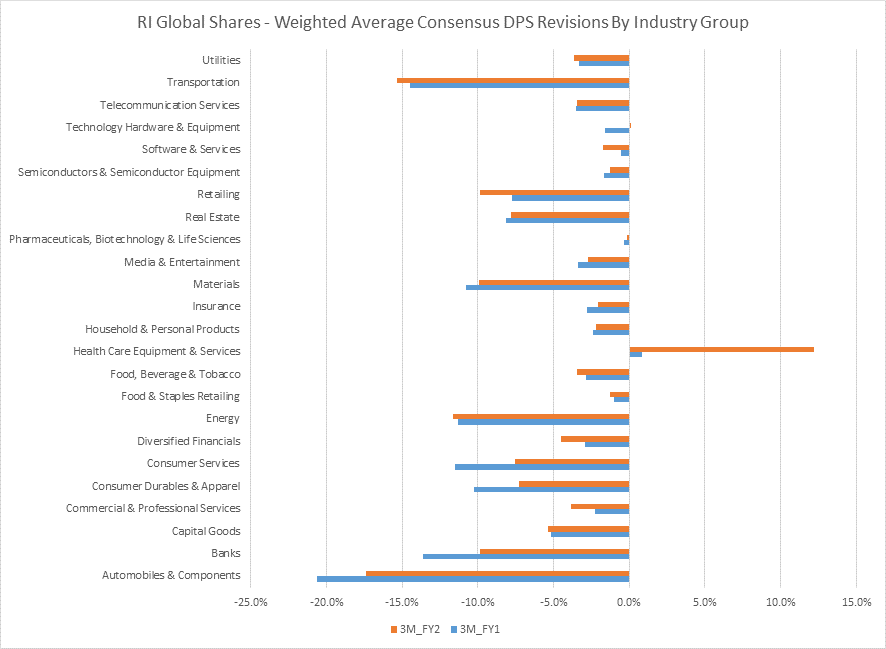
Source: Realindex, Factset as at 31 March 2020

Impact on Australian portfolios 

Our modeling suggests dividends in Australia will be more severely impacted from COVID-19 than other developed markets.

A decline in aggregate demand from China is likely to affect earnings in the Materials sector, at least in the short term. Real Estate, especially retail, is at risk of distress. Additionally, the low oil price will test the resilience of many energy companies, and we assume that this will lead to dividends being at risk, especially for global portfolios.

Beyond providing income, dividends can also play a key role in influencing corporate behaviour because they act as a signalling mechanism for firms. Strong, consistent dividend payout ratios and payments are a way for investors to understand the confidence that management has in the business.

In addition, companies that cater to the demands of investors by paying dividends can attract a premium for their shares. Significant changes to this behaviour could see changes in valuations going forward.

A changed dividend landscape could affect investment managers too, given that many investment processes rely on dividends as a key measure of company performance. This could be through core company metrics, or more widely through dividend yield and dividend futures. We are in the process of analysing whether we need to amend our normal processes in light of current market conditions, and we expect other managers will be doing the same.

Potential long-term consequences

Overall, the impact of these trends will depend on the length of the crisis. If it is a temporary change, many investment processes and market and corporate behaviour will probably not move markedly when averaged over a longer period. However, if this represents a longer-term change or permanent shift, then the implications may be very different. Time will tell.


David Walsh is Head of Investments at Realindex Investments, a wholly owned investment management subsidiary of First Sentier Investors, a sponsor of Firstlinks. This article is primarily for information. It discusses ideas that are important to the Realindex investment process and clients but may not be affected in the ways discussed here.

For more articles and papers from First Sentier Investors, please click here.


  •   13 May 2020
  • 3
  •      
  •   
3 Comments
Jack
May 13, 2020

Would love to see a calculation on how much $100,000 invested in the Big Four Aussie banks five years ago versus the Big Five US tech companies would now be different in value.

Kevin
May 14, 2020

Hiya Jack.

The difference would be huge in favour of the US Tech stocks. Just Google charts for Microsoft,Amazon,Apple etc.
However we could not see that 5 years ago when the Australian banks were trading at highs CBA at $96.

We don't know what will perform the best over the coming 5 years either,everybody will have their own opinion on that,and probably say I predicted it.

Do you like Afterpay at $40 and see what it is worth in 5 years. $40K to buy 1000 of them.

Ramani
May 17, 2020

Looking at the basics of joint stock enterprise, it is Orwellian that we are debating the pros and cons of distributing dividends vs retention, as if it is a foregone premise.
Equity investors commit capital to the extent uncalled. The agents (Board and management) 'assisted' by the corporate regulator and the stock exchange on which the stock is listed are expected to take care of stakeholder interests.
In a crisis like the present, it seems somehow ok for the agents to push aside investor interests ahead of counter-party, workers' and ATO to suborn money otherwise belonging to investors who take the residual risks. A question of inmates running the asylum, or agency risk morphing into saving their jobs and options. Investors relying on distributions is forced to fend for themselves by selling parcels of their stock in a crashing market.
All in the name of a bird in the future bush is worth more than one in hand.
Time to do more to make corporate democracy real instead of the current oligarchy overrun by boards, managers, academics and the state?


Leave a Comment:

RELATED ARTICLES

My SMSF in 2022: the good, the bad and the lucky

Is growth of zombie companies real or fiction?

Three reasons why current dividends matter

banner

Most viewed in recent weeks

Why spending more in early retirement can improve lifetime income

Conventional wisdom encourages retirees to preserve superannuation. But if those likely to qualify for the Age Pension later in life spend a little more today, it may deliver higher lifetime income and a more stable retirement.

Testamentary trusts have secured the CGT exemption

Treasury’s latest CGT reform draft delivers a win for testamentary trusts and deceased estates, exempting estate-derived gains from the 30% floor. However, questions on death and divorce rollovers remain unresolved.

Meg on SMSFs: What do we think about reversionary pensions these days?

Reversionary pensions have long been a staple of SMSF estate planning, but are they still the best option? Meg Heffron revisits a once-clear favourite and asks whether changing super rules have shifted the balance.

Is it time to bail on Australian stocks?

For generations, Australian investors have backed banks, miners and dividends. But has that loyalty come at a cost? A look at the numbers raises an uncomfortable question about where future returns will come from.

How does the 4% rule stack up?

The 4% rule has long been retirement's gold standard. But after a difficult period for investors, fresh analysis suggests a more conservative approach may significantly improve the chances of making savings last.

Testamentary trusts survived the trust tax. The drafting battle has just begun.

The fight over testamentary trusts looked settled. Then the draft legislation arrived. Hidden in a technical detail is a question that could force many families to rethink wills they thought were already future-proof.

Latest Updates

Planning

How the typical Australian Family could save $844,350 in taxes

The value of a testamentary trust is not determined by wealth alone. Depending on circumstances, it can reduce the tax burden on inherited income, create efficiencies and help build intergenerational wealth.

Superannuation

There's a reason why your super is locked up until your 60s

For decades, it seemed settled. Then one controversial idea reignited a debate that could reshape the financial future of millions. The real question isn’t who’s right or wrong, but whether a long-held assumption deserves another look.

Property

The housing slide could become a crash

House prices are sliding across Australia, yet the most dangerous ingredient for a housing crash is still missing. If job losses surge amid growing economic risks, today's correction could become a historic property downturn.

Retirement

Under-retiring: The greatest retirement risk in a generation

Two retirees. Similar savings. Completely different lives. New research from Challenger reveals why some Australians confidently spend in retirement while others hold back and the overlooked factor shaping retirement decisions.

Five risks to watch in markets

Things you may often hear are: a recession is around the corner, markets are overpriced, the AI sector is about to flop at any moment. It’s like the never-ending laundry pile that sits in my house, it never really disappears.

Investment strategies

Do you qualify as ‘rich’?

What does it mean to be 'rich'? For something so universally desired, it is surprisingly difficult to define. That ambiguity creates a challenge for investors and raises a bigger question about what financial success really looks like.

Investment strategies

If you’re worried about your bond portfolio, you’re missing the point

Most investors think they know what bonds are for. But when markets turn volatile, a surprising misunderstanding can lead to costly decisions. Here’s the overlooked lesson that could change how you view your portfolio.

Alliances

  • ASA-Logo-RGB-ActiveGreen-web.png

© 2026 Morningstar, Inc. All rights reserved.

Disclaimer
The data, research and opinions provided here are for information purposes; are not an offer to buy or sell a security; and are not warranted to be correct, complete or accurate. Morningstar, its affiliates, and third-party content providers are not responsible for any investment decisions, damages or losses resulting from, or related to, the data and analyses or their use. To the extent any content is general advice, it has been prepared for clients of Morningstar Australasia Pty Ltd (ABN: 95 090 665 544, AFSL: 240892), without reference to your financial objectives, situation or needs. For more information refer to our Financial Services Guide. You should consider the advice in light of these matters and if applicable, the relevant Product Disclosure Statement before making any decision to invest. Past performance does not necessarily indicate a financial product’s future performance. To obtain advice tailored to your situation, contact a professional financial adviser. Articles are current as at date of publication.
This website contains information and opinions provided by third parties. Inclusion of this information does not necessarily represent Morningstar’s positions, strategies or opinions and should not be considered an endorsement by Morningstar.