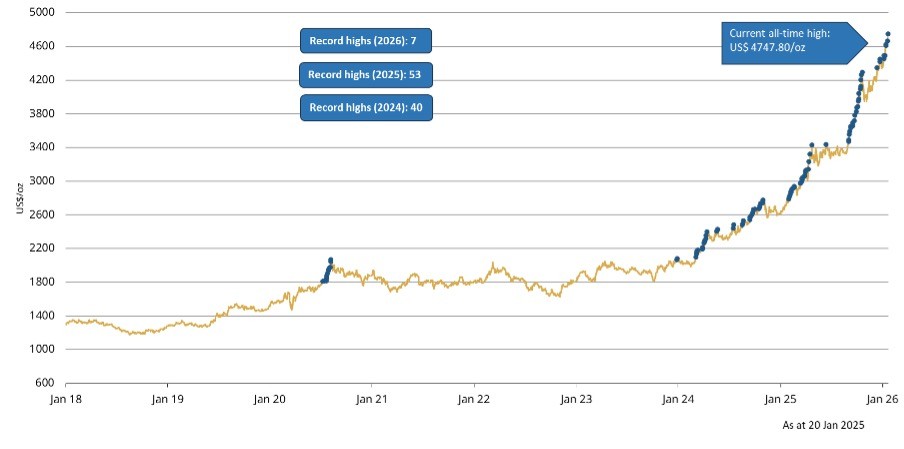
Gold entered 2026 the same way it exited 2025: at record highs. To date, the gold price has already notched seven all-time highs this year, extending a run that saw more than 53 new records in 2025 alone, totalling 95 all-time highs since 2024. For some investors, this raises an uncomfortable question: have we missed it?
In my experience, that question often reflects a misunderstanding of why gold has been performing so strongly, and what role it is designed to play in a portfolio.
Gold’s continued rally into 2026 is not being driven purely by fear, crisis headlines or short-term speculation. Its strength increasingly reflects deeper, more structural shifts in how asset classes behave, how policy is evolving, and how risk is being priced across markets – all of which shape portfolio construction and resilience.
Figure 1: Gold has reached 95 all-time-highs since 2024
All-time-highs in the LBMA PM benchmark price (US$/oz)
Momentum matters — but it’s not the whole story
There is no doubt that momentum and uncertainty have played a role in gold’s recent price. And while geopolitical tensions have further flared since the start of the year, economic events trump momentum in driving gold’s continued rally. These include expectations of US Federal Reserve rate cuts, declining real yields, and historically high levels of correlation between fixed income and equity markets.
So, while momentum-oriented investors seeking refuge have played a part, momentum alone can ignite and amplify trends but not sustain a multi-year trend – for any asset for that matter.
What underpins gold’s appeal today is a convergence of macroeconomic forces that are proving far more persistent than many investors expected: sticky inflation risks, rising sovereign debt burdens, and growing uncertainty around the effectiveness of traditional portfolio diversifiers.
These forces are further complicated by the expected change in US Federal Reserve leadership this year, an event that could materially reshape the policy reaction function and inject greater uncertainty into inflation expectations, real yields and broader market pricing.
Importantly, these are not short-lived shocks. They are slow-burn dynamics reshaping the investment landscape, and portfolios are responding accordingly.
The safe-haven trap
Geopolitical events inevitably push gold into headlines. But it’s worth being clear: while gold often responds positively to sudden shocks, those moments are rarely the best time to initiate an allocation.
The protection gold provides frequently shows up before the event, not after it. That is why we consistently caution against treating gold as a tactical trade triggered by breaking news.
Gold’s value lies less in reacting to crises and more in quietly improving portfolio resilience before correlations change and volatility rises.
Bonds lose ballast
Perhaps the most important shift for investors, particularly those managing balanced portfolios, is the changing behaviour of bonds.
For decades, government bonds offered reliable diversification against equity risk. That relationship has weakened, and in some periods broken down altogether. Rising inflation volatility, fiscal expansion and supply-heavy bond markets have altered how fixed income behaves under stress.
Many investors experienced this first-hand in recent years, when both equities and bonds declined together.
This matters because diversification is not about owning different assets - it’s about owning assets that behave differently when it matters most and shore up portfolio resilience.
Gold has historically exhibited low to negative correlation with equities over long horizons, and unlike bonds, it does not rely on a government’s ability to manage inflation, debt or deficits. Nor does gold, as a real asset, carry any counterparty risks. In a world where the interconnectedness of risks is increasingly questioned, gold’s independence matters.
Strategic allocation, not tactical timing
Aside from have we missed our chance?, another very common question we hear is: what’s the right price to buy gold?
The more useful question is: what role should gold play in my portfolio? - as you would ask of any potential portfolio asset.
Trying to time entry points after a strong rally can be counterproductive, particularly for an asset held for diversification benefits. Like any long-term asset, gold’s contribution should be assessed across market cycles, not month-to-month price moves.
This is why the World Gold Council’s research consistently frames gold as a strategic allocation, not a short-term hedge.
Across a wide range of portfolio simulations, allocations in the region of 3 to 10% have historically improved risk-adjusted returns - not because gold always rises, but because it behaves differently when other assets struggle.
Debt, deficits and the long game
While the world enters a period of geopolitical realignment - a backdrop likely to add to market volatility - a major and enduring feature of the global economy remains the scale of sovereign debt accumulation.
Major economies are running persistent deficits with limited political appetite, or ability, to materially reverse course. At some point, investors may begin to question whether bond markets are adequately compensating them for duration, inflation and fiscal risk.
Will 2026 be the year that concern becomes acute? That is impossible to forecast. But the underlying conditions are unlikely to disappear.
Gold’s role here is subtle but important. It is not a bet against any single currency or government. Rather, it acts as a portfolio anchor in environments where confidence in long-term policy outcomes is eroding.
Have investors missed the move — or missed the point?
For many investors, particularly in Western markets, the more pressing risk today may not be over-exposure to gold as a safe-haven, but persisting under-allocation as a strategic diversifier.
While we have seen Western investors reallocate to gold after decades on the sidelines - with Eastern markets continuing to play a far greater role in shaping prices - gold ownership remains modest relative to the size of global capital markets. And many portfolios still rely heavily on asset relationships that no longer behave as reliably as they once did.
Some large institutional investors, including the Future Fund have shifted course in anticipation of a new investment order, selecting assets for long-term resilience.
Seen through that lens, gold’s recent performance is less about a crowded trade, and more about a gradual reassessment of what diversification really means in a changing macro environment.
Gold does not need perfect timing to be effective
Investors who treat gold as a permanent component of their portfolio, building positions over time and rebalancing as conditions evolve, are more likely to capture its benefits than those attempting to trade short-term price movements.
That discipline matters even more after strong performance. Gold’s role is not to predict the next shock, but to help portfolios endure whatever comes next.
In an environment defined by policy uncertainty, rising debt and fragile diversification, gold’s value increasingly lies in disciplined portfolio construction rather than reactive positioning.
John Reade is a Senior Market Strategist, at World Gold Council, a sponsor of Firstlinks. This article is for general informational and educational purposes only and does not amount to direct or indirect investment advice or assistance. You should consult with your professional advisers regarding any such product or service, take into account your individual financial needs and circumstances and carefully consider the risks associated with any investment decision.
For more articles and papers from World Gold Council, please click here.