Register For Our Mailing List

Register to receive our free weekly newsletter including editorials.

Home / 659

Private Credit headwinds move onshore

Before the conflict’s commencement, the financial market’s main worry was the rise of AI tools and the potential implications for software companies, with substantial declines in their equity valuations being a painful experience for many investors. In being large lenders to the software space, US private credit funds have also been caught up in the turbulence, with fears of spiking defaults and lower returns impacting investor confidence.

Outflows from US private credit funds reached a crescendo last week, with famed lender Blue Owl (OWL) announcing investor redemption requests for 1Q26 totalled $US5.4 billion from two of its funds with significant software exposure. Investors in OWL’s Credit Income and Technology Income funds asked for an incredible 22% and 41% of their capital to be returned. For both funds, redemptions are now effectively gated, limited to 5% per quarter in accordance with the funds’ Business Development Company (BDC) structures, resulting in a frustrated queue of investors wanting liquidity.

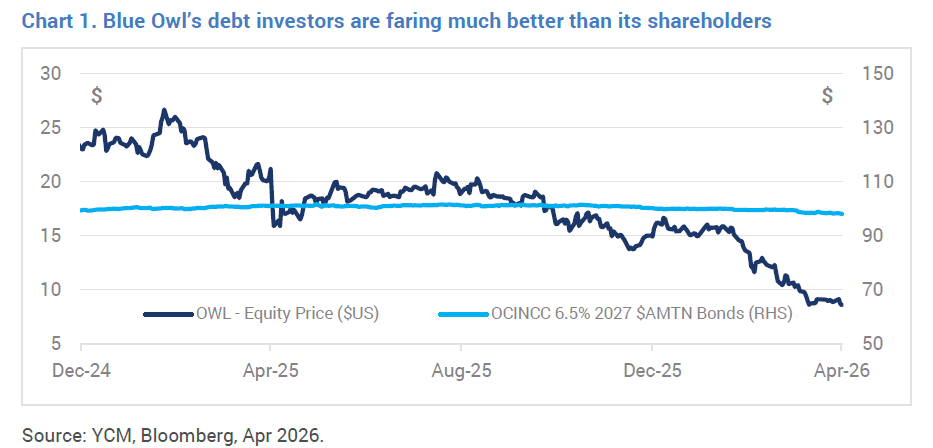
OWL’s share price is now down two-thirds from its peak in early 2025. By contrast, OWL’s Credit Income Fund $A bonds, which are effectively secured against the fund’s underlying assets, are less impacted and continue to hold their value (refer Chart 1). These bonds are protected by a significant equity cushion, with fund leverage at just ~0.7x, redemptions gated and a BDC mandated leverage covenant limit in place of 2x.
While we don’t have the software concentrations, Australian private credit is significantly more exposed to the riskier side of real estate lending, especially higher yielding commercial and residential development. In many ways, private credit’s exponential growth since the GFC was a meeting of minds, with local investors understanding Australian real estate and its resilience through multiple cycles; comfortable loan-to-value completion ratios have acted as a powerful magnet for yield hungry investors.

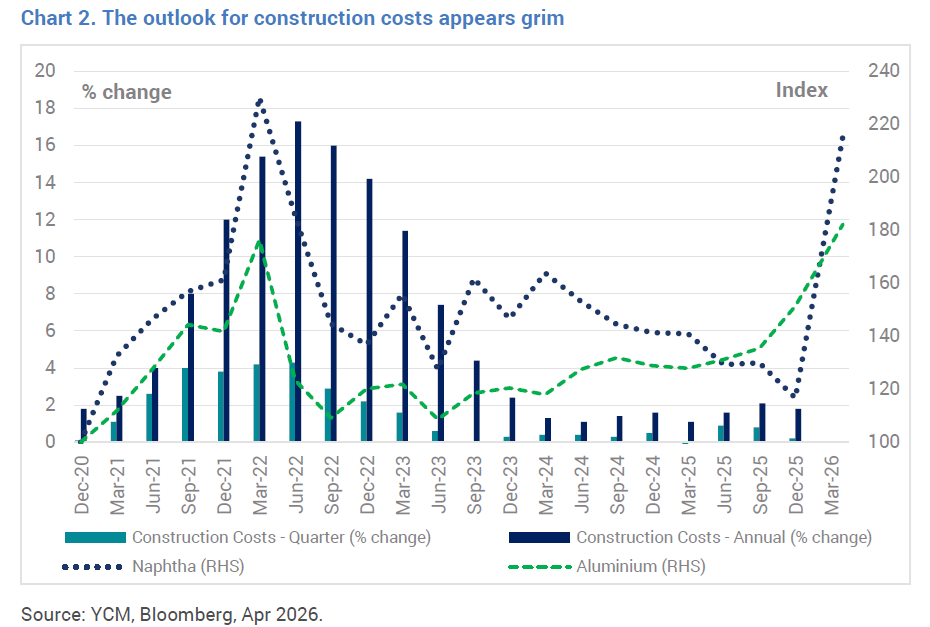
This brings us back to the current Iran conflict and the impact of inevitable cost escalations and higher interest rates on construction sites across Australia. Already weakened through the 2022/23 period of higher interest rates and cost escalations, property development/construction is enduring another round of higher costs (refer Chart 2) and constrained demand. For instance, since the commencement of hostilities, naphtha and aluminium prices – key components in plastic and metal building products – have increased by 85% and 20% respectively. Moreover, in being highly correlated (i.e. increased costs impact all developments similarly), a diversity of development exposures might offer only limited protection from credit losses given the systemic risk profile.
This confluence of events, if sustained, is likely to fuel similar redemption pressures in Australia, with more pure play private credit funds likely to close their liquidity gates in the months ahead. While actual losses will most likely be lower than feared, being unable to meet redemption requests for funds that have been marketed with a ‘promise’ of ungated monthly or quarterly liquidity will be damaging to the private credit landscape.


Phil Strano is Head of Australian Credit Research at Yarra Capital Management, a sponsor of Firstlinks. This article contains general financial information only. It has been prepared without taking into account your personal objectives, financial situation or particular needs. Both the Yarra Enhanced Income and Higher Income Funds are zero leverage funds, providing attractive yields.

For more articles and papers from Yarra Capital, please click here.


  •   22 April 2026
  •      
  •   


Leave a Comment:

RELATED ARTICLES

The improving outlook of Australian commercial real estate

Commercial property prospects are looking up

Has Australian commercial property bottomed?

banner

Most viewed in recent weeks

Indexation implications – key changes to 2026/27 super thresholds

Stay on top of the latest changes to superannuation rates and thresholds for 2026, including increases to transfer balance cap, concessional contributions cap, and non-concessional contributions cap.

The refinery problem: A different kind of energy crisis in 2026

The Strait of Hormuz closure due to US-Iran conflict severely disrupted global energy supply chains. While various emergency measures mitigated the crude impact, the refined product market faces unprecedented stress.

3 ways to defuse intergenerational anger

With the upcoming budget increasingly likely to include bold proposals to alter the tax code I’ve outlined three incremental steps with fewer unintended consequences.

The missing 30%: how LIC returns are understated, and why it matters

The perceived underperformance of LICs compared to ETFs is due to existing comparison data excluding crucial information, highlighting the need for proper assessment and transparent reporting.

Little‑known government scheme can help retirees tap into $3 trillion of housing wealth

The Home Equity Access Scheme in Australia allows older homeowners to tap into their home equity for retirement income, yet remains underused due to lack of awareness and its perceived complexity.

Welcome to Firstlinks Edition 655 with weekend update

Many investors are on edge as geopolitical turmoil continues to impact markets, often leading to short-sighted actions. These are the three quotes that I’ve relied on during periods of volatility.

  • 26 March 2026

Latest Updates

Retirement

2 billion reasons to fix retirement income

A proposal to address Australia's 'stranded balances' in retirement by requiring super funds to transition members to pension phase at 65, boosting retirement income and reframing super as a source of income.

Investment strategies

Not much alpha left in this bet

Google redefined advertising with its innovative business model, but its dominance is now under siege from AI competitors and shifting market dynamics.

Five simple reasons why Australian cash rates are highest

Australians are suffering the highest cash rates amongst their rich country peers for five simple reasons, including outdated inflation targeting and undisciplined monetary and fiscal policies.

Investment strategies

Spending big on AI: So where’s the proof it’s working?

Business leaders must reassess AI's return on investment using new frameworks that reflect productivity, capability shifts and long-term value creation.

Economy

Double down on renewables?

Global volatility has sharpened Australia's focus on energy security. Calls for domestic fuel production clash with renewable energy goals, sparking a debate on balancing traditional and sustainable energy sources effectively.

Investment strategies

Private Credit headwinds move onshore

It’s been a volatile couple of months in markets with the ongoing conflict in Iran. For Australian private credit investors, however, large exposures to real estate lending could mean the worst is yet to come.

Property

Five reasons unlisted commercial property is an attractive allocation in uncertain times

Cromwell takes a look at replacement cost as a practical lens on relative value in commercial property. When build-new costs rise faster than asset pricing, the gap can create opportunities in well-located existing assets.

Sponsors

Alliances

© 2026 Morningstar, Inc. All rights reserved.

Disclaimer
The data, research and opinions provided here are for information purposes; are not an offer to buy or sell a security; and are not warranted to be correct, complete or accurate. Morningstar, its affiliates, and third-party content providers are not responsible for any investment decisions, damages or losses resulting from, or related to, the data and analyses or their use. To the extent any content is general advice, it has been prepared for clients of Morningstar Australasia Pty Ltd (ABN: 95 090 665 544, AFSL: 240892), without reference to your financial objectives, situation or needs. For more information refer to our Financial Services Guide. You should consider the advice in light of these matters and if applicable, the relevant Product Disclosure Statement before making any decision to invest. Past performance does not necessarily indicate a financial product’s future performance. To obtain advice tailored to your situation, contact a professional financial adviser. Articles are current as at date of publication.
This website contains information and opinions provided by third parties. Inclusion of this information does not necessarily represent Morningstar’s positions, strategies or opinions and should not be considered an endorsement by Morningstar.