Register For Our Mailing List

Register to receive our free weekly newsletter including editorials.

Home / 639

Where to hide in the ‘everything bubble’

Stock markets have been shaky of late and talk of an AI bubble is rife. Bubbles don’t normally pop when everyone is talking about them and they also have a bad habit of going on for longer than most people think and/or can endure.

Stepping back from the daily noise, it’s clear that this AI bubble is different. The Magnificent Seven stocks are stupendously profitable, which makes them unlike the profitless tech names of the late 1990s. And their valuations aren’t nearly as high as those of the internet bubble or other bubbles.

The concern with the Magnificent Seven is about the sustainably of their magnificent profits and margins. Competition is heating up in the battle for AI supremacy and the companies are spending hundreds of billions of dollars on what could be a winner take all contest.

Recently, Meta CEO Mark Zuckerberg said that an AI bubble is “quite possible” though the larger risk for his company is hesitating.

"If we end up misspending a couple of hundred billion dollars, I think that that is going to be very unfortunate, obviously," he said. "But what I'd say is I actually think the risk is higher on the other side."

Increasing competition and investment normally lead to eroding margins and earnings. That hasn’t happened yet, but investors are focusing more on this and that’s led to some of the recent market volatility.

It’s not just the Mag Seven

There might be more of a worry with the valuations of smaller tech stocks. The only one of the Magnificent Seven that looks ludicrously expensive is Tesla, which is trading at a trailing price to earnings (P/E) ratio of 279x, though it’s been exorbitantly priced throughout most of its history.

There are lots of smaller tech names at mind-boggling valuations. For instance, leading AI business, Palantir, is trading at 106x revenue. It might be a good company but that valuation will be almost impossible to justify.

It’s not just tech in the US where prices seem high; it’s broader than that. Take large retailers such as Costco and Walmart. Both superb companies though they’re trading on PE multiples of 49x and 36x respectively. That’s a headscratcher given that they’re mature companies with slow and steady growth.

Outside of stocks, there’s been plenty of speculative activity too. Until lately, Bitcoin had been the best performing asset for almost any time frame over the past decade.

Gold had its moment in the headlines as people started queuing at ABC Bullion in Martin Place, which marked a peak in the yellow metal’s price, at least for now.

Residential property prices in Australia have popped up again, thanks to lower interest rates and the government’s ludicrous subprime mortgage scheme – I mean, 5% deposit scheme. The big question is whether momentum will stall if rates don’t go down further.

And private assets have also grabbed the limelight as money pours into the space. Cracks have emerged in this asset class though as some large private debt deals turn awry and private equity, especially funds that raised money and bought assets when rates were ultra-low in 2020-2021, is being forced to sell some of these assets at knock down prices (so-called ‘secondary’ sales).

Given the amount of money sloshing around and resulting speculative activity, it’s hard to believe that central banks are cutting rates. But that’s what they’re doing and the US is likely to cut much harder when Trump gets his nominated US Federal Reserve Governor in by May next year. Trump has openly stated rates should be much lower and the new Governor is unlikely to let him down (Fed independence be damned).

That’s what markets are betting on and why they may continue to go higher. At least for now.

Where to hide?

That begs the question about the best places to hide if you think a storm may be brewing. And that’s not an easy one to answer.

Cash is an obvious place to go. It offers the advantage of being liquid and can be deployed if markets go down. The disadvantage is they earn little to nothing, and after inflation, you go backwards.

Fixed term deposits are a favourite for many people. The rates for these deposits have started to tick back up, with expectations that the RBA may be done with cutting rates. So, the largest bank, CBA, is now offering fixed term deposit rates of 3.4% for six months and 4% for 12 months. My own go-to, Judo Bank, has rates of 3.9% for six months and 4.4% for 12 months.

The disadvantage with fixed term deposits is they’re taxed as income. Post tax, they aren’t going to earn you much after inflation is taken into account (especially after the latest inflation reading).

Bonds are hated by almost everyone right now, and that piques my interest. Every survey of institutional and retail investors suggests bonds have significantly decreased in asset allocations.

However, I suggested for more than three years that bonds are in a structural bear market, and previous bond markets have lasted about 30 years on average. We might be only five years into this one.

Therefore, while bonds might warrant a larger allocation in the short term, I remain negative on the asset class in the long term.

Turning to higher risk assets, not all equities and equity markets are frothy. The one area that stands out to me is value stocks. I’ve said it before but there are very few value-oriented fund managers left in the business. Most have been driven out as value has spectacularly underperformed growth stocks since the GFC.

It’s worth noting that during other periods where this happened, value subsequently got its revenge. In the inflationary 1970s, US value stocks trounced the index and their growth counterparts.
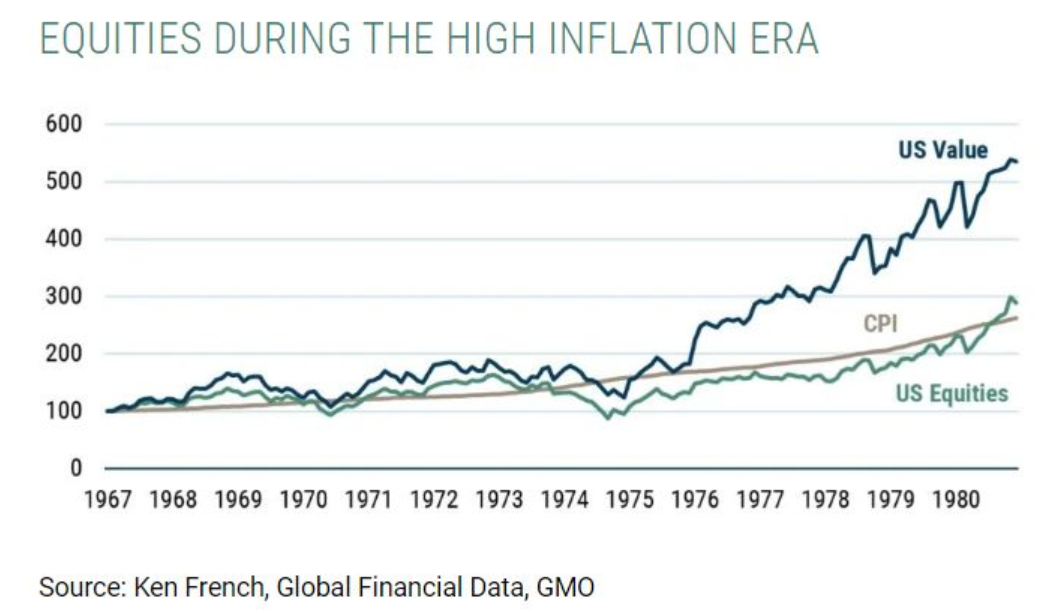
A similar thing happened in 2000-2001.

Today’s set-up for value stocks again looks interesting. Value has significantly underperformed growth and valuations look reasonable. The following charts show the breakdown for US stocks.
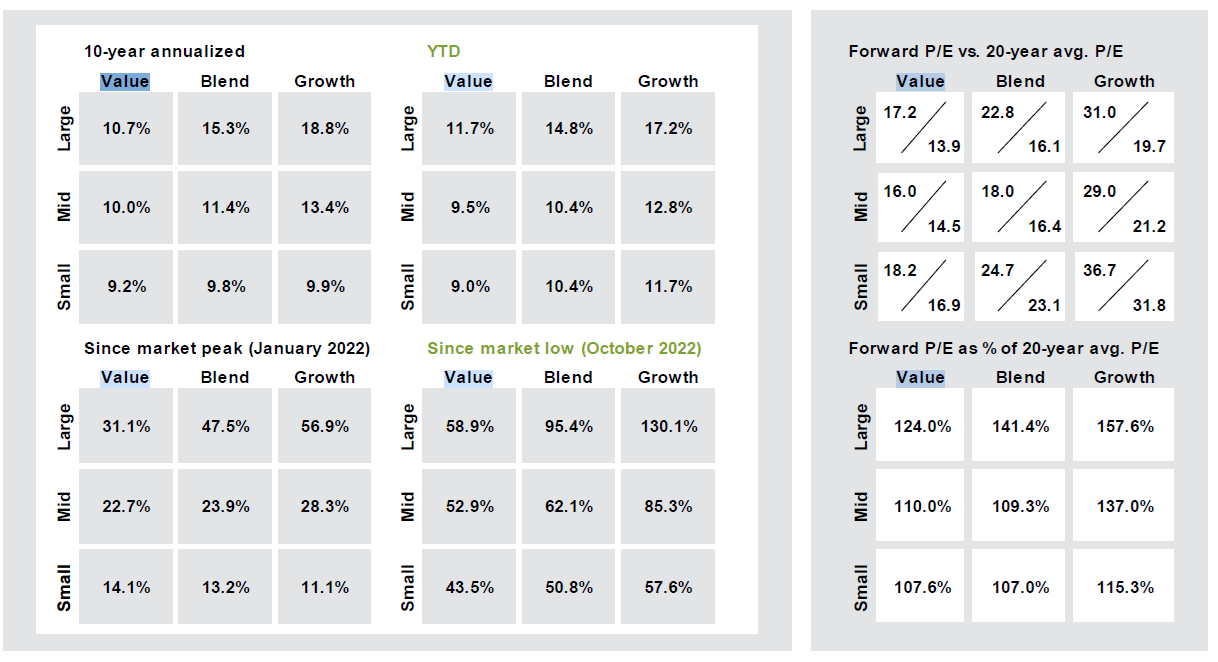
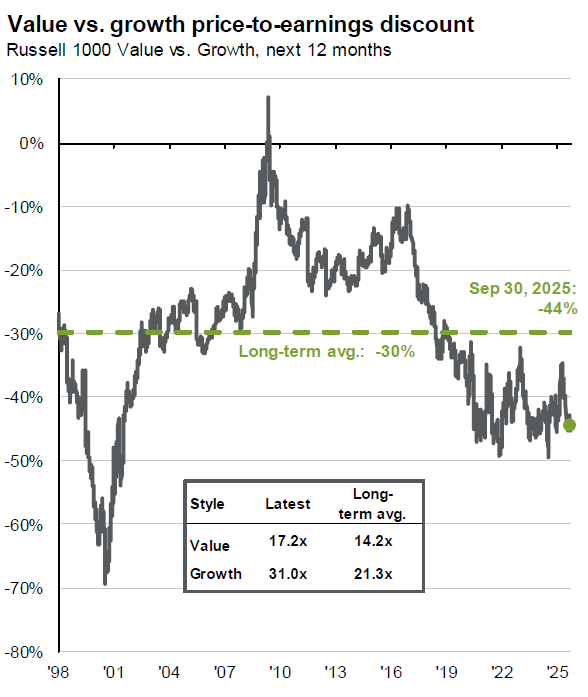

Note: As of end-September 2025. Source: JPM

Outside of the US, stocks aren’t as expensive. They’re not cheap versus history, though they aren’t extended as America’s. It’s fascinating that South Korea, a perennial global market laggard, is up 61% year-to-YTD, crushing even the likes of the US. Which goes to show that while everybody crowds into the US and US tech, there are opportunities elsewhere.
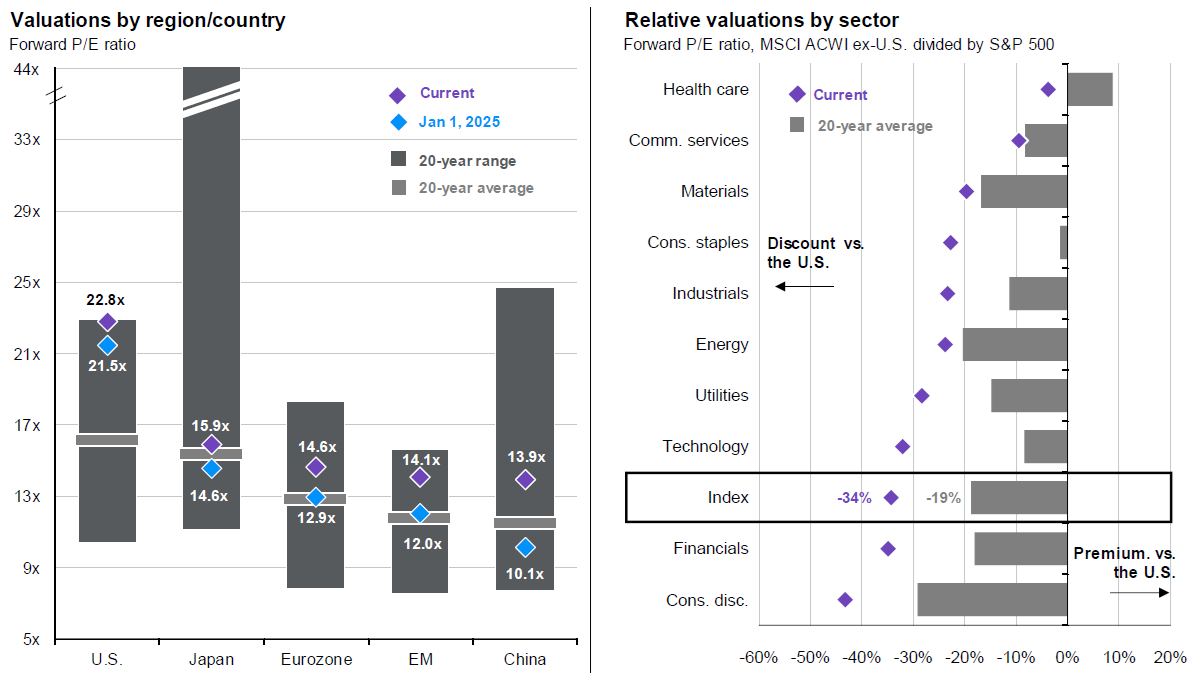

Note: As of end-September 2025. Source: JPM

On private assets, I am a sceptic. The main problems I have with them are around liquidity and transparency. Private equity and private debt are the private variations of public equity and public debt. That may sound obvious yet isn’t mentioned enough. And while public equity and debt often offer daily pricing and daily liquidity, most private equity and debt don’t. So, unless you’re compensated for the extra risks of holding private equity and debt, it may not be a great deal for retail investors.

As for other ‘alternative’ assets, I recently wrote about how I’d held gold for 17 years and had been selling down, especially as people started lining up to buy physical gold. I still hold some gold primarily as a hedge against government and central bank stupidity, but what worries me is the gold price has been going nuts alongside stocks, and if stocks swoon, gold may not be the portfolio diversifier that it has been in the past.

On Bitcoin, Charlie Munger described it as ‘rat poison’, and I don’t think he was too far wrong. I question what it’s useful for, other than being a conduit for scammers and criminals.

What to do with your portfolio?

Stress testing your portfolio makes a lot of sense right now. Would you be comfortable if global stocks went down 50%? Which areas would be most at risk if that happens? Perhaps you’re overweight US and particularly US tech stocks - could it be time to dial down some risk? Is your portfolio truly diversified?

If you’ve set up your portfolio right, it might be best to do nothing. If you haven’t, hopefully my suggestions can prompt ideas for tinkering, if necessary.


James Gruber is Editor of Firstlinks.


  •   26 November 2025
  • 14
  •      
  •   
14 Comments
Lauchlan Mackinnon
November 27, 2025

So, where DO you suggest people hide?

As far as I can see, the only option you gave are

1. "Cash is an obvious place to go. It offers the advantage of being liquid and can be deployed if markets go down. The disadvantage is they earn little to nothing, and after inflation, you go backwards." and

2. "Outside of the US, stocks aren’t as expensive. They’re not cheap versus history, though they aren’t extended as America’s. It’s fascinating that South Korea, a perennial global market laggard, is up 61% year-to-YTD, crushing even the likes of the US. Which goes to show that while everybody crowds into the US and US tech, there are opportunities elsewhere."

I think you would have to put the South Korean story in the context of the changes to governance there, which both raised the asset prices and raised the quality of the companies. Japan is another good Asian option. I kind of like global leaders like IOO and ESTX as kind of "blue chip" investments.(*)

It seems to me that in an overvalued market, if you are an active investor adjusting your portfolio to the current context on a monthly or quarterly basis, you'd be moving significant portion of your allocation out to cash.

But the deeper story probably SHOULD be (in my view) that if you're a long term "buy and hold" investor, particularly through broad based ETFs, you DON'T try to hide. You hold. Even for broad based tech like NDQ, or for the "magnificent 7" stocks like FANG+ (if you still believe in them over the long term). (*)

Overvaluation now isn't really the point. The point is the valuations in the future, over the term of your investment horizon.

* I am not a financial advisor, and any comments about stocks and ETFs above are my opinions only, and not general educational advice or tailored financial advice.

12
OJP
November 27, 2025

To Lauchlan Mackinnon,
Well said. And I've been enjoying your various comments and debates these recent weeks.

4
Lauchlan Mackinnon
November 27, 2025

Thanks OJP! :)

1
Wildcat
November 27, 2025

I agree with James that the earnings profile looks very different compared to then the world changing idea (the internet) in 1999. However history doesn't repeat but it rhymes, especially in financial markets. There used to be 100+ car companies in the US, now there are 3. There was an oil boom in the 1860's but without refineries and petrol stations there was a bust before oil changed the world. There was a bust in the 1830's for railroads in the US.

Bottom line is we have had a series of life changing technological advances. And they all had a profound impact on our lives and economies, as I'm sure AI will also.

What is also common is the companies participating in the first boom don't typically last from the "new thing" phase to the commercialisation and profit stage. Or if they do they are heavily diluted and/or merged.

From the market peak in 2000 it took 15 years for Nasdaq to recover the peak including dividends. The AI bust, assuming history repeats yet again, will likely not be so drastic again due to the current earnings, but think of this......if it took you 15 years to recover your capital WITHOUT accounting for opportunity cost simply doing nothing, Is this a wise thing to do?

By the way market timing also doesn't work unless you get lucky, so you need to tactically allocate over your longer term goals and not simply strap in and "enjoy the ride"....at least in my opinion.

1
Lauchlan Mackinnon
November 27, 2025

Wildcat,

I mostly agree with you ;)

I agree that tech innovation drives economic and market growth. Where you say "the companies participating in the first boom don't typically last from the "new thing" phase to the commercialisation and profit stage" I think that's sometimes true, but these are the biggest companies in the world. If someone else wins, one of these companies will probably buy them. Also, Gary Hamel wrote a management book "Competing For The Future." It described a scenario where there is a new technology (it's an old book, so if I recall correctly he used the example of plasma screen TVs). A lot of players jostle for positioning, building up a capability around the new technology which hasn't been brought to market yet. Eventually, it becomes viable, and there's a sprint to become the market leader. Then the market shakes out to a only few winners in each new market category. That's where I think AI is at now - they're "competing for the future."

I agree with your point around that it takes time to recover from dips. My reading of the charts though is that the recovery of the NASDAQ over 15 years wasn't one recovery, it was two. The NASDAQ (and S&P 500) recovered from 2000, and then after 7 years or so had pretty much recovered to where it was. Then it got hit AGAIN by the 2007-2008 financial crisis. So what looks like one 14 year downturn is more like two 7-year downturns in a row.

I think it's pretty unlucky to be hit by two major market crises in a row like that. If I was in the retirement phase myself though, I'd note that both of those crises hit the US much harder than Australia, and I'd likely move a lot of my asset allocation back to Australia to protect against that risk (i.e. I'd probably decide that the US is a riskier market than Australia and re-allocate assets accordingly).

This wouldn't be market timing - a "buy and hold" strategy over the long term for a broad based ETF is, in my view, fairly resilient.

3
OJP
November 27, 2025

To Allan B- very droll !!
Not that I've been to Svarlbard, but it's a suitably remote location to ponder life and the meaning of the universe.

8
Mark720
November 27, 2025

Now is not the time to forget Keynes, who said; "Markets can remain irrational longer than you can remain solvent".

4
Lauchlan Mackinnon
November 27, 2025

I agree with your sentiment. :)

If we get a little nerdy about it though, there's no evidence that Keynes actually said that - it was more likely A. Gary Shilling in the 1980s: https://quoteinvestigator.com/2011/08/09/remain-solvent/

Guy
November 28, 2025

Buy and Hold for the long term is fine if you are young and have plenty of time on your hands to ride out the inevitable highs and lows. It may not be the right strategy if you are retired with a good deal of cash and term deposits to be plunging into this market environment. If you had a portfolio of ETF's heavily weighted to the USA I would be taking some profits.

2
Dudley
November 28, 2025


Die with riches:

Tax 0%, return 4.5%, inflation 2.5%, to 95, from 75, capital Present Value $5,000,000, capital Future Value (today's money) $1,000,000;
= PMT((1 + (1 - 0%) * 4.5%) / (1 + 2.5%) - 1, (95 - 75), -5000000, 1000000)
= $262,989 / y

3
Lauchlan Mackinnon
November 28, 2025

Guy,

It's a good point.

One thing I took away from financial planning books I read, though, is to think carefully about what your investment horizon actually is.

If you're 35, you might initially think your investment horizon for capital accumulation is for 30 years, through to 65 - when you might plan to retire.

But if you're 60, you might rethink, and imagine that your investment horizon is that your money may need to last you through till you're 90. At 60, you probably should be a long term investor for the next 30 years, and by that logic you should still have at least some of your capital allocated to high growth assets as a long term play.

The bigger issue to me on the US risk front is what we think the US's long-term prospects are under it's current leadership, i.e. how much damage is the current leader capable of doing? And I imagine the honest answer is that no-one knows. And to the point of this article about the "everywhere bubble," no-one really knows how to mitigate it either.

4
Pete
November 28, 2025

That's a sensible approach. But if you did own a basket of US equities and they capitulated, would it be worth buying more based on your 'margin-of-safety'? For example, I own a large swag of an ETF that's invested in global shares, predominantly the US due to weighting/Market Cap. My cost base is almost half that of the current NAV. I have no inclination what-so-ever in taking profits. Instead, I'm waiting for a 50% pullback so I can buy more and increase my share count.

5
Graham W
November 29, 2025

In my opinion, only gold is a buy and hold for a long time apart from your home. The ideal place to buy gold is in a SMSF. If you need to realise some it will be CGT free if sold in pension mode. Otherwise it's wealth protection during pre retirement

1
 

Leave a Comment:

RELATED ARTICLES

What should you do next?

Australian equities: a tale of two markets

The quiet winners of AI competition

banner

Most viewed in recent weeks

Warren Buffett's final lesson

I’ve long seen Buffett as a flawed genius: a great investor though a man with shortcomings. With his final letter to Berkshire shareholders, I reflect on how my views of Buffett have changed and the legacy he leaves.

The housing market is heading into choppy waters

With rates on hold and housing demand strong, lenders are pushing boundaries. As risky products return, borrowers should be cautious and not let clever marketing cloud their judgment.

Why it’s time to ditch the retirement journey

Retirement isn’t a clean financial arc. Income shocks, health costs and family pressures hit at random, exposing the limits of age-based planning and the myth of a predictable “retirement journey".

Australia's retirement system works brilliantly for some - but not all

The superannuation system has succeeded brilliantly at what it was designed to do: accumulate wealth during working lives. The next challenge is meeting members’ diverse needs in retirement. 

The 3 biggest residential property myths

I am a professional real estate investor who hears a lot of opinions rather than facts from so-called experts on the topic of property. Here are the largest myths when it comes to Australia’s biggest asset class.

Welcome to Firstlinks Edition 637 with weekend update

What should you do if you think this market is grossly overvalued? While it’s impossible to predict the future, it is possible to prepare, and here are three tips on how to best construct your portfolio for what’s ahead.

  • 13 November 2025

Latest Updates

Investment strategies

Howard Marks: AI is "terrifying" for jobs, and maybe markets too

The renowned investor says there’s no shortage of speculative investors chasing AI riches and there could be a lot of money lost in the process. His biggest warning goes to workers and the jobs which will be replaced by AI.

Property

The 3 biggest residential property myths

I am a professional real estate investor who hears a lot of opinions rather than facts from so-called experts on the topic of property. Here are the largest myths when it comes to Australia’s biggest asset class.

Retirement

Australia's retirement system works brilliantly for some - but not all

The superannuation system has succeeded brilliantly at what it was designed to do: accumulate wealth during working lives. The next challenge is meeting members’ diverse needs in retirement. 

Retirement

Retirement affordability myths

Inflated retirement targets have driven people away from planning. This explores the gap between industry ideals and real savings, and why honest, achievable benchmarks matter. 

Retirement

Can you manage sequencing risk in retirement?

Sequencing risk can derail retirement, but you’re not powerless. Flexible withdrawals, investment choices and bucketing strategies can help retirees navigate unlucky markets and balance trade-offs.    

Retirement

Don’t rush to sell your home to fund aged care

Aged care rules have shifted. Selling the family home may no longer be the smartest option. This explains the capped means test, pension exemptions and new RAD exit fees reshaping the decision.

Shares

US market boom-bust cycles - where are we now?

This gives comprehensive data on more than 100 years of boom and bust cycles on the US stock market - how the market performed during these cycles, where the current AI uptick sits, and what the future may hold.

Property

A retail property niche offers a lot more upside

Retail real estate is outperforming as a cyclical upswing, robust demand and constrained supply drive renewed investor interest. This looks at the outlook and the continued rise of convenience assets. 

Sponsors

Alliances

© 2025 Morningstar, Inc. All rights reserved.

Disclaimer
The data, research and opinions provided here are for information purposes; are not an offer to buy or sell a security; and are not warranted to be correct, complete or accurate. Morningstar, its affiliates, and third-party content providers are not responsible for any investment decisions, damages or losses resulting from, or related to, the data and analyses or their use. To the extent any content is general advice, it has been prepared for clients of Morningstar Australasia Pty Ltd (ABN: 95 090 665 544, AFSL: 240892), without reference to your financial objectives, situation or needs. For more information refer to our Financial Services Guide. You should consider the advice in light of these matters and if applicable, the relevant Product Disclosure Statement before making any decision to invest. Past performance does not necessarily indicate a financial product’s future performance. To obtain advice tailored to your situation, contact a professional financial adviser. Articles are current as at date of publication.
This website contains information and opinions provided by third parties. Inclusion of this information does not necessarily represent Morningstar’s positions, strategies or opinions and should not be considered an endorsement by Morningstar.