Register For Our Mailing List

Register to receive our free weekly newsletter including editorials.

Home / 363

Welcome to Firstlinks Edition 363

  •   25 June 2020
  • 4
  •      
  •   

Weekend update: The US finished Friday on a weak note, with the S&P500 down 2.4% and NASDAQ losing 2.6% driven a loss of advertising revenue at both Facebook and twitter. Fears of a second virus wave pushed both the Australian and global stock markets down margionally for the week. A closing of economies will be even more difficult second time around.  

***

Since March, the stock market has defied most equity pundits and pushed through fears of ongoing recession, job losses and business closures. In Australia specifically, the loss of stimulus from population growth and immigration is underestimated. Releasing new population data last week, ABS Demography Director Lauren Ford said:

"The population at 31 December 2019 was 25.5 million people, following an annual increase of 349,800 people."

Natural increase accounted for 39.8% of the population growth, while net overseas migration claimed 60.2%. With 305,800 births and 166,700 deaths, the natural increase of 139,100 was a drop of 5.2% over the previous year. In recent years, there has been a decline in Australia's fertility rate, with births per woman down to about 1.7 (Source: ABS). We're not replacing ourselves.
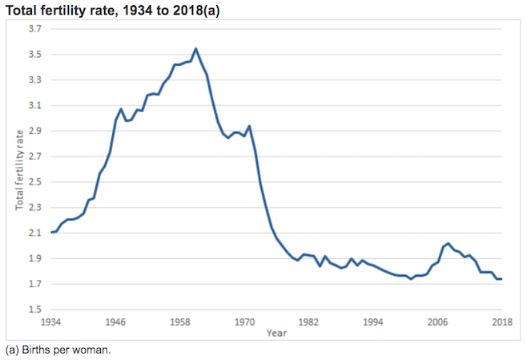
We rely heavily on migration for population growth, with 533,500 overseas migration arrivals and 322,900 departures resulting in net overseas migration of 210,700 people in one year. It creates demand for a lot of houses and sofas and cars and washing machines.

That was before COVID-19. With travel bans in place, borders closed and many parts of the world unable to control the virus spread, net overseas migration is forecast by the Government to fall 85% for the next two years. It will continue at lower levels for years as we raise the drawbridge with political pressure to give Australians jobs before migrants.

This major change will also take some pressure off infrastructure, house prices and wages. Shane Oliver at AMP Capital estimates that underlying demand for houses will fall by 80,000 dwellings a year due to immigration falling.

ANZ Chief Executive Shayne Elliott said recently:

"The reality is there is no V-shaped recovery because our economy is open and very, very dependent on exports and tourists and migrants and foreign students."

The 300,000 less permanent arrivals over two years represent a further setback for budget recovery, as many would have been skilled migrants and high-level taxpayers.

Meanwhile, over in the US, the Federal Reserve injections of liquidity took a new turn this week with Standard & Poor's Global Ratings adding a record number of companies to its 'fallen angel' list. These are bonds the Fed is buying which might soon be rated junk or never repaid, and that's not how a central bank should manage public money. S&P said:

"Potential fallen angels, or issuers rated BBB- with negative outlooks or on CreditWatch with negative implications, climbed to a fresh record high of 126 in the five months to May from 111 in the January-April period on lingering credit pressures due to the coronavirus pandemic."

And if we ever needed proof that future returns will be less than in the past for a very long time, Austria issued a Euro 2 billion bond this week for 100 years yielding 0.88%. At least none of the buyers will see it mature.

In this week's edition ...

When a market continues to rise defiantly, it's often because there is a source of new money or existing investors are doing something differently. Damien Klassen dissects where this demand is coming from to judge if it is sustainable. The US market fell heavily overnight and Australia will follow today.

Last week's article on 'Robinhood' investing had a tragic footnote when the next day, Forbes reported that a 20-year-old had committed suicide when his balance was reported as negative US$730,000, said to be the result of the timing of some complex option trades. Noel Whittaker has been advising clients for decades, and in describing his worries about these new, inexperienced traders entering the market, he reveals his trading secret I had to double-check to believe.

A traditional 60/40 investment portfolio seeks to buffer the risk of equities with the downside protection of bonds, but Amy Arnott believes it needs reviewing with bonds offering poor future returns. How do investors cope with the added risk if they go 80/20?

Rodney Lay researches many LICs and LITs, and the ongoing problems of funds trading at a discount to NTA have led him to the view that all boards and investment managers must review whether their structure is in the best interests of investors and not just themselves. He highlights a new development they should all consider. It's a frustrating space for investors, with another example this week at the highly-regarded VGI Investors. A senior portfolio manager, Douglas Tynan, resigned to move to a non-executive role, and at the time of writing, VG1 is trading at $1.89 versus an NTA of $2.32, a whopping 18.5% discount.

The latest data on SMSFs released by the Australian Taxation Office gives a much-improved picture on expenses compared with a previous study by ASIC. Franco Morelli reports on how much it costs to run an SMSF to see how you compare.

Dr Paul Mazzola examines social impact investing, and especially the potential to introduce a Social Impact Credit System to give investors better information.

Jonathan Rochford's look at the global news media links to quirky, revealing and sometimes controversial items most of us miss. 

In this week's Sponsor White Paper, Neuberger Berman makes the case for investing in credit and bonds in the coronavirus climate at a time when new allocation decisions for FY21 are underway.


Graham Hand, Managing Editor

A full PDF version of this week’s newsletter articles will be loaded into this editorial on our website by midday.

Latest updates

PDF version of Firstlinks Newsletter

Chi-X releases a new range of TraCRs, US-listed companies now tradeable in Australia

ASX Listed Bond and Hybrid rate sheet from NAB/nabtrade

Indicative Listed Investment Company (LIC) NTA Report from Bell Potter

Latest LIC (LMI) Monthly Review from Independent Investment Research

Plus updates and announcements on the Sponsor Noticeboard on our website


  •   25 June 2020
  • 4
  •      
  •   
4 Comments
Jackie
June 24, 2020

Agree it would be fantastic to host the Womens World Cup, with a far more sensible bid than the shambles by the men last time. Surely, with Colombia the only competition and all the problems in South America, we must win this time. Start queuing for tickets!

Tony Reardon
June 24, 2020

I have some difficulty reconciling these figures for births and deaths with the statement “We are not replacing ourselves”. The births are shown as 305,800 and the deaths are 139,100 so there is a natural increase of .66% year on year, so isn't this enough to replace ourselves?
I also have some puzzles about the emigration/immigration numbers. These accurately reflect the recently released ABS demographic statistics and show immigration at 533,500 but the Department of Home Affairs report on the 2018/19 migration program shows permanent migration for that fiscal year as only 160,323. The 6 month mismatch for the two sets of figures cannot explain such a huge disparity in numbers and I can only assume that there is some other non-permanent visa category (not just visitors) and I wonder what this does to forecasts of demand for housing and household goods.

Graham Hand
June 24, 2020

Hi Tony, the data quoted comes from ABS so I'll leave the numbers with you.

On my 'we are not replacing ourselves' statement, I look at it like this. If my wife and I are 'average' couples along with nine of our married friends and their partners, the 20 of us will have 17 babies. Over time, that means a net loss of three people. In any particular year, we might not die and there could be more births than deaths, but as the population ages, all 20 of us will die, having left behind 17 children. Then the cycle repeats.

Peter Murphy
June 26, 2020

Graham

Thanks again for your great publishing efforts and your insight to numbers, with the focus on the births rather than the current net figure. I did start reading this section because I thought you might be the only person who has looked into numbers and the impact of Australians returning home. Am I right or wrong in thinking that Aussie returning from time overseas, whether they are backpackers or Rupert, will bring a wealth of experience or perspective that will contribute to our innovation and productivity? And whilst I am asking if I am right or wrong, surely we and our shaky isle friends must be living in the most attractive destinations in the world and therefore will have long lines forming to be let in at our discretion or kindness?


Leave a Comment:

banner

Most viewed in recent weeks

Why have Australian living standards 'fallen' and how do we fix it?

For the last few years there has been much talk of a 'cost-of-living' crisis in Australia and of 'falling living standards'. Lately this has flared up again with the pickup in inflation resulting in a renewed fall in real wages.

Will you run out of money in retirement?

Fear of running out has become a defining retirement anxiety. Why do some retirees die with substantial wealth while others deplete their nest egg? Evidence suggests the answer is more complicated than we think. 

Four options for an income investor’s next dollar

What if Australia’s golden age of dividends is ending? Rather than overhaul your portfolio, it may be worth considering where new capital can work harder. I discuss four income strategies and the trade-offs behind each.

The investment that sidesteps the new tax traps

Tax rules have changed, but many investors are still using yesterday’s strategies. Insurance bonds may offer advantages for those seeking greater control, tax efficiency and certainty about their wealth.

Welcome to Firstlinks Edition 672 with weekend update

How does Australia measure up to the rest of the world?

  • 23 July 2026

Welcome to Firstlinks Edition 674 with weekend update

What begins as appetite, grows into excess and ultimately ends in spectacle. Millions of investors just discovered this the hard way.

  • 6 August 2026

Latest Updates

Retirement

Why spending more in early retirement can improve lifetime income

Conventional wisdom encourages retirees to preserve superannuation. But if those likely to qualify for the Age Pension later in life spend a little more today, it may deliver higher lifetime income and a more stable retirement.

SMSF strategies

Who really loses from the SMSF borrowing ban?

The ban on borrowing to buy residential property inside a self-managed super fund was framed as closing a loophole for the wealthy. Yet ATO data suggests its effects may be felt more heavily on members with moderate balances.

Investment strategies

The investing rule that explains the next market crash

What if investment success depends less on picking the right assets and more on understanding the decisions of other investors? A principle borrowed from game theory offers a different perspective on markets.

Investment strategies

Gold: should you own the metal or the miners?

Gold is back in the headlines but investors may be asking the wrong question. Before deciding where prices are headed next, it's worth considering whether the investment you choose will deliver the outcome you're actually seeking.

Fixed interest

Global bonds markets are hiccupping

For decades, investors looked the other way as government debt ballooned. But a reckoning may be beginning. Bond markets are stirring and the consequences could reach far beyond markets into everyday life.

Property

Why investors are looking beyond traditional property sectors

A little-known corner of the property market may be quietly benefiting from powerful demographic and healthcare trends. Could this specialised sector offer investors something increasingly difficult to find: enduring demand?

Retirement

Retirement in reality - 6 months in

Is retirement really an identity crisis, or is something else at play? New insights challenge conventional thinking and reveal why some retirees struggle to fully embrace life after work.

Sponsors

Alliances

  • ASA-Logo-RGB-ActiveGreen-web.png

© 2026 Morningstar, Inc. All rights reserved.

Disclaimer
The data, research and opinions provided here are for information purposes; are not an offer to buy or sell a security; and are not warranted to be correct, complete or accurate. Morningstar, its affiliates, and third-party content providers are not responsible for any investment decisions, damages or losses resulting from, or related to, the data and analyses or their use. To the extent any content is general advice, it has been prepared for clients of Morningstar Australasia Pty Ltd (ABN: 95 090 665 544, AFSL: 240892), without reference to your financial objectives, situation or needs. For more information refer to our Financial Services Guide. You should consider the advice in light of these matters and if applicable, the relevant Product Disclosure Statement before making any decision to invest. Past performance does not necessarily indicate a financial product’s future performance. To obtain advice tailored to your situation, contact a professional financial adviser. Articles are current as at date of publication.
This website contains information and opinions provided by third parties. Inclusion of this information does not necessarily represent Morningstar’s positions, strategies or opinions and should not be considered an endorsement by Morningstar.