Register For Our Mailing List

Register to receive our free weekly newsletter including editorials.

Home / 656

The case for staying the course in credit

When we think about the current volatility, we are reminded of a prescient quote from Russian revolutionary and president Vladmir Lenin:

“There are decades where nothing happens and there are weeks where decades happen.”

Time will tell whether the Iran war is indeed one of these periods where decades happened.

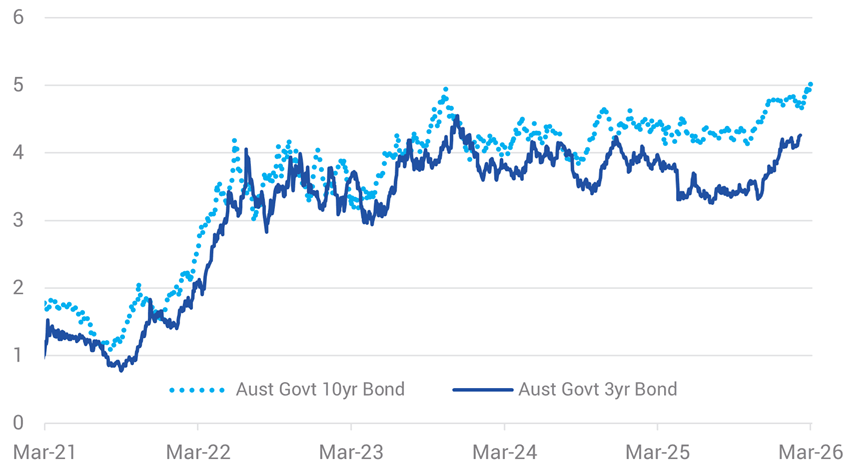
As for markets domestically, higher oil prices have collided with sticky headline inflation and a hawkish central bank. Australian government bonds have sold-off aggressively in March, with 3 and 10-year bond yields now at ~4.8% and 5% respectively (refer Chart 1). Moreover, despite the Reserve Bank of Australia (RBA) increasing the cash rate twice in February and March 2026 to 4.1%, interest rate markets as of 20 March were pricing in another ~70bps of tightening by the end of 2026 to 4.8% (i.e. close to another three 25bps increases in the RBA cash rate).

Chart 1: 3-year and 10-year Australian Government Bond Yields (%)
Source: Bloomberg, Mar 2026.

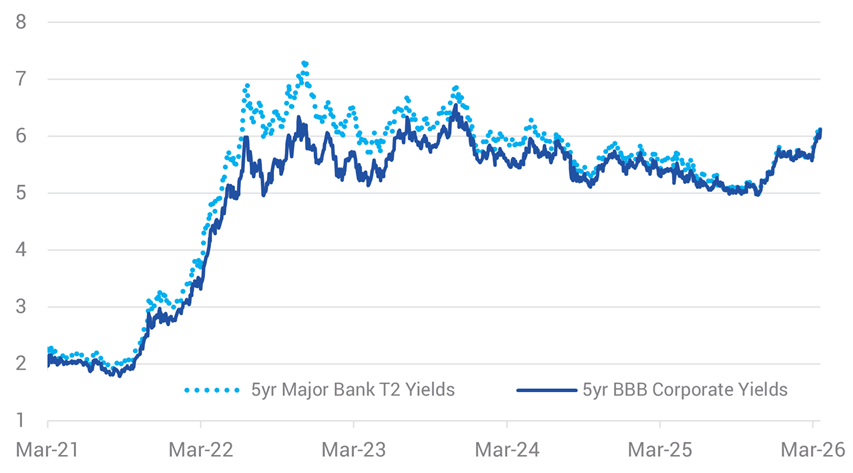
This higher rebasing of interest rates has a commensurate impact on corporate bond yields, with 5-year major bank T2 and triple B corporate yields now both back above 6% for the first time since late 2023 (refer Chart 2).

Chart 2: 5-year T2 and BBB Corporate Yields (%)
Source: NAB, Yarra Capital Management Mar 2026.

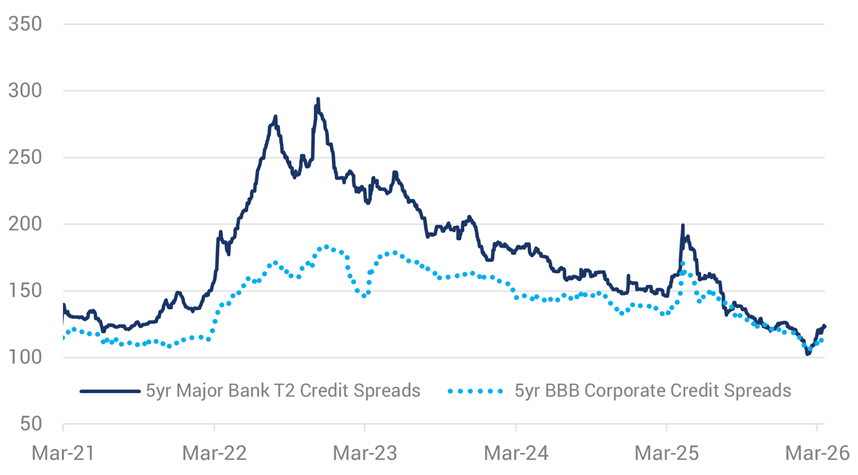
By contrast, the movement wider in investment grade (IG) credit spreads of ~20bps only takes us back to late 2025 levels (refer Chart 3). The orderly behaviour of IG credit thus far is testimony to the power of higher risk-free rates and outright yields (i.e. lessening the pressure on credit spreads to achieve investor return targets). Moreover, for the most part risk markets are still pricing in a speedier return to normalcy, enabling central banks such as the RBA to raise rates despite the heightened uncertainty.

Chart 3: 5-year T2 and BBB Corporate Bond Spreads (bps)
Source: NAB, Yarra Capital Management Mar 2026.

When uncertainty in markets is elevated, playing the averages over the medium term typically remains the best course of action. In many ways, what we’ve experienced in recent months, turbocharged by the Iran war, is a mini 2022 period with one important caveat. After the normalisation of bond yields in 2022, travel time to higher bond yields in 2026 was shorter and much less painful for interest rate duration positions.

From our perspective, while holding some duration has been reflected in performance in recent months, our focus has remained on taking advantage of higher outright yields and locking in attractive income. Portfolio running yields for the IG quality Yarra Enhanced and Higher Income funds are now well above 6% and approaching 7%, levels we last generated in 2023/24. Maintaining duration in portfolios at these elevated levels is advantageous for sustaining performance throughout the remainder of 2026.

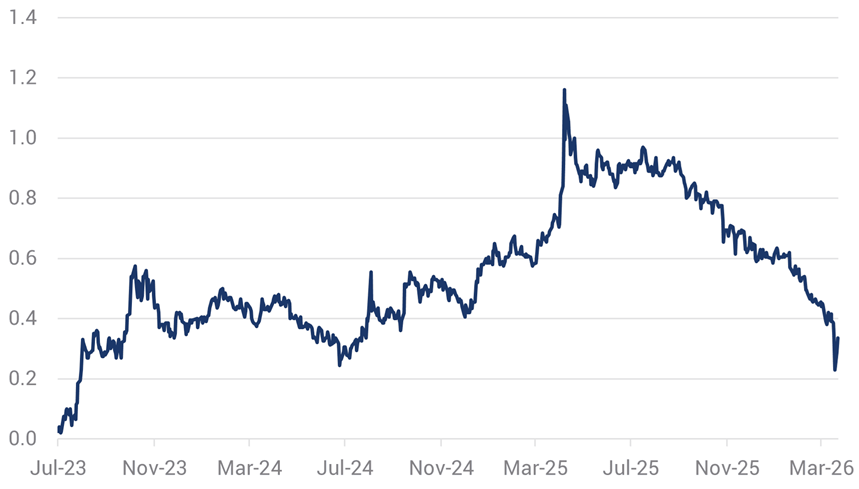
In addition to higher bond yields, the rebuilding of more rate hikes in market pricing has significantly flattened the yield curve. The difference between the 3 and 10-year bonds is now under 30bps, down from a peak of ~120bps during the liberation day selloff in April 2025 (refer Chart 4). In this environment and if sustained, a flatter yield curve should result in a steeper credit curve with investors at the very least demanding increased term premiums in the current environment (i.e. higher credit spread compensation for longer dated securities).

Chart 4: Yield Curve – 3s10s (bps)
Source: Bloomberg, Mar 2026.

While credit spreads remain well behaved, if the current interest rate pricing is even half realised – i.e. reflective of some RBA future hikes – then a significant deflationary impulse for the Australian economy is likely. This is especially the case when combined with an appreciating $A, much higher petrol prices, greater application of AI tools across the economy and a retreating public sector following a more austere May Federal budget. Resultant higher unemployment and much weaker economic growth is likely to reverse current interest rate settings through the course of 2026/27. Therefore, despite a small impact in recent months, maintaining interest rate duration in portfolios continues to make sense at current levels.

In an environment of much weaker growth and higher unemployment, rallying bond yields is likely to result in credit spreads moving wider, with the current calm in credit giving way to a further rebasing of spreads. Our focus remains on locking in favourable income and using duration and curve to protect the portfolio and strongly position us to take advantage of the transition in return composition, with credit spreads likely to comprise a greater proportion of future outright yields following a significant decline in risk free rates.


Phil Strano is Head of Australian Credit Research at Yarra Capital Management, a sponsor of Firstlinks. This article contains general financial information only. It has been prepared without taking into account your personal objectives, financial situation or particular needs. Both the Yarra Enhanced Income and Higher Income Funds are zero leverage funds, providing attractive yields.

For more articles and papers from Yarra Capital, please click here.


  •   1 April 2026
  •      
  •   


Leave a Comment:

RELATED ARTICLES

Things may finally be turning for the bond market

The two key risks facing investors

What to do about the growing chorus of market correction warnings?

banner

Most viewed in recent weeks

Want your loved ones to inherit your super? You can’t afford to skip this one step

One in five Australians die before retirement and most have not set up their super properly so their loved ones can benefit from all their hard work and savings. 

Super is catching up, but ageing is a triple-threat

An ageing Australia is shifting the superannuation system’s focus from accumulation to the lifecycle of retirement. While these pressures have been anticipated for decades, they are now converging at scale and driving widespread industry change.

Has Australia wasted the last 30 years?

The 20 years after Peter Costello left Treasury have been deemed wasted...by Peter Costello. The missed opportunities for Australia began long before.  

The 5% deposit scheme is bad for homeowners and Australia

An ‘affordability’ scheme making the county more vulnerable to economic shocks and contributing to the deteriorating financial situation of everyday Australians.

3 ways to defuse intergenerational anger

With the upcoming budget increasingly likely to include bold proposals to alter the tax code I’ve outlined three incremental steps with fewer unintended consequences.

Navigating the next stage of life in retirement

Retirement planning is more than just saving enough money. Long-term care needs, housing choices, and social networks are just as critical for a happy and enjoyable life.

Latest Updates

Superannuation

Indexation implications – key changes to 2026/27 super thresholds

Stay on top of the latest changes to superannuation rates and thresholds for 2026, including increases to transfer balance cap, concessional contributions cap, and non-concessional contributions cap.

Economy

Central banks need higher inflation targets

In a shift away from solely targeting low inflation, central banks are considering raising inflation targets to combat economic challenges, but face potential drawbacks and conflicts in policy implementation.

Exchange traded products

The missing 30%: how LIC returns are understated, and why it matters

The perceived underperformance of LICs compared to ETFs is due to existing comparison data excluding crucial information, highlighting the need for proper assessment and transparent reporting.

Latest from Morningstar

Alpha isn’t dead. You’ve just been measuring it wrong

New research shows smarter portfolio construction—not new factors—is the real edge in the hunt for alpha. However, finding it requires a fundamentally different mindset.

Investment strategies

The diversification illusion: why 'balanced' portfolios may be exposed

Many 'diversified' portfolios are increasingly driven by the same narrow set of forces. As concentration builds beneath the surface, understanding how portfolios behave - not just how they’re constructed - is critical for investors.

Investment strategies

The case for staying the course in credit

Current market volatility is likened to Lenin's quote on rapid change. Rising oil prices and interest rates impact bond and corporate yields, with a potential economic downturn ahead. Maintaining interest rate duration is advised.

Investment strategies

One risk after another

Investors often focus on front-of-mind risks, reacting to each headline event without considering long-term impacts. Cass Sunstein and Timur Kuran define this as an "availability cascade," affecting financial decision-making.

Sponsors

Alliances

© 2026 Morningstar, Inc. All rights reserved.

Disclaimer
The data, research and opinions provided here are for information purposes; are not an offer to buy or sell a security; and are not warranted to be correct, complete or accurate. Morningstar, its affiliates, and third-party content providers are not responsible for any investment decisions, damages or losses resulting from, or related to, the data and analyses or their use. To the extent any content is general advice, it has been prepared for clients of Morningstar Australasia Pty Ltd (ABN: 95 090 665 544, AFSL: 240892), without reference to your financial objectives, situation or needs. For more information refer to our Financial Services Guide. You should consider the advice in light of these matters and if applicable, the relevant Product Disclosure Statement before making any decision to invest. Past performance does not necessarily indicate a financial product’s future performance. To obtain advice tailored to your situation, contact a professional financial adviser. Articles are current as at date of publication.
This website contains information and opinions provided by third parties. Inclusion of this information does not necessarily represent Morningstar’s positions, strategies or opinions and should not be considered an endorsement by Morningstar.