Register For Our Mailing List

Register to receive our free weekly newsletter including editorials.

Home / 365

Welcome to Firstlinks Edition 365

  •   9 July 2020
  •      
  •   

Brief weekend update: While global markets had another strong week despite poor COVID-19 news, with the S&P500 up 2%, Australia fell 2.3%, driven by worries about the Victorian lockdown. Worldwide COVID cases now exceed 200,000 a day, although the death rate is down significantly from a few months ago. Chinese shares are on a run, up 14% in two weeks on optimism about a strong economic recovery.

***

The stock market and its many participants deserve admiration for hanging on to recent gains in the face of complete uncertainty. The S&P/ASX200 is only about 10% below its level at the start of 2020, and economic conditions and the outlook are clearly far worse. The Reserve Bank wrote this week:

"Uncertainty about the health situation and the future strength of the economy is making many households and businesses cautious, and this is affecting consumption and investment plans. The pandemic is also prompting many firms to reconsider their business models."

Then Gareth Aird of CBA's Global Markets Research acknowledged economists themselves are struggling. Anyone who thought Australia had flattened the curve and was heading for a V-shaped recovery has been jolted by events in Victoria. He wrote:

"Economists are having a torrid time trying to forecast the economic outlook as a whole host of unusual dynamics play out. Many traditional economic models are of little use right now as policymakers globally continue to grapple with the trade-off between limiting the spread of COVID-19 and the negative impact on the economy from restrictions on what people can and can’t do."

Amid the uncertainty, some stocks are enjoying the best rally of their listed lives. It's easy to forget that a $70 stock like Afterpay listed only a few years ago at $1, closing the first day at $1.25. We lead this week with a look at Afterpay's success and investment lessons from a stock that ignores normal valuation techniques.

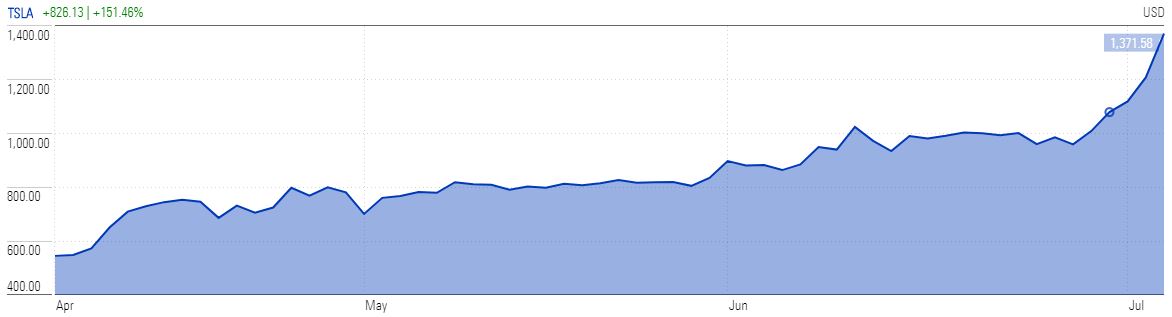
Similarly in the US, Tesla is on a tear after posting a first quarter profit for the first time. Elon Musk is laughing at the shorters. The market does not even care that its main plant in California was closed for a few months, as Morningstar Strategist David Whiston reports:

"If a recession can’t stop Tesla then virtually nothing will, and we expect the company to remain a leader in autonomous technology and range. Tesla is also gaining scale and its ability to make desirable vehicles while generating free cash flow and net profit is far better than it’s ever been."
This week, Ashley Owen reviews the Australian stock markets in FY20 by major sectors, placing the numbers in recent context and checking how much returns have relied on dividends in the past.

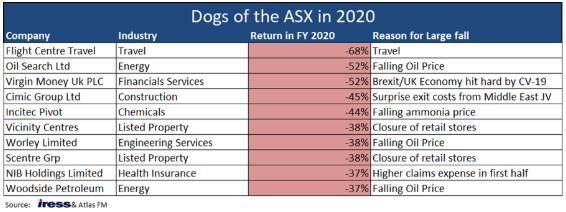
Then Hugh Dive looks ahead to the most uncertain August reporting season for a decade, as well as compiling this chart of the market dogs of last year.
The value versus growth debate is ongoing, and Stephen Bruce checks the conditions necessary to give value a better run, and whether the pandemic leans into this change. Then Angus McLeod looks ahead to five industries facing the profound and perhaps permanent impact of COVID-19, especially as we now know it will not go away until there is global availability of a vaccine.

Michael Recce identifies six types of 'big data' we need to watch, emphasising that the ability to interpret the numbers and integrate them into an investment process is vital to adding performance.

Jonathan Rochford called it 'madness' when investors trusted Argentina with a 100-year bond in 2017 but they have done it again with Austria. This time, it might not be credit risk but the price loss from small rises in rates is extraordinary over such long terms.

Finally, two articles on growing market segments. Richard Montgomery shows why not all ethical ETFs are the same, while David Zipparo and Tim Davis explain what to look for in private debt as it faces special challenges and opportunities this year.

In this week's White Paper, AMP Capital's Shane Oliver gives his review of FY20 and his views on FY21 amid the turmoil.

Now that's a packed edition worth reading over a slow cup of coffee.

Graham Hand, Managing Editor

Latest updates

PDF version of Firstlinks Newsletter

ASX Listed Bond and Hybrid rate sheet from NAB/nabtrade

Indicative Listed Investment Company (LIC) NTA Report from Bell Potter

Monthly Investment Products update from ASX

Plus updates and announcements on the Sponsor Noticeboard on our website


  •   9 July 2020
  •      
  •   


Leave a Comment:

banner

Most viewed in recent weeks

Does your will qualify for the discretionary testamentary trust exemption?

Treasury has confirmed the exemption many families were hoping for. But buried in the fine print are two conditions that could leave some wills on the wrong side of the exemption, despite years of careful planning.

Are you making these SMSF mistakes?

After four decades advising investors, there are a few common mistakes I've seen SMSF investors make. From holding too much cash and chasing yield to overtrading and trusting tips. Are these errors costing you?

Lithium's latest drop and what it means for ASX investors

Lithium's latest sell-off has punished ASX miners as prices remain hostage to shifting expectations. The key challenge is navigating a market prone to extreme volatility despite a strong case for the long-term demand outlook.

Retirement spending is not one-size-fits-all

New data challenges the idea that Australians are underspending their super. The bigger issue may be helping retirees navigate complexity, make confident decisions and use their savings to support security, wellbeing and choice.

Why have Australian living standards 'fallen' and how do we fix it?

For the last few years there has been much talk of a 'cost-of-living' crisis in Australia and of 'falling living standards'. Lately this has flared up again with the pickup in inflation resulting in a renewed fall in real wages.

The missing link in the CGT debate

A little-noticed consequence of Labor’s tax changes could have implications well beyond investors’ tax bills. The issue raises bigger questions about incentives, capital allocation and the drivers of long-term economic growth.

Latest Updates

Planning

Testamentary trusts have secured the CGT exemption

Treasury’s latest CGT reform draft delivers a win for testamentary trusts and deceased estates, exempting estate-derived gains from the 30% floor. However, questions on death and divorce rollovers remain unresolved.

Superannuation

How much super should you have?

Average super balances are one of the most misleading benchmarks. They ignore your goals, spending and future needs, creating a false sense of security. Here is how I calculate exactly where I need to be at every decade.

Retirement

Retiring from work is easy, retiring into life is harder

Most people spend decades planning how to retire. Far fewer plan for what comes next. The biggest retirement challenge isn't always financial, and it often catches even the most prepared retirees completely off guard.

Shares

Right asset class, wrong index: the trap in Australian small caps

Most Australian portfolios are concentrated in large caps, with relatively little exposure to smaller companies. But what if the biggest risk isn't the economy, interest rates or valuations? For many, the risk is hidden in plain sight.

Property

Are these assets the missing piece in Australian portfolios?

Many investors remain concentrated in shares, cash and property. Despite their popularity among institutional investors, real assets remain underrepresented in many SMSF portfolios. Could they be the missing piece?

Investment strategies

The biggest risk that buy-and-hold investors ignore

Investors spend decades learning how to stay invested, yet few have a plan for getting out. When a financial goal has a hard deadline, a worked example shows why a fixed derisking schedule should outrank buy-and-hold discipline.

Investment strategies

How passive investing is driving the decline of active fund alpha

Why have active managers struggled as passive investing has surged? Research suggests that flows into index funds and ETFs are creating structural headwinds, penalising the stock-picking strategies that once generated alpha.

Sponsors

Alliances

  • ASA-Logo-RGB-ActiveGreen-web.png

© 2026 Morningstar, Inc. All rights reserved.

Disclaimer
The data, research and opinions provided here are for information purposes; are not an offer to buy or sell a security; and are not warranted to be correct, complete or accurate. Morningstar, its affiliates, and third-party content providers are not responsible for any investment decisions, damages or losses resulting from, or related to, the data and analyses or their use. To the extent any content is general advice, it has been prepared for clients of Morningstar Australasia Pty Ltd (ABN: 95 090 665 544, AFSL: 240892), without reference to your financial objectives, situation or needs. For more information refer to our Financial Services Guide. You should consider the advice in light of these matters and if applicable, the relevant Product Disclosure Statement before making any decision to invest. Past performance does not necessarily indicate a financial product’s future performance. To obtain advice tailored to your situation, contact a professional financial adviser. Articles are current as at date of publication.
This website contains information and opinions provided by third parties. Inclusion of this information does not necessarily represent Morningstar’s positions, strategies or opinions and should not be considered an endorsement by Morningstar.