In 1971, an uncle of Don Brash, the governor of the Reserve Bank of New Zealand from 1988 to 2002, invested the proceeds from selling his fruit farm in 18-year government bonds yielding 5.4%. At that time, the uncle’s NZ$30,000 could buy 11 four-cylinder cars.
But when the bonds matured in 1989 the NZ$30,000 could buy only one of those cars. Inflation, of course, had killed the bond investment’s purchasing power.
Brash used this and other anecdotes to explain how the social injustices of inflation prompted the RBNZ to a world first in 1990 when New Zealand’s inflation was 8%. That year the central bank and the government formalised an inflation target between 0% and 2%. The pact said the goal must be met by 1992.
The RBNZ’s success in crushing inflation to below 2% in less than half the time prompted politicians the world over to gift central banks the autonomy to meet inflation targets of around 2%. – about 150 of the world’s 200-odd central banks are judged to be depoliticised inflation fighters.
The move to ‘independent’ central banking ushered in decades of price stability (even if the coincidental rise of China and technological advancements helped). Such became their aura, central bankers epitomised the Davos ideal of a world run by the technocratic elite.
Those days are gone for the foreseeable future. The Israeli-US attack on Iran has sparked an inflation shock, foremost so far from higher energy prices, while impeding economic growth. The re-emergence of the 1970’s curse of ‘stagflation’ will expose the social and political limits of monetary policy as an inflation-fighting tool.
Higher interest rates are an inadequate macro-economic weapon to control prices because they only target indebted businesses and consumers, notably mortgaged families in the case of the latter – about one-third of households in Australia.
If the object is to reduce demand to anchor the public’s outlook for inflation and thus avoid a wages-price spiral, measures such as fiscal tightening are needed to spread the burden of taming inflation. Otherwise, interest rates need to rise to levels that cripple the indebted to achieve the same reduction in demand.
As the economic, political and social costs of primarily relying on monetary policy to combat inflation manifest, policymakers will seek other solutions. Part of the conundrum to solve is that monetary policy is innately political. Monetary settings including inflation goals must resolve the competing interests of debtors and creditors and savers and spenders. When inflation is elevated, the conflict of interests intensifies to a trade-off between the future jobless against reduced inflationary pain for others – essentially the question becomes how high might be an acceptable rate of unemployment.
One appealing solution might be to lift inflation targets so the blows to the indebted, employment levels and economic growth can be softer.
One way to do that would be to raise inflation targets to, say, 4%. In 2020, the Federal Reserve veered in this direction when it scrapped a 2% inflation ceiling for an average target of 2%. That meant the US central bank would let inflation exceed 2% “for some time” if it had undershot that figure. Such higher inflation targets would ease the monetary-policy squeeze and erode real debt burdens.
While many central banks only target low inflation, some including the Federal Reserve and the Reserve Bank of Australia have two main goals – tame inflation and full employment – that in conventional economics are mutually exclusive. A way to formalise this trade-off would be to target nominal gross domestic product.
Nominal GDP is the dollar value of an economy’s output before it is adjusted for inflation to derive real GDP. Economists suggest central banks target, say, 5% for nominal GDP, where the ideal outcome would be 2% inflation and 3% real GDP growth.
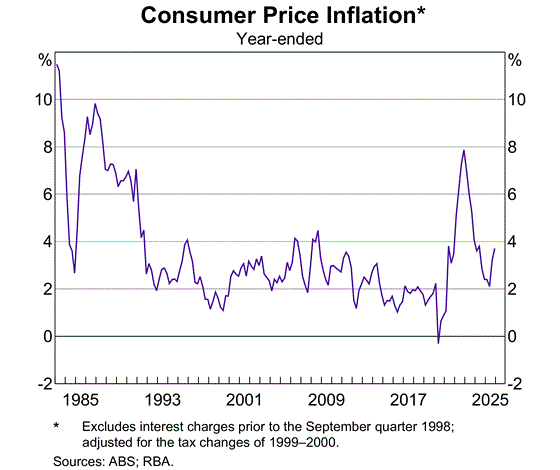
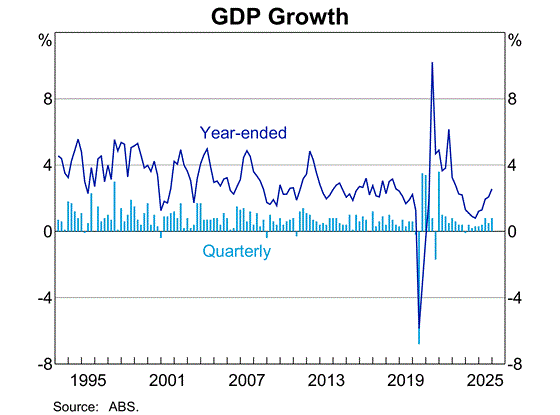
Among advantages, targeting nominal GDP implicitly contains ‘forward guidance’ and lowers the risk of boom-bust cycles by avoiding the rigidity whereby inflation close to 0% pressures central banks to cut rates even if the economy is thriving. The target better copes with shocks because it tolerates faster inflation when economies are struggling. Inflation, in theory, could reach 7% if the economy is shrinking 2% in real terms.
But the reverse applies too. Inflation above 5% demands shrinking real GDP, which is politically difficult to even articulate let alone implement (especially when high unemployment risks among other damage a housing crash that would threaten the banking system).
The threat of a surge in unemployment due to the energy, food and other price shocks (on top of any blows to employment from the use of artificial intelligence) makes it likely that in coming times politicians will raise inflation targets in some way. If the coming hit to economic growth is severe enough, policymakers might even suspend inflation goals. Whatever happens, no gentle solution to today’s inflationary shock looms.
Raising inflation targets has drawbacks, to be sure. Such moves unmoor inflation expectations as an inflation goal raised once can be lifted again. Targeting nominal GDP has additional disadvantages in that it’s hard to explain to the public, and central banks might not allow inflation to rise too high even if the economy is contracting. Perhaps inflation targets might only need a little loosening as inflation is not headed towards doubt-digits as it did in the 1970s. The antics of President Donald Trump against the Fed might make it harder for the US central bank to raise its inflation target without looking like Trump’s patsy. However the Fed tries to preserve its credibility (or not), policymakers know the public prioritise jobs over inflation-busting.
In the 1990s, inflation targets of 2% were the solution. Today’s war-driven shocks, erratic US policymaking, high indebtedness and darkening economic outlook suggest more flexible inflation targets are needed.
Michael Collins is a freelance writer and editor, economist, and investment specialist. Republished with permission from the author’s Substack newsletter @denouementwatch.