Register For Our Mailing List

Register to receive our free weekly newsletter including editorials.

Home / 650

If people talk about a bubble, it’s unlikely to crash soon

We have had our fair share of bubble talk in the AI space over the last six months. So many people argue that AI stocks are in a bubble and that bubble may lead to a crash soon. But while we can debate the former, I think the latter is the wrong conclusion.

It is extremely hard, if not impossible, to identify a bubble in real time. Still, even if you can identify a bubble with certainty, you shouldn’t expect the affected stocks to see a drastic decline in prices anytime soon. That is one of the lessons I take away from reading a new paper by Christian Stolborg and Robin Greenwood.

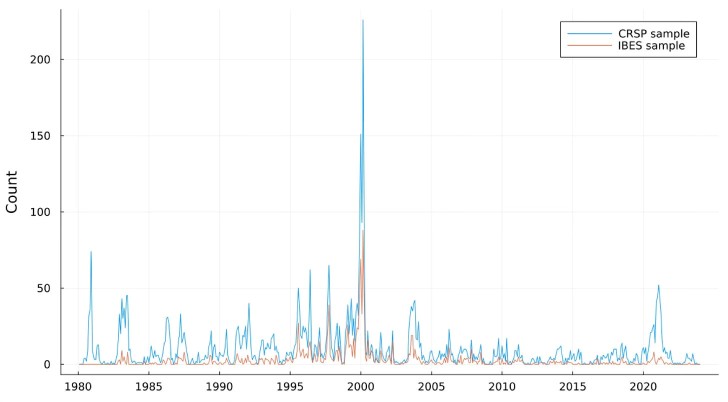
They looked at all the boom-bust stocks in the US since 1980. Boom-bust stocks meet the following criteria: (i) they have had >100% return in the last 12 months and the last 6 months, (ii) a positive return in the current month, (iii) a price-to-book or a price-to-sales ratio of more than 5x, and (iv) a drawdown of at least 50% in the next 24 months.

As you can see in the chart below, there have been quite a few of these boom-bust stocks, not just in 2000 but throughout the period from 1980 to 2023 covered in the study.

Figure 1: Boom-bust stocks since 1980
Source: Stolborg and Greenwood (2025)

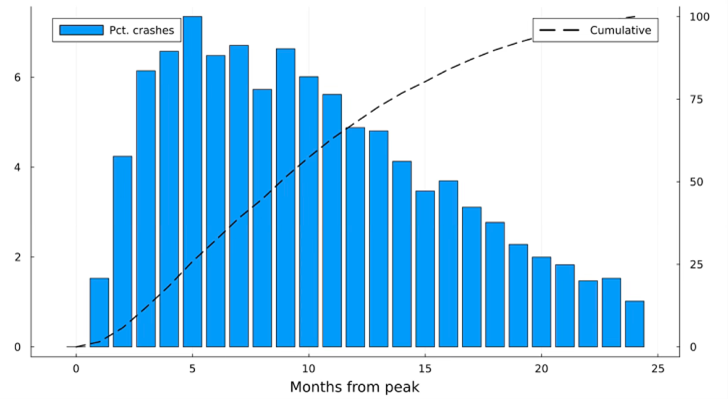
In hindsight, we can identify these stocks and know precisely when their share prices peaked. But when did they crash? The second chart today shows that it can take more than a year before even these extreme bubble stocks face a significant drawdown. About 75% of bubble stocks are down by 50% within a year after they have reached their peak, but 25% of stocks continue to drift along for more than a year before they crash.

And because boom stocks are defined as having at least 100% return in the six months before they peak, a 50% drawdown only means that investors have lost six months’ worth of gains by then. Often, the drawdowns continue from there until most of the gains from the bubble phase are lost again.

Figure 2: Months until boom stocks meet the bust criteria of 50% drawdown
Source: Stolborg and Greenwood (2025)

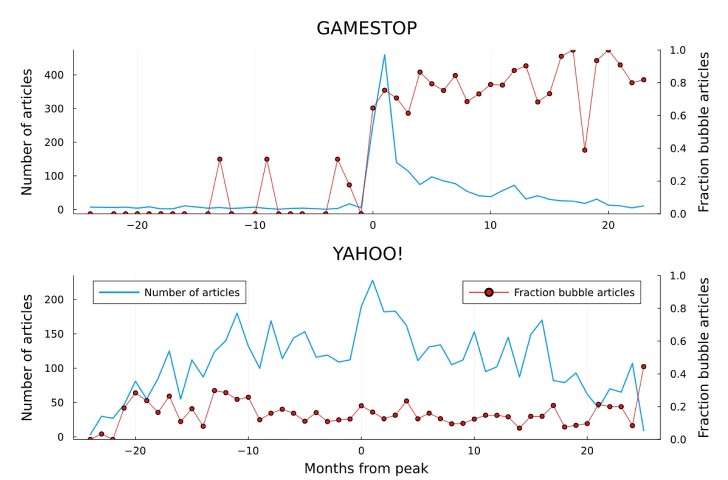
So even if you know you are in a bubble, share prices can linger near the bubble peak for quite some time. But do people at least talk about the stocks being in a bubble during that time? It turns out no. There are two types of media coverage of boom-bust stocks, as exemplified by Gamestop in 2021 and Yahoo in 1999. Gamestop was immediately identified as a bubble stock, and the media talked a lot about the bubble in Gamestop as it unfolded and before the stock crashed. But this is the exception rather than the rule.

According to the authors of the study, most media coverage resembles that of Yahoo in 1999 much more closely. The media coverage of a potential bubble in Yahoo intensified about one year before the shares actually hit their all-time high and then collapsed. Once the bubble actually burst, the share of media articles covering Yahoo as a bubble stock was about half of that in 1997 and 1998. Only when the crash had fully unfolded in 2003 did the media characterise Yahoo shares again as a bubble stock because by then, it was clear to everyone that the shares had gone through a boom-and-bust cycle.

Figure 3: Gamestop 2021 vs. Yahoo 1999
Source: Stolborg and Greenwood (2025)

The lessons I learn from the paper are that it is (i) incredibly difficult to identify a bubble in real time, (ii) you cannot trust media or investor worries about a potential bubble as a signal to identify crash risk, (iii) even if you are in a bubble, many stocks can linger for a long time near their all-time highs giving investors hope and short-sellers seemingly endless pain before the share price collapses.

But just to be sure that you don’t blame me for being a booster to AI stocks. Even though the media typically misses a bubble, it sometimes catches it in time. Maybe AI stocks follow the path of Gamestop, perhaps they follow the path of Yahoo. I don’t know. We will find out in due course.

There are some other interesting results in the paper about which metrics to use to get some indication that a stock may be in a bubble, but I leave you to read the paper and find out about them yourself.


Joachim Klement is an investment strategist based in London. This article contains the opinion of the author. As such, it should not be construed as investment advice, nor do the opinions expressed necessarily reflect the views of the author’s employer. Republished with permission from Klement on Investing.


  •   18 February 2026
  •      
  •   


Leave a Comment:

RELATED ARTICLES

Dotcom on steroids Part II

The wisdom of buying absurdly expensive stocks (or not!)

Orbital AI data centers prepare for launch

banner

Most viewed in recent weeks

Indexation implications – key changes to 2026/27 super thresholds

Stay on top of the latest changes to superannuation rates and thresholds for 2026, including increases to transfer balance cap, concessional contributions cap, and non-concessional contributions cap.

The refinery problem: A different kind of energy crisis in 2026

The Strait of Hormuz closure due to US-Iran conflict severely disrupted global energy supply chains. While various emergency measures mitigated the crude impact, the refined product market faces unprecedented stress.

Has Australia wasted the last 30 years?

The 20 years after Peter Costello left Treasury have been deemed wasted...by Peter Costello. The missed opportunities for Australia began long before.  

3 ways to defuse intergenerational anger

With the upcoming budget increasingly likely to include bold proposals to alter the tax code I’ve outlined three incremental steps with fewer unintended consequences.

Navigating the next stage of life in retirement

Retirement planning is more than just saving enough money. Long-term care needs, housing choices, and social networks are just as critical for a happy and enjoyable life.

The missing 30%: how LIC returns are understated, and why it matters

The perceived underperformance of LICs compared to ETFs is due to existing comparison data excluding crucial information, highlighting the need for proper assessment and transparent reporting.

Latest Updates

Superannuation

Do super funds need a massive wake up call?

UK retirement expert, Guy Opperman, believes super funds are failing at supporting members in deaccumulation. Here is what Australia should do about it. 

Retirement

Sequencing risk resurfaces for retirees

A retirement strategy must consider how both the timing of cash flows and the sequence of returns impact the final dollar outcome from which a retirement is funded.

SMSF strategies

Meg on SMSFs: Payday super – why should SMSF members even care?

Not filing your SMSF annual return on time can mean missed contributions under the new Payday super regulation. 

Strategy

There will be no permanent underclass

Worries about AI causing mass job loss are misguided. Far from creating a permanent underclass, Like other technological innovations AI will improve living standards around the world.

Taxation

Reforming the taxation of wealth and wealth transfers

As the budget approaches debate continues about the need and method for addressing wealth inequality. Could reinstating wealth transfer taxes be the answer?

Investment strategies

The biggest oil shock in history. Why isn't the price higher?

While increases in oil prices are dominating media coverage of the turmoil in the Middle-East it is worth exploring why prices haven't gone up more. 

Financial planning

Structured giving's new moment

A big year for philanthropy has seen multiple tax changes impact the approach donors are taking. For those with the intention to give generously there is a third structure available in the structured giving landscape.

Sponsors

Alliances

© 2026 Morningstar, Inc. All rights reserved.

Disclaimer
The data, research and opinions provided here are for information purposes; are not an offer to buy or sell a security; and are not warranted to be correct, complete or accurate. Morningstar, its affiliates, and third-party content providers are not responsible for any investment decisions, damages or losses resulting from, or related to, the data and analyses or their use. To the extent any content is general advice, it has been prepared for clients of Morningstar Australasia Pty Ltd (ABN: 95 090 665 544, AFSL: 240892), without reference to your financial objectives, situation or needs. For more information refer to our Financial Services Guide. You should consider the advice in light of these matters and if applicable, the relevant Product Disclosure Statement before making any decision to invest. Past performance does not necessarily indicate a financial product’s future performance. To obtain advice tailored to your situation, contact a professional financial adviser. Articles are current as at date of publication.
This website contains information and opinions provided by third parties. Inclusion of this information does not necessarily represent Morningstar’s positions, strategies or opinions and should not be considered an endorsement by Morningstar.